Detailed Explanation of Key Points in Off-Season Mandarin Fish Farming Techniques
Mandarin fish have high yields and good farming returns, with tender and delicious flesh; moreover, mandarin fish meat is rich in nutrients and has dietary therapeutic effects, as it can replenish qi and blood, treat deficiency and damage, benefit the spleen and stomach, and nourish the five internal organs. Using off-season farming techniques can also increase farming returns. The following introduces off-season mandarin fish farming techniques.
I. Materials and Methods
1. Time: June 2016 to June 2017.
2. Pond Conditions
One pond with an area of 6 mu; 5 supporting bait fish ponds with an area of 23 mu. The soil is all clay loam, the pond bottom is flat, and the water level is maintained at 1.8-2.0 m year-round, with a complete inlet and drainage system. The water source is sufficient and the water quality is good. There are no pollution sources nearby, the environment is quiet, electricity is available, and transportation is convenient. The experimental pond is equipped with a 3 kW microporous aeration facility installed in a disc configuration, plus one 3 kW impeller-type aerator; each bait fish pond is equipped with one 3 kW impeller-type aerator.
3. Preparation Before Stocking
(1) Pond clearing and disinfection: In early June of that year, all ponds were drained, excess silt was removed, and less than 10 cm of silt was left at the pond bottom. The pond bottom was fully exposed to the sun for 10 days, and then the bottom sediment was rotary-tilled and broken up. On June 12, water was added to the ponds to a depth of 5 cm-10 cm, and quicklime was slaked into a slurry and splashed over the entire pond for disinfection at a rate of 150 kg/mu.
(2) Water filling and fertilization: On June 15, all ponds were filled with water to 1.2 m after filtration through 100-mesh silk screen, and 100 kg of fully fermented livestock and poultry manure per mu was applied as base fertilizer, scattered underwater around the pond perimeter to cultivate plankton. In the early stage of farming in the experimental pond, water transparency was controlled within 30 cm; in the middle and late stages of farming, water transparency was controlled at 35-45 cm; in the bait fish ponds, water transparency was controlled at 25-35 cm.
(3) Stocking and cultivation of bait fish in the original pond: On June 20, bighead carp fry were purchased from Guangdong and stocked at 300,000 fry per mu. After the bighead carp fry were put into the pond, soybean milk was splashed continuously for 7-10 days. When the bighead carp reached a size of 2-3 cm, mandarin fish fingerlings were promptly stocked into the pond, at which point suitable-sized bait fish could be preyed upon.
(4) Stocking and cultivation of bait fish in dedicated ponds: On June 20, in 2 dedicated bait fish cultivation ponds totaling 8 mu, 500,000 bighead carp fry were stocked per mu. On June 26, in 3 dedicated bait fish cultivation ponds totaling 15 mu, 600,000 locally bred barbel chub fry were stocked per mu. Two hours before all fry were put into the ponds, aerators were turned on to prevent oxygen deficiency in the water. The cultivation methods for bighead carp fry and barbel chub fry were similar to conventional fish fry cultivation. After the fry were put into the ponds, traditional soybean milk splashing was used; when they reached 2-3 cm, crushed feed was given; at 7-8 cm, broken feed was given, and generally bream feed with about 28% protein content was sufficient. To ensure the bait fish were suitable in size, the growth rate of bait fish was controlled by controlling the amount of feed given.
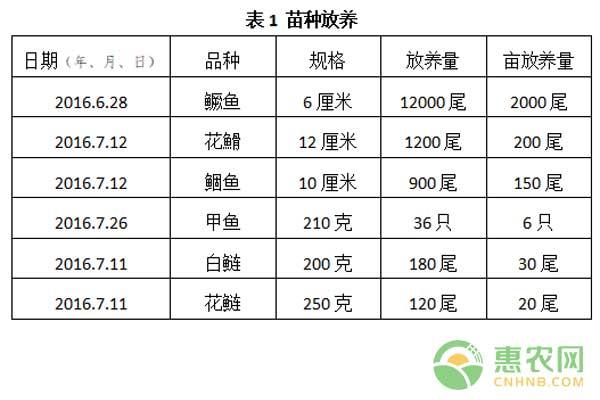
(5) Fingerling stocking in the experimental pond: Fingerling stocking is shown in Table 1. Before stocking, all fingerlings were soaked in 2%-4% saline solution or 10-15 mg/L potassium permanganate solution for about 10 minutes before being put into the pond.
II. Feeding Management
1. Bait Fish Feeding
In the early stage of farming, because mandarin fish are relatively small, the bait fish cultivated in the original pond can meet their predation and growth needs. When bait fish in the original pond are insufficient, bait fish need to be stocked promptly. The following points should be noted when stocking bait fish:
① Bait fish species. From July to mid-November 2016, the bait fish stocked were bighead carp cultivated in dedicated ponds; from mid-November onward to June of the following year, the bait fish stocked were barbel chub fingerlings cultivated in dedicated ponds. ② Bait fish disinfection. Before feeding, bait fish should be bathed in 3%-4% saline solution for disinfection and parasite removal. ③ Bait fish size control. Mandarin fish prefer to prey on bait fish that are 1/3-1/2 of their own body length. To ensure the bait fish are suitable in size, first, control the growth rate of bait fish by controlling the amount of feed given; second, screen the bait fish with appropriately sized fish screens before feeding. ④ Control of bait fish feeding quantity and frequency. The feeding of bait fish should be determined according to the season and the feeding intensity of mandarin fish. More should be fed in summer and autumn, and appropriately less in winter and spring. Generally, the food intake of mandarin fish is 5%-12% of their body weight. The ratio of mandarin fish to bait fish should be kept at 1:(5-10). The feeding frequency of bait fish should be as follows: from July to September, stock once every 3-5 days; after October, stock once every 5-7 days; in winter and spring, reduce the stocking frequency and gradually change to once every 10-15 days. ⑤ Scientifically judge the amount of bait fish remaining in the pond. When bait fish in the pond are sufficient, mandarin fish chase and feed on bait fish at the bottom layer of the pond water, with only scattered small splashes on the water surface; the sound made by mandarin fish chasing bait fish is small, and the intervals are relatively long. When bait fish in the pond are insufficient, mandarin fish chase bait fish up to the upper layer of the pond water, with large splashes and loud sounds that last for a relatively long time. If mandarin fish chase bait fish in groups along the pond edge, it indicates that the bait fish in the pond have basically all been consumed.
2. Water Quality Management
First, promptly add and exchange new water. After mandarin fish are stocked, add new water once every 7-10 days, 15-20 cm each time, ultimately maintaining the pond water depth at 1.8-2 m; exchange water once every 20-30 days, replacing 15%-20% of the old water each time; in the early stage of farming, water transparency should be controlled within 30 cm; in the middle and late stages of farming, water transparency should be maintained at 35-45 cm, and the water color should be maintained for a long time as yellow-green or tea-brown with green algae and diatoms as dominant populations, which can effectively protect a good water ecosystem and achieve the purpose of healthy farming. Second, control water acidity and alkalinity well. Throughout the farming period, maintain water pH stable at 7.5-8.5. Generally, splash quicklime over the entire pond once about every 20 days at a rate of 10-15 kg/mu. Third, effectively reduce the content of harmful and toxic substances in the water. In spring and autumn, use EM bacteria at 0.5-1 kg/mu or Bacillus subtilis at 50-400 g/mu once every 10-15 days; in the high-temperature season from July to September, apply once every 7 days. Ensure that ammonia nitrogen content is below 0.3 mg/L, nitrite content is below 0.1 mg/L, and no hydrogen sulfide is detected. Fourth, maintain a high dissolved oxygen level in the water. Determine the start-up time and periods of aerators according to changes in dissolved oxygen in the water, and always maintain the dissolved oxygen level in the water above 5 mg/L day and night. In the high-temperature season from July to September, turn on the microporous aerator in the first half of the night, and turn on both the microporous aerator and the impeller-type aerator in the second half of the night; turn on the aerator for 1-2 hours at noon on sunny days; turn it on 24 hours during continuous muggy and rainy weather. During power outages or when aeration equipment cannot be used due to failure, take emergency measures such as broadcasting granular oxygen-releasing agents. Water quality management was always treated as the top priority in the farming management process, so no water quality deterioration occurred throughout the farming period, ensuring the healthy growth of mandarin fish.
3. Disease Control
First, before stocking, all fingerlings and bait fish were disinfected with 3%-4% saline solution to kill pathogenic bacteria and parasites on the body surface and gills. Second, every 30-45 days, preventive measures were taken by first killing parasites and then disinfecting; at the same time, internal medicine was mixed into the bait fish feed and fed to mandarin fish for 3-5 days to enhance the immune resistance of mandarin fish. On the 4th-5th day after each parasite-killing and disinfection treatment, microbial preparations were supplemented. Throughout the experimental period, only a small amount of parasites such as Trichodina and Chilodonella appeared, and no other diseases occurred.
III. Experimental Results
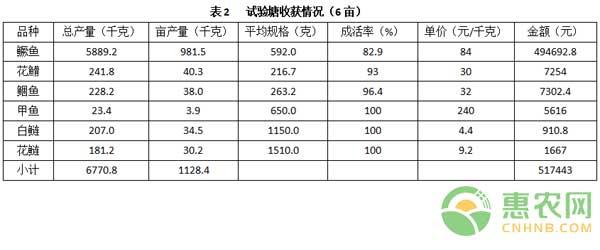
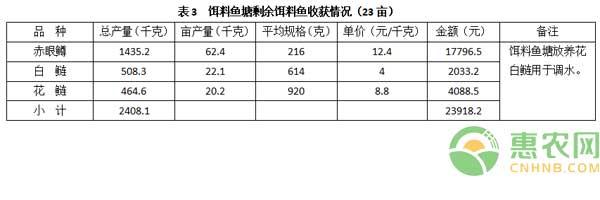
All cultured species in the experimental pond and the unconsumed bait fish in the bait fish ponds were all marketed before the end of June 2017. The specific harvest situation of the experimental pond is shown in Table 2, the harvest situation of the remaining bait fish in the bait fish ponds is shown in Table 3, and the input situation is shown in Table 4.
Output value: 541,361.2 yuan.
Cost: 279,540 yuan.
Profit: 261,821.2 yuan, equivalent to a profit of 9,028.3 yuan/mu.

IV. Summary and Discussion
1. Innovating the farming model. Polyculture of silver carp and bighead carp can fully filter-feed on plankton and organic debris, promote algae renewal, prevent water eutrophication, and effectively inhibit the occurrence of ciliate disease, because the reproductive stage of ciliates mainly feeds on organic debris. Polyculture of Hemibarbus maculatus and Xenocypris microlepis, both bottom-dwelling and omnivorous fish, can promptly remove mandarin fish feces and play a "home cleaning" role. Polyculture of soft-shelled turtles can feed on dead bait fish (because some bait fish will inevitably be injured or die during netting and transport), preventing decay and deterioration and the spread of disease.
2. Optimizing farming water quality. Throughout the entire production process of this experiment, first, water pH was maintained stable at 7.5-8.5. Quicklime was used in a timely manner to adjust pH, balance acidity and alkalinity, and improve water hardness and water buffering capacity. Second, microbial preparations were applied regularly. Through the application of microbial preparations, various organic substances in the water and bottom sediment were effectively degraded. Third, a high dissolved oxygen level in the water was maintained. This experiment was equipped with microporous aeration and impeller-type aerators, and sufficient aerator power was provided, so that aeration was carried out in a timely manner, the dissolved oxygen level in the pond was balanced, and the dissolved oxygen level in the water was ensured to reach above 5 mg/L day and night, promoting the healthy growth of mandarin fish.
3. Developing high-quality bait fish. For many years, the bait fish for mandarin fish farming mainly depended on bighead carp. Because bighead carp is a warm-water fish, it cannot overwinter in the Yangtze River basin, resulting in a lack of efficient bait fish support and restricting the development of off-season mandarin fish farming. In recent years, barbel chub has been successfully developed as a supporting bait fish in this region, and fry breeding has become large-scale, laying the foundation for off-season mandarin fish farming and balanced marketing. As a supporting bait fish for mandarin fish farming, barbel chub has a large egg-carrying capacity, fast growth, omnivorous feeding habits, and strong adaptability. Its breeding period (May-September) covers the entire mandarin fish farming cycle, and fry farming yield can reach about 1,500 kg/mu, making it significantly superior to bighead carp as a bait fish.
4. Controlling the growth size of mandarin fish. By controlling the stocking density of mandarin fish fingerlings and the amount of bait fish stocked, the average size of mandarin fish was controlled within 300 g by the end of that year, so that by June of the following year they could reach a suitable commercial size for sale.
5. Mandarin fish prices fluctuate significantly by season. In recent years, when mandarin fish are concentrated on the market at the end of the year, the price is generally 40-50 yuan/kg; while in May-June each year, mandarin fish are "valuable because they are scarce," and the price soars to 80-100 yuan/kg.
The cost of off-season mandarin fish farming increases by less than 20%, but the price nearly doubles, and the benefit increases by more than 50%.
Off-season mandarin fish farming has great potential for increasing efficiency and good development prospects. Experienced farmers can try off-season farming!
(Don't know about agricultural benefit policies? Not clear about market conditions? Not familiar with agriculture, rural areas, and farmers hot topics? Follow the Henan Science and Technology News "New Agriculture, Rural Areas and Farmers" WeChat public account: hnkjbxsn, and all agriculture, rural areas and farmers information will be at your fingertips.)
Operator: Wei Yubo MX008