Introduction to the Breeding Methods and Techniques of the Yellow Mud Turtle
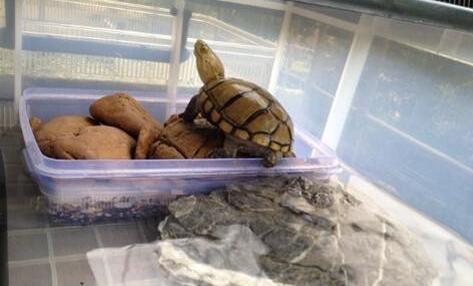
1. Introduction to the Yellow Mud Turtle Breed
The yellow mud turtle, also known as the yellow marsh turtle or yellow mud egg turtle, is one of the common breeds among mud turtles. The carapace is yellow, with relatively large, flat scutes, and there are black edges between the scutes, making the colors look very attractive. The yellow mud turtle is a semi-aquatic turtle, but it prefers to stay in the water, likes to eat some meaty foods, and has a narrow diet.
Chinese scientific name: Yellow Mud Turtle
Alias: Yellow Mud Egg Turtle
English name: Yellow Mud Turtle
Binomial name: Kinosternon fiavescens
Kingdom: Animalia
Phylum: Chordata
Subphylum: Vertebrata
Class: Reptilia
Order: Testudines
Family: Kinosternidae
Species: Yellow Mud Turtle
Geographic distribution: From northern Nebraska southward to Texas, eastern and southern New Mexico, and southeastern Arizona, all the way to Mexico. There are isolated populations in marginal areas of Illinois and Iowa.
Reproduction method: Oviparous. In New Mexico, their egg-laying period is in June. A clutch has 1 to 6 eggs (usually 4), the eggs are oval-shaped, and the shell is relatively hard. Hatchlings reach sexual maturity after 6 to 7 years.
Habits: They like quiet, slow-moving freshwater bodies with a bottom of mud or sand. In the colder months, these turtles hide under bushes or leaf litter, or in tree holes, or in muskrat burrows, or buried in mud underwater. Generally speaking, they are very shy and usually will not attempt to bite.
Body features: Body length 9 to 16.2 cm, the carapace is olive to dark brown, smooth and without keels, usually relatively flat; the scutes have black edging.
Diet: They consume worms, arthropods, as well as snails and tadpoles.
Habitat nature: Semi-aquatic turtle, but leaning toward aquatic.
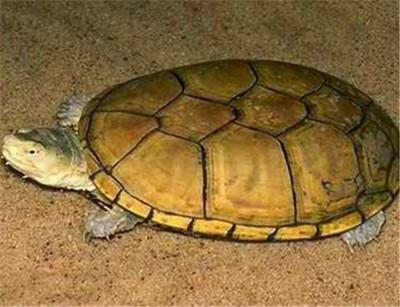
2. Morphological Features of the Yellow Mud Turtle
The yellow mud turtle is one of the mud turtle breeds, so the carapace looks oval, with no keels or markings, like a smooth pebble. The yellow mud turtle is also easy to identify, and the adult yellow mud turtle is one of the larger breeds among mud turtles.
1. Morphological Features of the Yellow Mud Turtle
The head is moderate in size; adult males have a protruding snout and a hooked upper jaw, while by comparison the hooked outline of the female's upper jaw is not obvious. The color of the head is usually yellow or light gray; the color of the throat area ranges from pale to yellow and bears small papilla-like fleshy tubercles, perhaps mixed with small black spots; the lower jaw has a pair of barbels, and the rest of the skin color ranges from yellow to gray. The base color of the skin is black or dark olive, and like the carapace, it also has no markings. The color of the lower part of the lower jaw, the throat, and the limbs tends to become lighter.
2. Size of the Yellow Mud Turtle's Carapace
The yellow mud turtle is the second-smallest water turtle in Iowa, larger only than the musk turtle. Newly hatched hatchlings are less than 2.5 cm in body length. There are yellow spots on the edge of the shell, and there is no vertebral keel. The adult carapace is only about 13 cm long. The carapace is dark with no markings, extremely flat on top, and oval-shaped. The plastron is much more developed than that of the stinkpot: on a pale yellow base color there are several lines, with no spots of any size, and the pectoral scutes, abdominal scutes, and femoral scutes are connected by two ligaments.
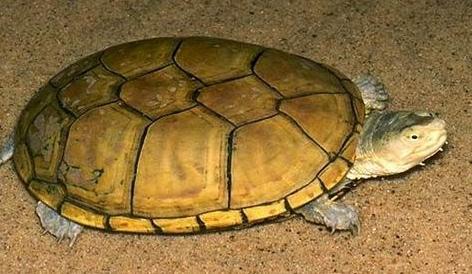
3. Care Knowledge for the Yellow Mud Turtle
The yellow mud turtle is not difficult to keep, but many people wonder why, when keeping yellow mud turtles in the same way, the appearance of adults can differ so much. In fact, the environment in which the yellow mud turtle is kept and the choice of food affect the color of its body surface, so the differences can be very large.
1. Habits of Wild Yellow Mud Turtles
For more than half of the year, the yellow mud turtle is in a resting state. When the climate changes noticeably, they seek out natural hiding places to conceal themselves, such as tree stumps, the base of bushes, dry leaves, and under logs. Some hide in burrows and cover themselves with sand and soil, especially during periods of hibernation and aestivation. One of the factors that restores them to an active state is the influence of warm rainwater (rainwater that fills dried-up ponds or streams). Sometimes they migrate very long distances to search for water sources.
2. Reproduction of the Yellow Mud Turtle
During the mating season, fighting among male yellow mud turtles is very severe and often leads to injuries and disabilities. At the same time, during mating the males are also very rough, often biting the females and forcing them to submit. In such cases, the method of controlling the male-to-female ratio can be used to avoid fights among them. A relatively reasonable male-to-female ratio should be 1:2 or 1:3. At the same time, in order to prevent excessive mating, keep males and females in the same tank only during the estrus period.
3. Precautions for Keeping Mud Turtles
The water quality for keeping yellow mud turtles should be good; this will better bring out their body color and make the radiating lines of mud turtles that have them clearer. The yellow mud turtle is a turtle that greatly needs sunlight; with the nourishment of sunlight, its body color can become brighter and it can absorb better. For the container, choose white or cream-colored and completely opaque if possible. This is because mud turtles are a turtle breed that is good at adapting to their surroundings and changing their body color. At the same time, keep the food varied. Do not use a single type. Shrimp is relatively good and is also one of the more recommended foods.
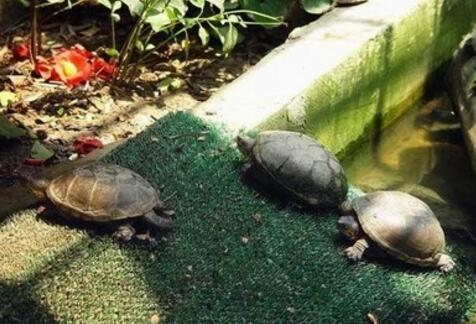
4. Living Environment of the Yellow Mud Turtle
The quality of the yellow mud turtle's living environment not only relates to its health, but more importantly affects its appearance. A reasonable environment can help the yellow mud turtle's carapace become more glossy. Just as humans need beauty care, the yellow mud turtle also needs special care.
1. Wild Environment and Survival Status of the Yellow Mud Turtle
Yellow mud turtles live in swamps, streams, ponds, lakes, cisterns, reservoirs, semi-arid grasslands, open woodlands, and environments surrounded by sand dunes. Ponds with a mud-and-sand bottom and abundant aquatic plants are what they like.
The yellow mud turtle has a relatively wide distribution and currently still maintains a relatively high density, so apart from humans there are no particularly great threats. Quite a few populations are still distributed in other areas: northwestern Nebraska, southeastern Iowa, and southeastern Illinois.
2. Artificial Keeping Environment for the Yellow Mud Turtle
The size of the breeding tank for adult turtles is length 100 * width 50 * height 50. Since the yellow mud turtle is a turtle that relatively likes basking in the sun, it is best to design a platform for it to bask its back. In the tank, control the ratio of land to water at 1:2. The yellow mud turtle relatively does not like high temperatures and has the habit of aestivation, so a water temperature of generally 25 degrees is more suitable. Therefore, keepers raising yellow mud turtles in the south must pay attention to this! During this period of raising the yellow mud turtle, you will find that the yellow mud turtle is a turtle breed that is good at adapting to its surroundings and changing its body color. According to this characteristic, it is recommended that everyone use white containers to raise CB individuals, which will make its body color more brilliant.
5. Key Points for Keeping the Yellow Mud Turtle
There are many food choices for the yellow mud turtle. In the wild environment, the yellow mud turtle tends to eat some meaty foods; they will catch some insects and mollusks. In an artificial keeping environment, people are more inclined to change the color of its carapace through food, making the color more brilliant.
1. Diet of the Yellow Mud Turtle
Yellow mud turtles are carnivores, and their food includes: insects, mollusks, crustaceans, amphibians, annelids, nematodes, leeches, flatworms, centipedes, spiders, aquatic plants, as well as carrion. Yellow mud turtles with a carapace length of less than 5 cm mainly feed on small aquatic insects, algae, carrion, and dead fish. Those over 5 cm show diversity in their food. Yellow mud turtles usually forage at the bottom of the riverbed, but sometimes they also prey on shore and at the water surface. A keen sense of smell helps them easily find food underwater.
2. What to Feed the Yellow Mud Turtle for a Better-Looking Carapace Color
If you want the yellow mud turtle to have a more brilliant carapace, there must be a constant intake of pigment. Many people choose shrimp, because shrimp contain astaxanthin, which will gradually accumulate in the turtle's body and then show up in the turtle's patterns and skin. Some patterns gradually emerge as the turtle grows, so this is a long-term process; do not rush for quick results. If, in pursuit of color, you feed only shrimp, it will only cause health problems for the yellow mud turtle.
For more content, please follow WeChat: shouguiwang