What does a pomegranate flower with "a tower upon a tower" look like? A detailed explanation of the flowers and trees in Dream of the Red Chamber
Author: Jiang Chunlin
“
Cuilü said: "There is a pomegranate over on their side, with four or five branches in succession; it really is a tower upon a tower. It's remarkable that it has grown that way." Shi Xiangyun said: "Flowers and plants are just like people: when their vital energy is abundant, they grow well." Cuilü turned her face away and said: "I don't believe that. If they were like people, how is it that I've never seen a person with another head growing out of their head?"
”
-- Dream of the Red Chamber, Chapter 31
The pomegranate is a deciduous shrub or small tree, becoming an evergreen tree in the tropics. Zhang Qian of the Han Dynasty brought it to China from the Western Regions, and it is also called the "An pomegranate." When this foreign pomegranate came to China, with its rich expressiveness it blended into Chinese culture without the slightest discord.
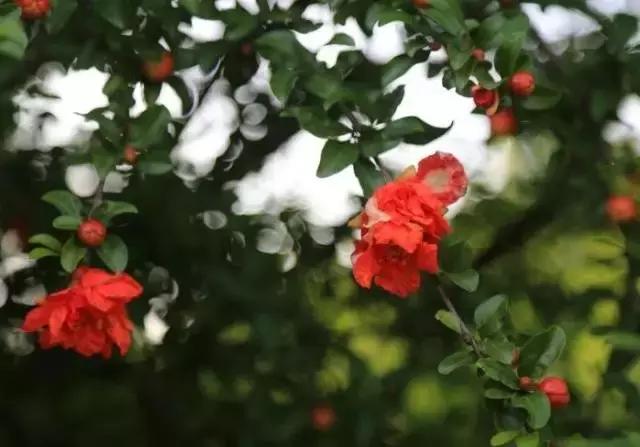
In May the pomegranate flowers shine bright to the eye. The pomegranate is the flower of May. As an ornamental flowering tree, its flowers may be red, white, or variegated, and the fiery, flourishing red hue is the most admired of all; it is called pomegranate red, bright as fire and pure as blood. The petals and sepals are all deep red, the petals slightly wrinkled, with a silken luster and texture. "The flying general's precious tripod, a thousand layers of flame; refined into cinnabar, ten thousand points of red." Blossom after blossom dazzles with red brilliance, possessing an air of auspiciousness and wealth. Su Shi called it "the pomegranate has the true color," and Yuan Ge said, "Suddenly in the courtyard I see the An pomegranate; I sigh that among flowers there is true color." True color and correct color are very high praise; this noble and authentic red has risen to become the inner quality of the pomegranate flower.
In the register in Chapter 5, there is this hint regarding Jia Yuanchun:
The register picture: a bow, with a citron hanging from it.
The verdict verse: For twenty years she distinguishes right from wrong; where the pomegranate blooms, it shines upon the palace chambers. The three springs vie with the scene of the first spring; when the tiger and the rhinoceros meet, the great dream returns.
The pomegranate flower is the flower that represents Yuanchun.
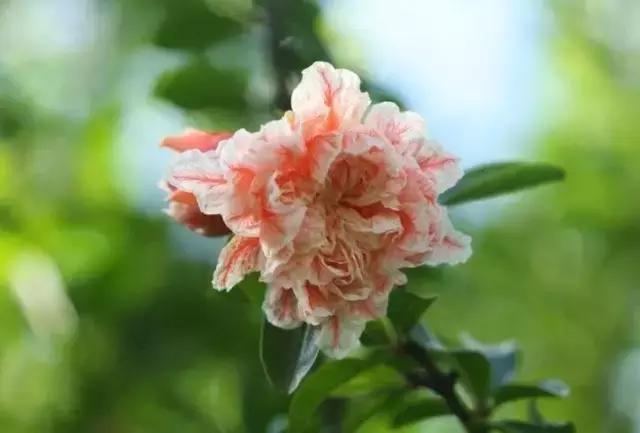
Pomegranate flowers may be single-petaled or double-petaled. What kind of pomegranate flower is the "tower upon a tower" that Cuilü spoke of? I always thought it referred to double-petaled pomegranate flowers, until one time I stood before a flowering pomegranate tree and saw blossom after blossom with layer upon layer of petals. Looking carefully, there was actually an extra layer of sepals in the middle, with dense petals between the two layers of sepals, and dense petals above the sepals as well. It looked as though upon one flower there was another flower. Amid my astonishment I could not help but be deeply moved, and I admired Cao Gong enormously; to have such meticulous and refined observation and description of plants -- this is the "tower upon a tower" pomegranate flower.
The "tower flower" phenomenon is called chongtai or the taige phenomenon, referring to the center or pistil of a flower mutating into a flower stalk or petals, equivalent to a flower blooming again upon a flower, equivalent to what Cuilü said about another head growing out of a head. This is a malformed phenomenon of plant flowering; it belongs to gene mutation, is uncommon, and is very rare. The chonglou phenomenon is common in lotuses and in tree peonies and herbaceous peonies; the chonglou pomegranate is extremely rare.
The "tower upon a tower" pomegranate flower appeared in the Grand View Garden. On the one hand, just as Xiangyun said, the Grand View Garden had abundant vital energy, and its flowers and plants grew especially luxuriantly, so a rare taige pomegranate could appear; on the other hand, it showed that at this time the Jia household, because of Yuanchun's investiture as a consort, had reached the utmost wealth and honor, and even its flowers and trees were extraordinarily wealthy and noble -- truly the splendor of a roaring fire fed with oil, of fresh flowers brocaded in silk.
In Chapter 27, Tanchun deliberately called Baoyu to talk beneath the pomegranate tree. Perhaps this pomegranate tree was the very one Cuilü said was growing so vigorously and blooming with tower flowers. These two Jia daughters who would obtain noble husbands were like the passionate pomegranate flowers of May, dazzling and auspicious, wealthy and fortunate.
The pomegranate fruit is highly esteemed for being a symbol of flourishing descendants. The pomegranate berry is spherical, with many chambers like a honeycomb; plump seeds gather within one and the same thick outer rind, a thousand chambers in one membrane, a thousand seeds as one. "Boundless vitality is contained in its thickness; a belly full of pearls and gems is displayed in turn." "The flushed face still shines, intoxicating both eyes; the pearl-like seeds become a wonder of a hundred seeds." In ancient times it was a symbol of many sons and grandsons, and of a harmonious household, both in China and abroad. In ancient Greek myth, Hera, the goddess who presided over marriage and childbirth, held a plump pomegranate in her left hand. In Chapter 5, when the Goddess of Disenchantment makes her entrance, there is a descriptive line: her lips part like cherry kernels, her pomegranate teeth hold fragrance. Pomegranate teeth describes teeth like pomegranate seeds. The seeds in each chamber of the pomegranate fruit, crystalline and moist as agate and gems, are neatly arranged, plump and sparkling, pleasing to the eye and festive; used to describe teeth, one can imagine how clean and white those teeth must be.
Eileen Chang, in Little Reunions, describes pomegranate seeds: "It was the first time she had seen a pomegranate, with each red crystal die inside; after eating, she used the pits to make soldiers and set them in formation. Under the lid of the fruit basket was a peach-red label; she put it under the bed -- it was the muddy-red Qinhuai River, and one had to cross the river." Using crystal dice to describe the crystal-clear pomegranate seeds is very vivid. In "Record of Life in an Apartment" she also has a wonderful passage: "On the roof garden children often skated; when they were in high spirits, from morning to night they would grind back and forth above our heads, gh-tsz gh-tsz, like the friction of porcelain, and also like a person sound asleep grinding their teeth, so that we heard each tooth in our gums turn sour like the seeds of a green pomegranate, which would fall out at a single pick." Each tooth in the gums turning sour like the seeds of a green pomegranate, falling out at a single pick -- this image really makes one slap the table in admiration.
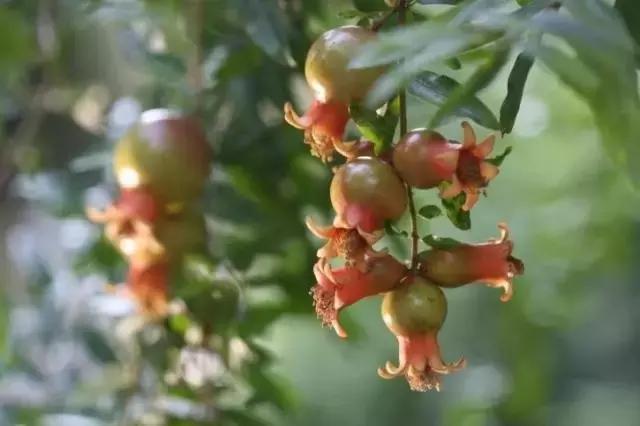
It is just that these good-looking pomegranate seeds cannot fill you up, nor do they taste very good; each pomegranate seed has only a little bit of sweet juice to eat, and the membrane attached to the seeds is extremely bitter, and if you accidentally eat it, it is truly unbearably bitter. Eating a pomegranate is like eating melon seeds; you must not be impatient. If juice accidentally drips on your clothes, you must hurry to wash it, or it will leave a faint mark on the clothes. Yet the juice can be brewed into wine, and pomegranate wine appears often in ancient poems, such as "In the cup, pomegranate wine; on the loom, grape patterns." "On the jade table, the peach of the Western Queen; in the ladle-shaped cup, pomegranate wine." "Pomegranate wine, grape syrup, orchid and cassia fragrance, cornel scent. May you halt your golden saddle, and for a time share this year's fragrance."
"In the shadow of the weeping willow, fading red. How hurried. Only the pomegranate flower does not resent the east wind at all. The evening rain is urgent. The dawn crow is wet. Green and exquisite. It is just like a madder-red skirt newly dyed, exactly the same." "The eyebrows' dark hue robs the daylily of its color; the red skirt makes the pomegranate flower die of envy." The bright red women's skirt was called a pomegranate skirt. Legend says that Consort Yang loved pomegranate flowers, loved eating pomegranates, and loved wearing a pomegranate skirt. The ministers were very disrespectful to this consort and refused to bow to her. When Emperor Ming learned of it, he was furious and ordered all civil and military officials to kneel in salute whenever they saw the consort. The ministers had no choice; when they saw the pomegranate skirt from afar, they knew the consort had arrived and hurried to salute, and so one after another they "fell down in worship beneath the pomegranate skirt."
Wu Zetian, the only female emperor in Chinese history, strong and calm, also loved to wear a pomegranate skirt. She once wrote a romantic and sentimental "Song of Ruyi Niang": "I see red as green, my thoughts in confusion; emaciated and broken, it is for longing for you. If you do not believe that lately I have been weeping long, open the chest and examine the pomegranate skirt." She sees red as green, she is emaciated and broken; if you do not believe it, why not open the chest and examine it -- look at the speckled tear stains on my pomegranate skirt. She was simply an ordinary woman with a hundred turns of tender feeling. Who knows by what psychological course, by what life experience, she was forged into a leader with an iron will who commanded the entire vast empire?
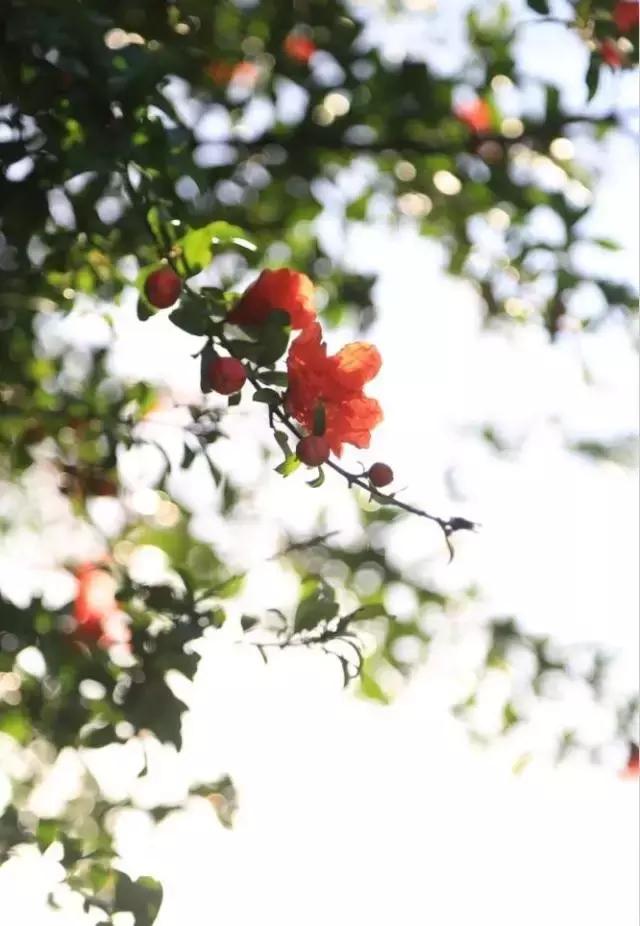
Xiangling had a pomegranate skirt. Chapter 62 of Dream of the Red Chamber is "The Naive Xiangyun Lies Drunk on a Peony Mattress; The Foolish Xiangling Sentimentally Unties Her Pomegranate Skirt." What Xiangling wore was a pomegranate-red silk skirt, brought by Baoqin; Baochai had one, and Xiren had one too.
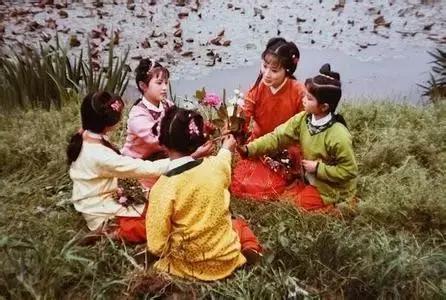
In late spring, the sunlight is warm, flowers bloom and grass grows. The girls in the Grand View Garden put on fine dress, their flowing fiery-red pomegranate skirts dotting the brilliant spring scenery as they search for rare flowers and strange grasses and compete to name fragrant plants and flowers. What a leisurely and wealthy picture this is.
Daily riddle
If you are not a ruthless person, it is hard to become one who is free of all ties
-- Who said this line in Dream of the Red Chamber?
Answer to last issue: Madam You