What are the cultivation methods for a Chinese trumpet creeper bonsai?
Flowering plant productionCultivation methods for Chinese trumpet creeper bonsai
Nowadays, in many private courtyards on both sides of the porch or in parks: Chinese trumpet creeper can be seen in full bloom, most delightful. Chinese trumpet creeper is a small deciduous climbing vine with old stems that twist and coil, vigorous and aged-looking; its flowers are brightly colored, strongly fragrant, and have a very long blooming period, making it an excellent potted vine flower.
Morphological characteristics Chinese trumpet creeper, also known as large-flowered Chinese trumpet creeper and ziwai, is a deciduous woody vine of the genus Campsis in the family Bignoniaceae, native to central China and Japan. It is now widely cultivated in the Yellow River and Yangtze River basins and in southern regions such as Guangdong, Guangxi, Jiangxi, Hunan, Fujian and Zhejiang, where some grow it into a shrub form with abundant vines and branches, decorating the small world of the home with a distinctive charm.
The nodes of Chinese trumpet creeper branches readily produce aerial roots. Branches can reach more than 20 m in length. The bark is light brown, the young branches purplish brown, and the wood soft; the odd-pinnate compound leaves are opposite, with serrated leaf margins and rather rough leaf surfaces. The inflorescence is a terminal paniculate cyme, and the corolla is large: up to 7 cm - 8 cm in diameter, funnel-shaped. The outside is orange-red and the inside flesh-red. The blooming period is from June to September. The resulting capsules are slender like bean pods, each containing several seeds, ripening from October to November; the seeds are flat, mostly with thin wings.
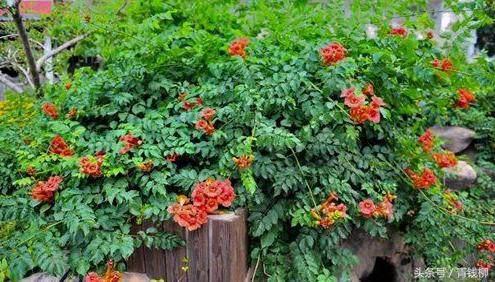
Growth habits Chinese trumpet creeper is vigorous by nature and prefers warmth, though it also has a certain cold tolerance; in the south, plants can overwinter in the open ground, while in the north they need to be earthed up for cold protection when overwintering. Chinese trumpet creeper likes full sunlight but is also fairly shade-tolerant. It is not demanding about growing conditions and can grow normally even in saline-alkaline and barren soil, but grows best in deep, fertile, well-drained slightly acidic soil. Its sprouting and suckering ability are both strong; during cultivation, as the branches and vines grow, they must be manually trained or tied to a support to climb and grow. Every year in early spring, dead branches should be cleared away, and during the growing period, excessively long branches should be appropriately shortened to maintain even growth as needed. Keeping the soil moist favors its robust growth: abundant branches and flowers.
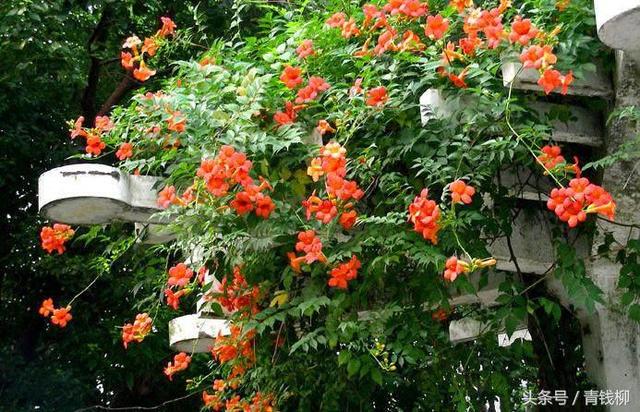
Propagation methodsFor horticultural cultivation, cutting propagation is generally used most often; in addition, it can also be propagated by seed sowing, layering and division. Seed propagation,Collect mature seeds each year in October, store them well, and in spring clean the seeds and soak them in water for 2 days to 3 days before sowing; they generally germinate in 5 days to 7 days.
Cutting propagation: in the north, generally from November to December each year, cut vigorous current-year branches as cuttings, each 10 cm - 15 cm long (generally with 3 nodes), and store them in sand; in March to April of the following year, insert them into the seedbed, where they readily send out new roots. In the south, hardwood branches can be cut as cuttings in early spring, and current-year branches (softwood) can be cut as cuttings in summer; cutting propagation roots very easily, and after the seedlings survive they can be transplanted and will bloom the following year.
Layering propagation is even easier to succeed, because Chinese trumpet creeper stems have many aerial roots, which take root in the soil as soon as they touch the ground. Cut the branches into small sections, generally 10 cm - 15 cm long, place them on the seedbed, cover them with a thin layer of cooked loess, keep them moist, and generally after half a month they can grow roots of 5 cm - 8 cm; transplant them into plants at an appropriate time.
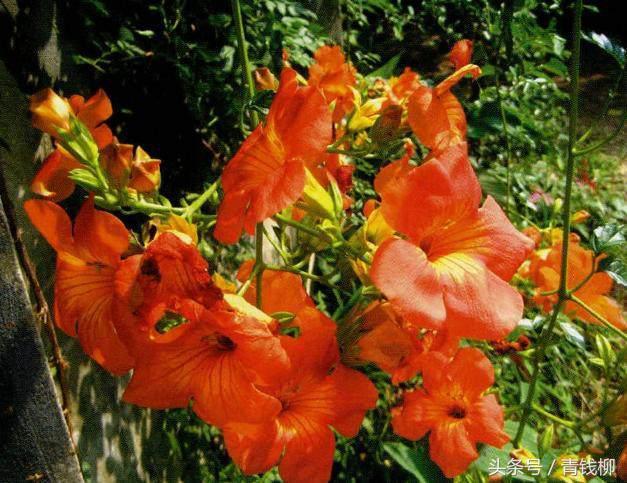
Division propagation is done by digging out the root-sucker seedlings growing from the root crown, which then become divided transplant seedlings and can quickly survive after transplanting.
Potted cultivation methods When potting, choose a container with a relatively large diameter, such as a large ceramic pot or large wooden tub, filled with loose, fertile, slightly acidic soil; if conditions permit, fertile vegetable garden soil mixed with one third leaf mold can be used as the potting soil, and vigorous divided seedlings, layered seedlings or cutting seedlings are transplanted into the pot. Note to keep a suitable amount of soil around the roots when lifting the seedlings, try not to damage the roots, and ensure rapid survival after transplanting. After survival, keep the potting soil moist and water diligently in normal times. But do not let water accumulate; the potting soil is best kept slightly dry and a little moist. When potting or repotting and changing soil, apply some decomposed organic fertilizer appropriately in the potting soil as a base fertilizer; during the growing period, according to growth conditions and shaping needs, use the amount of fertilizer to regulate growth speed and promote flowering. In the peak growing season each year, spray the leaves once every 10 days to 15 days with a 0.2%-0.3% potassium dihydrogen phosphate liquid fertilizer to promote large, brightly colored flowers. After flowering, apply one additional phosphorus-potassium fertilizer to ensure the needs of normal overwintering. During the winter dormant period, no application offertilizeris needed.
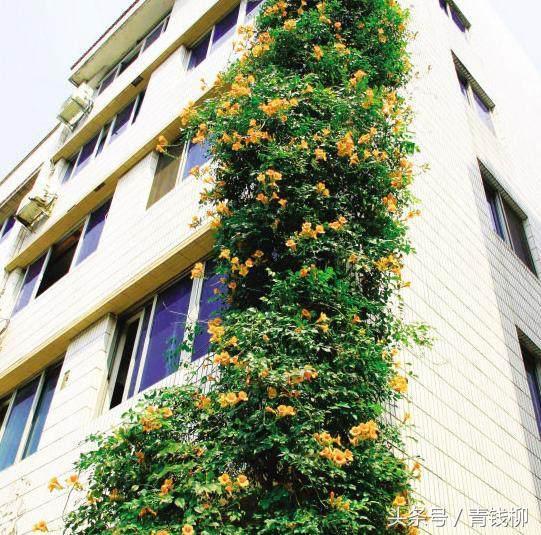
Pruning and training Chinese trumpet creeper's pinnate leaves are profuse and delicate: in summer and autumn the red flowers are brilliant like clouds, the blooming period lasts as long as 3 months, and the old branches and trunks are gnarled, curved and elegantly antique. It is mostly used for vertical greening and beautification of corridors, trellises, walls, stone cliffs, dead trees, rockeries and flower gates. To achieve an excellent ornamental effect, pruning must be done well in normal times and the plant trained onto the support in time. For general ornamental purposes, note to promptly cut off dead branches, diseased and pest-infested branches and overly dense branches, and shorten excessively long branches to encourage more vigorous branch growth and reduce unnecessary nutrient consumption, which favors flowering. After flowering, if seeds are not to be kept, promptly cut off the faded flowers to accumulate nutrients and promote the next flowering. During maintenance, as the branches grow, gradually train or tie them section by section onto trellises, walls, flower corridors and so on, not allowing them to sprawl and grow on the ground; according to environmental needs, part of the stems can be allowed to hang naturally, or wire can be used to train and pull them to climb upward, connecting top and bottom into one mass, making them even more graceful and beautiful. Every year before sprouting in early spring, clean up the dead branches thoroughly and shorten excessively long branches so that growth is even and displays an excellent ornamental effect.
Tree bonsai making techniques (revised edition) Home gardening care Bonsai design and cultivation books Potted planting art Bonsai pest prevention knowledge