How to Choose an Earthworm Farming Site? A Detailed Guide to 12 Farming Methods
Outdoor Farming Site Selection:
1. Site Requirements
1. Facing away from the sun, well ventilated and well drained, to suit the earthworm's habit of preferring darkness and emerging at night.
2. The site should be able to prevent waterlogging and rain soaking.
3. Avoid places with heavy foot traffic, vibration and serious noise.
4. Free from pesticides and other toxic contamination, and able to prevent harm from snakes, rats, frogs, ants, etc.
2. Soil Requirements
1. It is best to use humus soil; the use of clay soil is strictly prohibited.
2. The pH should be neutral.
3. Water Quality Requirements
The water should be hygienic, clean and free of pollution; it is best to use groundwater.
Twelve Major Farming Methods
1. Pond Farming
Idle spaces such as balconies and corners of rooms can be used to build ponds for farming.
Indoors, build a square pond of 5 sq m with bricks, about 25 cm high, and line it with more than 10 cm of loose soil. Or build a pond 2 m long, 2.5 m wide and 0.4-0.5 m deep, or build them arranged one next to another with a row spacing of about 0.5 m. If the groundwater level is high, you may skip digging the pond bottom and simply build the pond directly on the ground with bricks. If the terrain is high and dry, you may dig down 40-50 mm deep for the pond, so as to use it to maintain the temperature and humidity inside the pond.
2. Pot Farming
Flower pots and other containers can be used for raising them. Suitable for farming Eisenia foetida, Dichogaster minima, Allolobophora caliginosa, etc.
In ordinary flower pots and similar containers, you can raise 10-70 Eisenia foetida. The feed placed in the pot should not exceed 3/4 of the pot's depth. With this farming method, the temperature and humidity of the soil or feed in the pot are prone to change, so attention must be paid to controlling them.
3. Vat Farming
Drill 1-2 mm round holes in the bottom of the vat for drainage, and spread 10 cm of farming soil on it.
4. Farming Bed Method
Spread farming soil directly on the ground to make a farming bed; the farming bed should have an area of 5-6 sq m, with a water ditch 30 cm wide and 50 cm deep around it, which can both drain water and serve as a protective ditch.
5. Box and Basket Farming
Packing boxes, cardboard boxes or plastic boxes, wicker baskets, bamboo baskets, etc. can be used for farming. The area of the box or basket should not exceed 1 sq m. The bottom and sides of the farming box should all have drainage and ventilation holes. The diameter of the drainage and ventilation holes is 0.6-1.5 mm.
6. Trench Farming
Choose a sheltered and shaded spot, and dig trenches for farming. The trench is 10 m long, 2 m wide and 60-80 mm deep. One upper side of the trench is slightly lower and the other slightly higher, with a certain degree of slope.
Spread 15 cm of farming soil on the bottom of the trench, and cover the trench with rainproof materials such as film, plastic sheets and bamboo blinds; 3000-500 earthworms can be stocked. Drainage ditches should be dug well around the surface of the trench, and the farming soil at the bottom of the trench should be piled into a frustum shape for drainage.
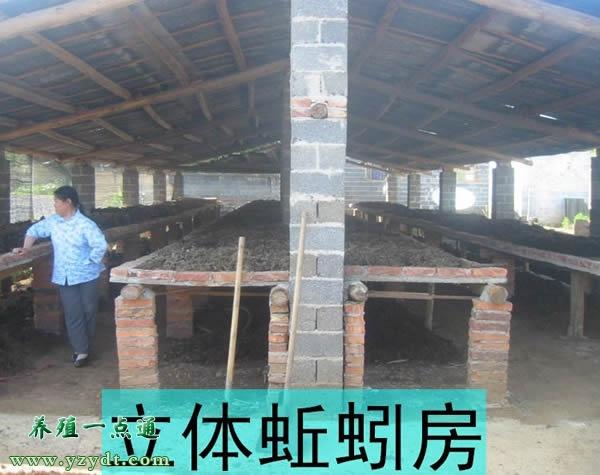
7. Box-Type Three-Dimensional Farming
Stack farming boxes of the same specifications on top of one another to carry out three-dimensional intensive farming; this is one of the farming methods commonly used at present.
First make the wooden boxes and the racks. The racks can be welded from rebar and angle iron, or built with bamboo or wood, or built and laid with materials such as bricks and cement boards. The farming box is about 50 cm in water, 35 cm wide and 25 cm high, placed on the farming rack, generally in 4-5 layers.
Line the box with more than 10 cm of loose soil, and cover it with a breathable anti-escape net. During farming, pay attention to ventilation and air exchange, adjust the temperature and soil humidity, and keep the soil clean and the indoor environment hygienic.
8. Plastic Shed Farming
Existing winter warm sheds and greenhouses can be used to farm earthworms.
9. Underground Cellar Farming
Use dark, damp and heat-preserving locations such as air-raid shelters, civil defense works, pits, caves or earthen cellars for farming.
10. Semi-Basement Farming
Choose a sheltered, dry slope, and dig a trench 1.5-1.6 m deep and 2.5 m wide, with the length determined by yourself. One side of the trench rises 1 m above the ground and the other side rises 30 cm above the ground, forming a slope, and the slope is covered with double-layer plastic film.
11. Garden and Field Farming
Choose a mulberry garden, vegetable garden, orchard or feed field with relatively flat terrain that can be irrigated and drained, dig trenches 35-40 cm wide and 15-20 mm deep along the rows between plants, apply decomposed livestock and poultry manure, household waste and other organic fertilizers, cover with about 10 cm of soil on top, and put in earthworms for farming. The trench should be kept moist regularly, but must not accumulate water. This farming method is not suitable for digging trenches and stocking in gardens planted with citrus, oak, fir, pine, silver fir, eucalyptus, etc.
12. Simple Pile Material Farming
①. Site: choose flat ground with relatively high terrain, close to a water source and without water accumulation as the farming site;
②. Material preparation: use cow, horse, sheep manure or other livestock and poultry manure, then add 30% dry grass feed, mix well, pile up and ferment;
③. Seeding: after adjusting the humidity of the prepared feed, spread it at the selected site, with the pile material 1-1.2 m wide and 15 cm thick. Evenly introduce earthworm seed containing egg capsules and young earthworms, then cover with another 5 cm thick layer of pile material;
④. Covering: cover with film;
⑤. Anti-escape: enclose with nylon net with a mesh of 3 mm, or dig a water ditch for enclosure.
For more farming techniques and entrepreneurship guides, please refer to the mobile version of Yangzhi Yidiantong at http://m.yzydt.com, or follow the WeChat public account: yangzhiuu; the service account (mall): yangzhimall, WeChat private account: yzydt1.