Cultivation Methods and Pest and Disease Control Techniques for Chun Jian Orchid
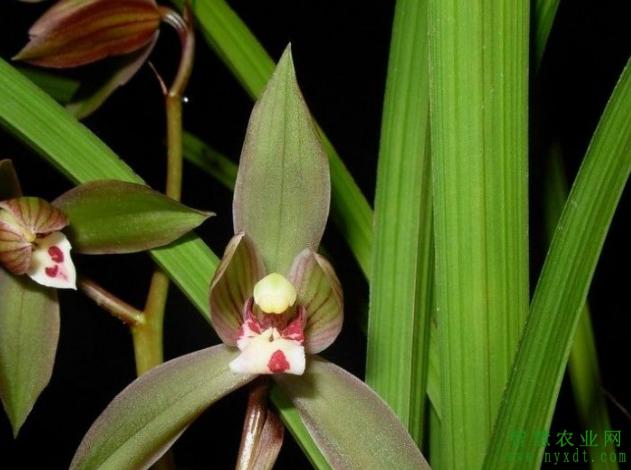
Chun Jian is often called the authentic Sichuan orchid. Although Yunnan, Guizhou, and Sichuan all have famous varieties, the most precious are the famous Sichuan orchid varieties. Chun Jian is a monocotyledonous plant belonging to the Orchidaceae family. It grows 20-40 cm tall, with long tubular roots and evergreen leaves year-round. Its posture is elegant and dignified, with a distinctive charm, making it one of the flower species frequently grown by flower lovers.
Planting and Cultivation
Chun Jian is suitable for planting in spring. Before planting, wash the roots and leaves of Chun Jian thoroughly with clean water, then trim away any residual and rotten roots, and remove all diseased and dried leaves. Then soak the root system of Chun Jian in diluted potassium permanganate solution for a while, let it dry in the shade for a day before planting.
Water Management
Chun Jian prefers a relatively humid environment, but this flower is susceptible to waterlogging, so care must be taken not to water too much when watering. Keeping the soil slightly moist is sufficient. Generally, watering when the potting soil is slightly dry is adequate. Watering is best done on sunny days, and the warmer morning hours are most suitable for watering. It is best not to water on rainy days to prevent waterlogging damage. When watering in winter, be careful not to water thoroughly; simply keep the soil slightly moist. It is best to use weakly acidic softened water for watering. Do not use tap water directly; let it sit in the sun for one or two days before using it for irrigation. When watering, do not pour water directly onto the branches and leaves. Instead, slowly water along the edge of the pot until thoroughly watered, and be careful not to let water accumulate, as this can easily cause root rot.
Fertilizer Management
Chun Jian has a relatively high demand for fertilizer. When planting, first spread a layer of base fertilizer at the bottom of the pot. Potted Chun Jian that has been given base fertilizer should not be fertilized again during the same year, otherwise nutrient excess can easily burn the roots. Chun Jian that is over a year old can be appropriately fertilized before the flowering period arrives or after new shoots sprout. The fertilizer amount should not be too heavy; light application is sufficient. Seedlings can be given a small amount of nitrogen fertilizer. It should be noted that fertilizing is not suitable when temperatures are too high or too low.
Light Management
Controlling light is an important aspect of caring for Chun Jian. If sunlight is too intense or excessive, it will cause the leaves of Chun Jian to turn yellow or even wither and drop. If sunlight is too little, it will slow the growth of Chun Jian, affect the germination of flower buds, reduce the number of blooms. An appropriate amount of sunlight will make Chun Jian grow vigorously and germinate more flower buds, improving flower quality.
Pest and Disease Control
Pests and diseases of Chun Jian are best prevented in advance. In daily care, pay attention to sterilizing and disinfecting the plants and the growing medium. Medicinal solution can be sprayed onto the leaves of Chun Jian to improve the immunity of the branches and leaves. If diseased leaves are found, promptly cut off the leaves with disease spots to prevent the disease from spreading further.
Morphological Characteristics
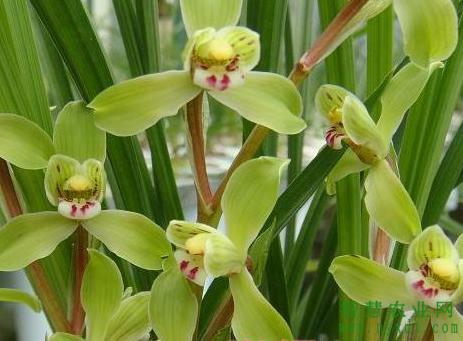
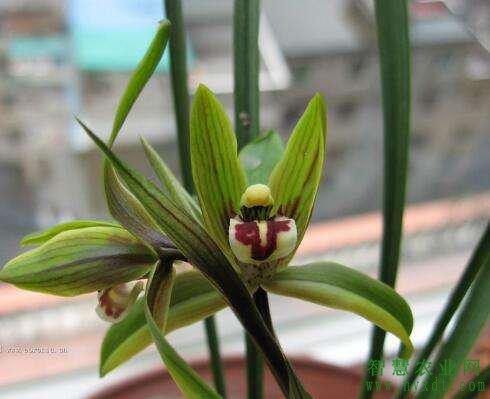
The leaves of Chun Jian orchid grow in clusters, with 4-7 leaves, 1.2-1.5 cm wide and 50-70 cm long, with some individuals being even longer. They are narrowly strap-shaped, strongly upright, mostly thin and leathery, stiff, and dark green in color. The leaf margins have fine serrations, with pointed tips. The cross-section of the leaf is V-shaped, with the midrib protruding on the back and the lateral veins distinct. The petiole ring is not obvious. The leaf sheath is thin and leathery, 9-15 cm long, tightly wrapping the leaf base, and remains tightly wrapped even after the leaf blade matures. There are also soft-leaf varieties and dwarf-leaf varieties. The flower stem is upright, and the pseudobulbs are elliptical, clustered in clumps, 1.3-1.7 cm in diameter and 1.5-2.0 cm tall. The roots are short and thick, uniform in thickness, without branching, 20-30 cm long and 6-9 cm in diameter. The sepals are oblong-lanceolate; the middle sepal is upright and slightly tilted forward, while the lateral sepals spread diagonally to the left and right. There are 2 to 5 flowers, sometimes 7. The flower bracts are longer than the ovary plus pedicel; the petals are shorter than the sepals, with three purplish-red stripes at the base. The lip is blunt at the tip and recurved. The leaf posture of Chun Jian is upright and vigorous, extraordinarily elegant, and full of charm. The flowering period is from February to March, with peak bloom in early to mid-March. The pedicel emerges from the base of the pseudobulb or from inside the leaf sheath, cylindrical, upright, 17-35 cm long. There are 5-6 bract sheaths, semi-transparent, clasping the pedicel, fused into a tube at the lower part. It is a raceme with 2-5 flowers, and some individuals have more. The flower diameter is generally 5.5-7 cm, or larger. Flower colors include light green, water red, purplish red, brownish green, brownish purple, and many other colors, generally with veins or spots of different colors interspersed, but there are also solid-color varieties without any secondary color. Chun Jian was earliest considered a variety of Cymbidium faberi, and later was established as an independent species.
Article source [China Smart Agriculture Official Website]