How to Raise the Chinese Giant Salamander? A Detailed Explanation of Giant Salamander Farming Techniques and Prospects
The Chinese giant salamander is the common name for the giant salamander (Andrias davidianus), a national second-class key protected wild animal. In China, the giant salamander has not been reported in Xinjiang, Tibet, Inner Mongolia, Heilongjiang, Jilin, Liaoning, or Taiwan, China, but it is distributed in all other provinces and autonomous regions. It is mainly found in the mountain streams and rivers of the middle and upper tributaries of the Yangtze, Yellow, and Pearl Rivers, especially in Sichuan, Hubei, Hunan, Guizhou, and Shaanxi provinces. The giant salamander prefers shade and fears light, and grows slowly. Under wild conditions, it takes 5 to 6 years to reach sexual maturity and weigh more than 500 grams; under artificial conditions, it takes at least 3 years to reach marketable size. Moreover, artificial breeding of the giant salamander is relatively difficult. Therefore, farming is not widespread and is limited to a few farms in Jiangsu, Hubei, Guangdong, and other places. However, in recent years, giant salamander farming has received widespread attention and is a famous, special, and high-quality farming species with great potential.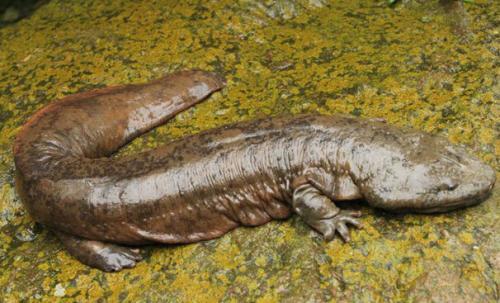
I. Design and Construction of the Farming Site
Based on the unique ecological habits of the giant salamander, the design of the farming pond must take into account an ecological environment suitable for its living habits and growth and development.
(1) Pond Structure There are two types of giant salamander farming sites: one is an open-air farming pond, and the other is a farming pond in civil air defense engineering and basements. The structure is made of brick, cement, stone, or concrete. The specific structural requirements are:
1. Pond Wall Structure The requirements for the pond wall of a giant salamander farming pond are: ① watertight, so that it does not leak; ② safe and firm, able to withstand the pressure of the soil around the pond wall and the pressure of the pond water, with the pond wall not sinking; ③ equipped with anti-escape facilities; ④ inexpensive.
The pond wall of a giant salamander farming pond is generally built with square stones, bricks, or concrete, with cement filling the seams, and the pond wall should be smoothed with cement slurry or tiled.
The top of the pond wall should extend inward by 10 cm to prevent the giant salamander from escaping.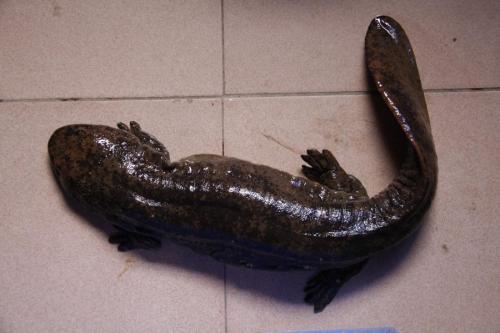
2. Pond Bottom Structure The bottom of a giant salamander pond is generally first compacted with stones to a thickness of 20 to 30 cm, then filled with small gravel, and finally paved flat with concrete. To facilitate drainage, the pond bottom slopes from all sides toward the center at a gradient of about 2%, and then slopes from the center toward the drainage outlet at one corner at a gradient of about 1% to 1.5%.
3. Water Inlet The position of the water inlet depends on the water intake channel and is set at the corner of the pond opposite the drainage outlet. The water inlet should be higher than the pond wall, preferably 60 cm above the water surface in the pond, and extend 20 cm into the pond. The water inlet material can be cement pipe or concrete square, or cast iron pipe or plastic pipe. Regardless of the material used for the water inlet, a control facility and a filter screen must be installed. The control facility uses a straight-through stop valve, and the pipe diameter can be determined according to the water demand of each type of giant salamander pond and the water inlet pressure. Juvenile ponds can use 100-300 mm, and adult ponds can use 300-500 mm. The filter screen material for the water inlet should be stainless steel, and the mesh should also be determined according to the size of the giant salamander pond.
(2) Construction of the Farming Site The adult giant salamander farming pond is an important environmental condition for giant salamander farming and is a key period in the commercial farming stage of the giant salamander. At the adult stage, the giant salamander's resistance and adaptability increase, while escape and the law of the jungle among the same species also reach their peak. Therefore, the adult site must be based on the physiological characteristics of this stage. More than 5 ponds should be built so that they can be farmed separately according to individual size.
According to the actual situation in each place, adult ponds can be built indoors or in civil air defense engineering, or outdoors. The pond area can reach 100 to 2,000 sq m. The area of artificial arcs or burrows in the pond accounts for 2/3 of the adult pond area, and the size of the arcs or burrows depends on the size of the adult individuals. For outdoor pond construction, in addition to the requirements and facilities of indoor adult sites, shading facilities must be installed. Each place can install shading materials according to actual conditions, and it is required that the top and all sides of the pond be fully shaded.
II. Farming of Adults
China has already gained successful experience and technology in adult farming. Its main farming methods include outdoor farming, basement and civil air defense engineering farming, and the industrialized temperature-controlled farming developed by our research. In summary, they are mainly divided into still-water farming and flowing-water farming.
Wild giant salamanders use food organisms in the natural environment as their nutritional basis, so they grow slowly and generally need 5 years of age to reach adulthood. Artificial farming of giant salamanders creates a good ecological environment and provides nutritionally rich feed. Generally, only 2 to 3 years of age is needed to reach the adult stage.
Because of its high nutritional and medicinal value, the giant salamander has enormous economic development value. Therefore, giant salamander breeding and farming technology will be a key focus of competition in China's aquaculture industry for some time to come, and the giant salamander will also be a key species for future development.
(1) Farming Methods The farming method for giant salamanders can be chosen according to local conditions. The following introduces temperature-controlled farming technology - the industrialized three-dimensional farming method for giant salamanders. This technology has obtained an invention patent.
(2) Stocking of Adults
1. Preparation Before Stocking
(1) Maintenance and Disinfection of Adult Ponds This mainly involves checking the inlet and outlet pipes, whether the barrier nets are damaged, checking the filter pond, filtration devices, and temperature control machines for faults, and carrying out maintenance. It also involves inspecting the adult ponds to see whether there is damage and repairing it in time, then disinfecting the adult ponds and stocking only after the drug effect has dissipated.
(2) Disinfection of Adults Disinfection of adults mainly prevents water mold disease and bacterial diseases. The disinfection method and drugs are the same as for juveniles. When stocking, the water temperature of the adult farming pond should be the same as that of the juvenile pond.
(3) Inspection Before Stocking The number and size specifications of the adults should be checked so that they can be graded into large, medium, and small individuals and raised in separate ponds. In this way, adults of the same specification have basically the same feeding ability and feeding intensity and basically the same growth rate, which can avoid mutual cannibalism caused by mixed farming of different sizes.
2. Stocking Density The stocking density of adult giant salamanders should be determined according to the farming method, technical level, and farming conditions in each place. The stocking standards for different adult farming methods are summarized in Table 5-2.
III. Feed and Feeding
Feed and feeding are the central link in the entire giant salamander farming technology. The quality of feeding management work has an extremely close relationship with adult growth and development, the occurrence of giant salamander diseases, water quality stability, and adult survival rate and yield.
(1) Ecological and Physiological Habits of Adults
1. Living Habits In the natural environment, adults live in places with shaded rivers and hidden springs; artificially farmed ones live in artificial burrows.
2. Bait Adults are carnivorous animals. Bait is divided into two major categories: fresh and frozen animals (but those with excessive fat are unsuitable), and artificial compound feed.
3. Water Temperature This is the decisive factor for adult growth and gonadal development. The suitable range is 16 to 25°C, and the optimal range is 18 to 23°C.
4. Oxygen Consumption During the day it is 20.28 to 32.89 mg/kg·hectare, while at night it is 21.69 to 36.24 mg/kg·hectare.
5. PH The suitable PH for adults is 6.5 to 7.5.
6. Light Adults move away from light - that is, they are photophobic - and require a light intensity of 100 to 500 lux.
(2) Feed and Feeding Methods
1. Types of Feed The giant salamander is a carnivorous animal, and its natural bait resources are very rich, mainly including fish, shrimp, frogs, shellfish, loach, chicken and duck embryos, mutton, beef, rabbit meat, earthworms, etc. For artificial compound feed, eel compound feed can be used, and we have already developed an artificial compound feed for giant salamanders. The feed conversion ratio for raising adults with natural bait is 3.5 to 6.3. The feed conversion ratio for raising adults with artificial compound feed is 2.8 to 3.6. Each place can decide the feeding species according to local feed resource conditions.
2. Feeding In order to improve the farming efficiency of giant salamanders and reduce feed costs, before feeding it is necessary to understand the adult's ability to digest, absorb, and utilize nutrients in the feed so as to determine reasonable feeding. Reasonable feeding includes factors such as giant salamander nutrition, growth, metabolism, physiology, and ecological environment, as well as feeding amount, feeding frequency, feeding methods, and feeding principles.
(1) Feeding Time and Frequency Under suitable temperature conditions, giant salamanders have strong digestion and absorption. Generally, feed once every 2 to 3 days. If the humidity is below 10°C, feed once every 5 to 7 days. Giant salamanders hide by day and come out at night, feeding at night. Therefore, in summer the feeding time is from 8 to 10 p.m. every day, and in winter it can be from 6 to 8 p.m.
(2) Feeding Amount There are many factors affecting giant salamander feeding, such as water temperature, dissolved oxygen, water quality, disease, feed species, and feed quality. The amount of feed needed by the giant salamander can be calculated according to the number of adults in the pond and the daily feeding rate. The calculation formula is:
A=W×E
Where A - daily feeding amount;
W - body weight of the giant salamander;
E - feeding rate.
Water temperature is an important factor affecting giant salamander feeding, because the giant salamander is a poikilothermic animal, and with changes in water temperature, the body's physiological metabolism also changes. Within the suitable temperature range, the feeding and growth of the giant salamander are positively correlated with rising water temperature. Generally, feeding and growth occur above 12°C, with the largest feeding amount and fastest growth at 18 to 23°C. When the water temperature rises above 26°C, the feeding amount decreases, and above 28°C it enters "summer dormancy." Under suitable temperature and the same feed quality conditions, dissolved oxygen and water quality play the main role. Therefore, the feeding amount for adults must be determined by integrating various factors. After 10 years of research results, we have obtained a feeding standard under different water temperature conditions, which can be used for feeding in adult farming.
(3) Feeding Methods Feeding methods should be determined reasonably according to the biological and ecological habits of the giant salamander. In order to improve feed utilization and reduce feed costs, feeding must adhere to the four-fixed feeding method, namely fixed time, fixed location, fixed quality, and fixed quantity.
① Fixed time means feeding on time according to the giant salamander's biological habit of feeding at night, while also appropriately advancing or delaying according to season, water temperature, and water quality conditions. The general feeding time: in summer it is set at 10 p.m., and in winter at 8 p.m.
② Fixed location Developing a habit of feeding at a fixed location in giant salamanders can promote concentrated feeding. Concentrated group feeding not only improves the giant salamander's appetite and increases food intake, but also reduces the scattering of feed and improves feed efficiency.
③ Fixed quality If artificial compound feed is used for feeding, it should be stored in a low-temperature, dry, and non-damp place. Because adult giant salamanders have different farming purposes, the feed additives added also differ. In order to improve the utilization rate of protein in compound feed, oil should be added during feed preparation, generally requiring the addition of fish oil, vegetable oil, etc. The amount of oil added increases or decreases with different water temperatures. Generally, when the water temperature is 18 to 23°C, add 5% each of fish oil and corn oil; when the water temperature is 14 to 17°C, the amount of oil added is 5% to 6%; when below 12°C, oil may not be added. Natural bait is required to be fresh and clean, and spoiled bait must never be fed. Ideal natural bait includes loach, earthworms, crucian carp, and chicken and duck embryos.
④ Fixed quantity According to different factors such as the giant salamander's feeding and digestion, individual growth, individual size, water temperature, and water quality, an appropriate amount of feed is given.
IV. Farming Management
(1) Management of Adult Ponds After a period of farming, adults grow in size and density relatively increases, and giant salamander diseases also occur accordingly. Therefore, daily management work is very important. The daily management of adult ponds can be summarized as one diligence, two earlies, three observations, and four preventions.
One diligence: that is, frequently patrolling the pond. Patrol the pond 3 times a day. In the morning, patrol the pond to observe post-feeding conditions; at noon, patrol the pond to pay attention to water temperature changes; at night, patrol the pond to observe adult feeding conditions.
Two earlies: that is, early stocking and early feeding. Pay attention to whether they are feeding when the water temperature rises after the Spring Festival. If they are not feeding, heating should be used to make the adults feed as early as possible.
Three observations: that is, observe feeding, observe whether they compete for food or spit food, and observe water quality. Observing feeding mainly means observing whether adults feed in a concentrated or scattered manner at the feeding site. Observe whether they compete for food or spit food in order to adjust the feeding amount. Observing water quality mainly means observing whether the water quality is fresh and whether transparency is high, so as to take measures to improve water quality.
Four preventions: that is, preventing heatstroke, preventing disease, preventing escape, and preventing water deterioration.
Preventing heatstroke is one of the important tasks in the management of adult ponds in summer. Because summer water temperatures are high, adults are prone to death, so measures must be taken to prevent heatstroke and lower temperature, which is beneficial to giant salamander growth. Outdoor heatstroke prevention mainly involves setting up shade materials to reduce light intensity. Water changes should be carried out late at night, which is beneficial for adults to "pass the summer."
Preventing disease means preventing giant salamander diseases. Always pay attention to the feeding and activity conditions of the giant salamanders. If adults are found swimming alone away from the group, the disease condition should be checked and studied, isolation and prevention measures should be adopted, and treatment should be carried out in time.
Preventing escape means preventing adults from escaping. Frequently check the water inlet and outlet areas, strengthen management, and prevent escape.
Preventing water deterioration means preventing water quality from deteriorating.
In addition to doing a good job in feeding management, adult ponds also require water quality management and prevention and treatment of adult diseases.
V. Prospects for Giant Salamander Farming
(1) Current Status of Giant Salamander Farming
At present, China's giant salamander farming industry is still in a trial stage that has just started, and breeding is mostly carried out in scattered research institute laboratories. Due to insufficient research funding and the animal's unique physiology and living habits, many research projects and topics have been aborted midway. There are very few farms of a certain scale, and it will still take some time to form a large-scale farming situation.
(2) Ornamental Value of the Giant Salamander
The giant salamander has a colorful back, with four fingers on the front limbs resembling hands and five toes on the hind limbs resembling feet, and a particularly large mouth with a loud call, hence the name "baby fish." Among amphibians, it is one of the longer-lived species. Under artificial rearing conditions, it can live as long as 50 to 60 years or more, and in the wild state there are those that have lived more than 130 years and are still plump and tender, so some people also call it the "longevity fish." As an ornamental animal, the giant salamander has always been loved by people and can add a novel touch of color to parks, zoos, and scenic areas.
(3) Scientific Research Value of the Giant Salamander
The giant salamander is a relatively primitive species among existing amphibians that have transitioned from aquatic to terrestrial life, and it has certain research value in studying animal evolution and in other scientific research and teaching.
(4) Medicinal Value of the Giant Salamander
According to the record in "Compendium of Materia Medica," the giant salamander has special uses such as improving appetite, replenishing deficiency and treating weakness, darkening hair and beautifying the face, prolonging life, enhancing human immune function, and preventing cancer and strengthening the body. Its skin is an excellent medicine for treating gunshot wounds, knife wounds, burns, scalds, and various other traumas. In particular, its treatment of facial burns and scalds without leaving scars is even more miraculous, and it can be called a panacea for traumatology.
(5) Edible Value of the Giant Salamander
The meat of the giant salamander is white, fresh, and tender, fatty but not greasy, and contains extremely rich nutrients. It is a high-grade tonic and health-care treasure, praised as the "living ginseng" in water. As early as the 1960s, it once earned a large amount of foreign exchange for China. If fully artificial farming is successful, a series of health-care treasures can be reasonably developed, and its farming prospects are extremely broad.
(6) Farming Prospects from the Perspective of the Difficulty of Feeding Management Technology
1. The living environment requirements of the giant salamander are fresh water quality and flowing fresh water with a relatively large drop, with a water temperature within 0 to 25°C, such as small river water, mountain spring water, and groundwater. The environment should be quiet, and the light should be dim. The giant salamander has strong disease resistance, and its vitality and hunger tolerance are also astonishing.
2. The giant salamander grows very quickly, reaching sexual maturity at more than 0.35 kg. The giant salamander lays eggs once a year, and the number of eggs laid varies with individual weight. Generally, each time it lays 300 to 1,500 eggs. Artificial farming must achieve the optimal ecological environment and comprehensive nutritional supply in order to achieve the best egg-laying effect.
3. Fully artificial breeding is still in the stage of research and breakthrough. Because this animal has special physiological and living habits and is extremely afraid of being startled, artificial breeding often requires cumbersome procedures such as catching and injecting, which causes the giant salamander, after being startled, to absorb its eggs, resulting in a very low success rate and requiring further exploration and research.
In summary, with the continuous progress of artificial breeding technology for giant salamanders, choosing good farming sites, artificially creating an ecological environment, and vigorously developing artificial farming are of great significance and have broad prospects.