A Detailed Guide to Common Orchid Types and Their Care Techniques
Common Orchid Types and Orchid Care Tips
As one of the "Four Gentlemen of Flowers" along with plum, orchid, bamboo and chrysanthemum, the orchid has graceful and elegant flowers, and its vitality and environmental adaptability are stronger than most flowers and plants, making it a common flowering plant in gardening. At present, there are about 500 to 800 genera of orchids worldwide, with as many as tens of thousands of varieties; the common ones mainly belong to 15 genera.
1. Common Orchid Varieties
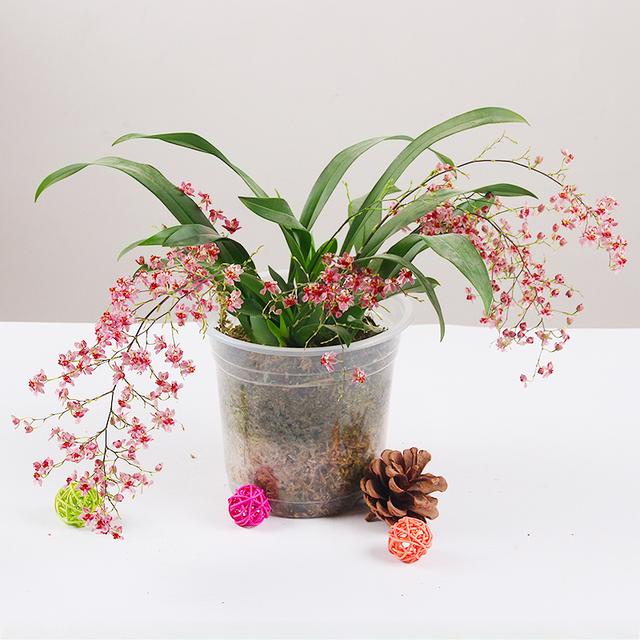
(1) Oncidium Distributed in tropical America such as Mexico and Brazil, with about three hundred or more species, ranging from small to large, and flower colors mainly in the yellow to brown range. Because its flowers resemble a girl dancing gracefully in a fluffy dance skirt, it is also called the "dancing lady orchid." This lovely little orchid has leaves only 6 to 8 cm long, flowers over 2 cm in diameter, and petals with fine spots or block-like markings. It has many closely related genera, among which the spider orchid is named for its flower shape resembling a long-legged spider.
(2) Dendrobium It can be found in Japan, South Korea, China, Thailand, Vietnam, the Philippines, Malaysia, Indonesia, Australia and New Zealand, with more than 1,500 native species, and its flower forms are very varied. The greatest common feature of Dendrobium is that the two side sepals of the flower close together to form a chin-like shape. On this basis, there are also many variations in flower posture, such as the "Thyrsiflorum Dendrobium" that grows like a waterfall.
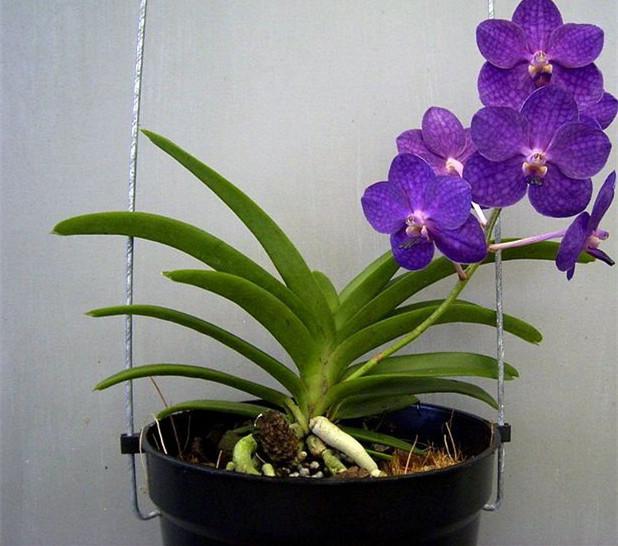
(3) Vanda "Vanda" comes from the Sanskrit "Vandaka," meaning "growing on trees." There are about seventy or more native species, most of which are large varieties except for a few miniature types. Most Vandas can bear more than a dozen flowers on a flower stalk and can bloom almost all year round. Flower colors range from white, yellow, green and red to blue, and flower shapes are endlessly varied, some twisted and reversed, some round and flat.
(4) Cattleya With large flowers, gorgeous colors and a great many varieties, it enjoys the reputation of "King of Orchids." Its place of origin is Central and South America, and it has many varieties, such as single-leaf type, two-leaf type and multi-leaf type; there are also large varieties and miniature varieties. Generally speaking, single-leaf species usually have larger flowers and more beautiful, wider petals, while two-leaf species have smaller flowers and narrower petals, and usually have more obvious flower colors and more flowers.
(5) Phalaenopsis It gets its name because its flower posture resembles butterflies fluttering and dancing; especially when in bloom, the flower stem droops in an arch, and when the breeze moves it, it looks like a flock of butterflies dancing, so it is praised as the "Queen of Orchids." The flowering period lasts 2 to 4 months, but through modern cultivation techniques, blooming flowers can be enjoyed almost all year round. There are about 50 native species, most of which grow in countries such as Indonesia and the Philippines, and it is suitable for growing in a high-temperature (about 25 to 30°C) and humid environment. It is drought-tolerant and also relatively shade-tolerant, suitable for cultivation in courtyards and rooftop balconies with insufficient sunlight.
2. Orchid Care Tips
(1) Maintain a ventilated and breathable environment Ventilation of the environment and the growing medium (charcoal, bark, wood shavings, etc.) are the main considerations; whether air permeability is good or bad is the first priority, and then the issue of water retention should be considered.
(2) Do not water too much or apply excessive fertilizer Orchids have good drought tolerance; it is better to water less than too much, as too much watering will cause root rot. To avoid harming the plant, light fertilization is the correct method of applying fertilizer.
(3) Do not plant too deep Most orchids, apart from their roots, are exposed on the outside; planting them deep will instead cause smothering and rot or wet rot of new shoots. Plants that cannot stand steadily should be fixed with a support rather than buried deep.
(4) Light must be sufficient Each type of orchid has different light requirements. The way to judge whether light is appropriate is: if the plant's color becomes pale or turns yellow, the light is too strong; if the plant gradually turns dark green, it indicates insufficient light.