Technical points of "planting grass to raise geese" for improving economic benefits
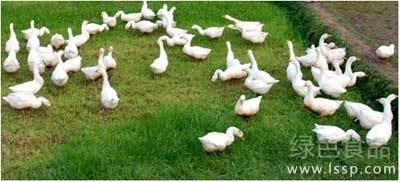
Raising geese
Geese are herbivorous animals with omnivorous feeding habits. Planting grass to raise geese can significantly reduce feeding costs and improve breeding benefits. With the improvement of the scale, intensification and industrialization of goose raising, artificially planting high-yield and high-quality forage grass and feed crops to meet the demand for high-quality green forage in goose production has become an important part of developing goose raising and giving play to its benefits. Planting grass to raise geese has high benefits and is a combination model of planting and breeding worth promoting. In the process of planting grass to raise geese, the following aspects should be done well:
1. Grow forage grass well
To grow forage grass well, the first thing is to choose good grass species, achieving not only high yield, but also good palatability, and also meeting the need for grass supply in different seasons. The climate in this region is mild and humid. In summer and autumn, wild weeds are relatively good and can be used, while green feed is in short supply in winter and early spring. The selection of grass species should mainly be cold-season forage grass (such as annual ryegrass, Winter Grazer-70 rye), supplemented by warm-season forage grass (such as chicory, wild endive, etc.). The second is to strengthen field management. Generally, grass seeds are much smaller than wheat seeds, so careful tillage and leveling the land are very important. To achieve uniform emergence and good growth, it is also necessary to dig a complete set of ditches, strengthen water and fertilizer management and weed control at the seedling stage, and plant forage grass as carefully as growing vegetables. Third, use it rationally, persist in cutting grass to raise geese, use racks for feeding, do not carry out direct grazing, and increase the carrying capacity per unit area. The principle of utilization is to cut at the right time and leave an appropriate stubble to facilitate regrowth. Feeding young geese requires tender grass, and the cutting interval should be short. Young geese have strong digestive ability, so cut again when the forage grass grows to a height of 20-30 cm. In the later period, the cutting frequency should be increased, which can slow down the aging of forage grass and prolong the utilization time.
2. Raise goslings well
To raise goslings well, first, build good sheds. The site should be chosen in a place with high terrain, good ventilation, sufficient water source and smooth drainage. The shed should meet the requirements of leak prevention, heat preservation and ventilation, with an area calculated at 10 birds per sq m. There should be a pond or river nearby for the geese to bathe. Equip heating facilities to ensure successful brooding in winter; otherwise, there will be grass but no geese, causing waste. Also equip troughs, water troughs, grass racks and other equipment. Second, prepare sufficient supplementary concentrated feed. Relying only on grass cannot meet the growth and development needs of goslings. Each gosling needs 6-7 kg of feed. The principle of supplementary feeding is half concentrated feed and half green feed during the brooding period, then gradually reduce it; during the growing period, grass is the main feed; in the later period, increase the amount of feed to fatten them for market, and also manage flexibly according to body condition. Third, do a good job in disease prevention and control and feeding management, and implement the model of two vaccinations and one deworming, that is, give the one-day-old gosling plague vaccine; the 15-day-old paramyxovirus vaccine; and at 40 days old, use a broad-spectrum deworming drug for deworming. Usually pay attention to observing the goose flock, achieving the three observations: first observe spirit, second observe feed intake, third observe droppings, and deal with problems promptly when found. Do a good job in controlling temperature, humidity and air freshness and in daily disinfection and sanitation work.
Planting grass to raise geese
3. Do a good job in combining grass and geese
Planting grass is for raising geese, and raising geese is the purpose of planting grass. Planting grass and raising geese are two linked links, and only close combination can succeed. When implementing the project of planting grass to raise geese, first plan well the grass species, area, and the number and batches of geese to be raised, so that where there is grass there are geese, the grass can meet the supply, and the geese can consume it in time. Two models are introduced below for reference.
Model 1: annual ryegrass or Winter Grazer-70 rye. Sow from late September to early October. The grass supply period is from November to early June of the following year. The yield per mu can reach 8000 kg. Cut in batches to feed geese. About 300 geese can be raised per mu. Raise them in 3-4 batches in a complementary manner. The first batch: 30 goslings per mu in November, marketed at the end of January; the second batch: 50 goslings per mu at the end of January or early February, marketed in early April; the third batch: 120 goslings per mu in early March, marketed in mid-May; the fourth batch: 120 goslings per mu in early April, marketed in early June. This model solves the difficult problem of reducing wheat area in the adjustment of the planting structure in rice and wheat production areas.
Model 2: chicory or wild endive. Chicory is a perennial plant, sown once and used for many years. The yield is low in the first year, and it enters the full production period in the second year. The yield per mu is 8000 kg, and the grass supply period is from April to November. Wild endive is an annual forage grass with good quality and high protein content. It is sown in March, with a yield per mu of 4000 kg, and the grass supply period is from April to November. Chicory has a short period of slow growth in the high-temperature season, while wild endive grows most vigorously in July and August when the temperature is high. Planting both forage grasses together can achieve a complementary effect. This model, supplemented by wild weeds, can raise about 300 geese per mu, in 3-4 batches in a complementary manner. The first batch: 30 goslings per mu in mid-April, marketed in late June; the second batch: 100 goslings per mu in late May, marketed in early August; the third batch: 100 goslings per mu in mid-June, marketed in late August; the fourth batch: 80 goslings per mu in early August, marketed in November.
The yield of forage grass is greatly related to management. On the premise of applying sufficient base fertilizer, appropriately apply more fertilizer after each cutting and do a good job in water and fertilizer management, so as to increase yield and improve quality. In planting grass to raise geese, the number of geese should also be adjusted in good time according to the growth of the forage grass, to prevent insufficient forage or waste.
Using the two models together can allow goose raising throughout the year.