How should ewes in late pregnancy be fed to be reasonable?
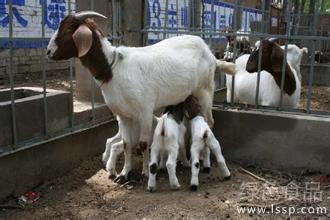
Sheep farming
After the long winter, by spring most ewes are in late pregnancy. At this time the fetus grows faster and needs a large amount of nutrition, while the ewe's abdomen is compressed by the fetus, so feed intake is limited. Therefore, the proportion of concentrate in the daily ration should be increased; generally concentrate makes up 5% in early pregnancy, rises to 18% in the 6th week before lambing, and to 30% in the 3rd week before lambing. When there is no green fodder in the ration, vitamin A, E, D, etc. must be supplemented.
In management, attention must be paid to protecting the pregnancy. Do not crowd the ewes or let them run fast, and prevent them from slipping; do not let the ewes drink cold water on an empty stomach in the morning, do not feed them too full, and do not let them eat moldy fodder or fodder with ice bits in it; do not use excessive laxatives. Insulation measures must be taken for the lambing shed, drafts must not get in, and clean, soft bedding must be spread on the floor inside. The lambing shed must be thoroughly disinfected before the ewes enter, and afterwards sprayed with disinfectant once every 5 days. Ewes about to lamb should be moved into the maternity pen 2 to 3 days in advance.
Inject E. coli vaccine 1 month before lambing. Deworm once 25 days before parturition; 0.2% Xiuweijia can be used, 0.1 g per kg of body weight. For ewes with mange, repeat the medication 7 days after the first treatment, and at the same time spray the sheep shed with 4% trichlorfon.
A low-calcium ration must be fed 20 days before lambing, with a calcium content of 0.2% in the ration, and immediately increased to 0.8% after lambing, which can prevent postpartum paralysis in ewes. Injecting vitamin D into ewes 5 to 6 days before lambing can also effectively prevent postpartum paralysis. Gradually reduce the amount of concentrate fed 3 days before lambing. On the day of lambing, do not feed the ewe concentrate; feed easily digestible green grass or hay, and give warm bran water with some salt and brown sugar added. After lambing, gradually increase the amount of concentrate fed, reaching the maximum amount by the 10th day. Ration composition: concentrate 0.3 to 0.6 kg, silage 1 to 2 kg, hay 1 to 2 kg, carrots 0.5 kg. Stop feeding root and succulent feed 7 to 10 days before weaning, and gradually reduce the concentrate, so as to avoid mastitis.
Immediately after lambing, inject 5 to 10 international units of oxytocin and 2 doses of Chankang, to prevent puerperal fever, mastitis and metritis, promote the early recovery of the ewe's uterus, and bring on estrus and mating as early as possible. Motherwort decoction can also be given orally.
Carry out the relevant vaccine injections 30 days after lambing. Deworming before mating helps the ewe conceive and prevents miscarriage caused by parasites. Xiuweijia powder is effective at expelling internal nematodes and external parasites; albendazole can expel tapeworms, flukes, nematodes, etc.; using the two together has a very good complementary effect.
Generally, mating is carried out 40 to 60 days after lambing; those that cannot come into estrus naturally must be induced artificially. For every 1 kg increase in the ewe's body weight before mating, the lambing rate can increase by 2.1%. Increasing the amount of concentrate fed 20 days before mating, especially energy feed, can significantly raise the ewe's conception rate.