Silkie chickens are not suited to indoor cage-free rearing on wire netting; how can they be raised free-range at scale in woodland?
Silkie chicken meat is fresh, fragrant, sweet and delicious, and highly prized; green ears, dark meat and black bones are the characteristics of the Silkie chicken. Since Silkie chickens do not adapt to large-scale concentrated rearing on wire netting, the editor will now introduce free-range rearing of Silkie chickens at scale in woodland.
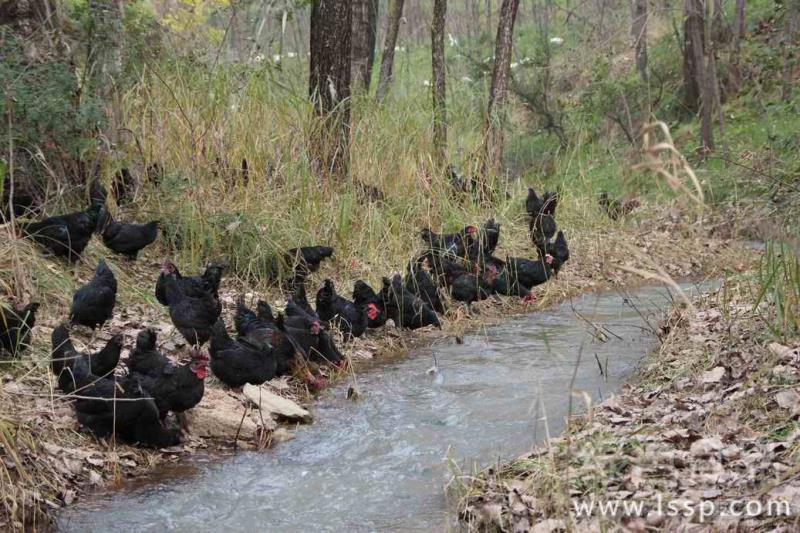
Free-range rearing of Silkie chickens
(1) Choosing the chicken farm:The Silkie chicken farm must be far from residential areas and main highways, and requires a quiet environment, fresh air, an ample water source and easy access to electricity. Natural forests, artificial tea plantations, orchards and similar sites can be used, choosing and determining the scale of the Silkie chicken farm according to local conditions.
(2) Building the chicken houses:Build chicken houses facing south on flat ground that is sheltered from the wind and catches the sun. Old buildings can be converted, or new ones built. The heated brooding house is about 20 sq m; inside the chicken house, an elastic plastic net with a mesh diameter of 1 cm must be installed 80 cm above the ground, and 2—3 tiers can be built with 20 cm between tiers. The houses for breeding chickens, commercial chickens and growing chickens depend on the number of Silkie chickens being raised. In the chicken house, build wooden beds 80 cm above the ground, and 2—3 tiers can be built with 20 cm between tiers; build wooden ladders at the walkways, to satisfy the Silkie chicken's habit of resting at height. Raising 200 breeding Silkie chickens requires 10 mu of land with fencing all around; raising 2,000 commercial Silkie chickens requires no less than 20 mu with fencing all around, to prevent attacks by wild animals and wild birds. The fencing is determined by the number of Silkie chickens being raised. The chicken farm must have a feed storage room, a veterinarian room, a work room and a duty room, and at the entrance a changing room, a disinfection room and a disinfection pit. There must be a certain buffer zone between the living area of the chicken farm workers and the chicken farm. Outside the chicken farm, build harmless treatment facilities such as those for handling chicken manure and dead chickens.
(3) Bringing in the chickens:Before introducing Silkie chickens, carry out thorough disinfection of the chicken farm and equipment, and prepare feed and commonly used medicines. Silkie chickens are introduced either as chicks or as heated brooding chickens.
(4) Rearing during the brooding period:Room temperature: 37-35°C at 0-1 weeks of age, 35-24°C at 2-3 weeks of age, and 23-20°C at 4 weeks of age; alternatively, after the Silkie chickens are 1 week old, lower the temperature by 0.5°C per day, and they can be taken off heat at 5 weeks. Humidity in mountainous areas need not be considered. Use electricity to supplement lighting: maintain 24 hours of light per day in the first week, then reduce it by 1 hour per day until natural light. Provide water and start feeding at the right time. Chicks should be started on feed — and water as early as possible; in the first week the drinking water should be warm boiled water with 5% glucose added, and in the first 3 days penicillin to prevent stress should also be added to the drinking water. Feed the Silkie chickens only 3 hours after they have drunk water. A complete feed with 19% protein is sufficient, with free access to feed. In the second week, add veterinary medicine to prevent pullorum disease to the feed; in the third week, add veterinary medicine to prevent coccidiosis to the feed. Brooding density: for Silkie chickens less than 15 days old, 60-70 birds/sq m; generally each batch of Silkie chicken brooding is 2,000 birds (the scale of brooding is determined by the farm's demand for chicks). Clean out the chicken manure at fixed times each day; at 35 days of age they can be taken off heat and transferred to the growing stage.
Silkie chicken rearing woodland
(5) Rearing during the growing period:Combine free-range grazing with supplementary feed: mix 1 jin of broiler concentrate with 39% protein with 3 jin of cornmeal, mix evenly and feed, until the growing Silkie chickens reach 1 kg. At the 1-1.5 kg stage, use a ratio of 1 jin of concentrate mixed with 5 jin of cornmeal, mix evenly and feed. After 1.5 kg, do not add concentrate to the Silkie chicken feed; supplement with miscellaneous grains such as corn and wheat, and they can be sold after 20-30 days. Generally male Silkie chickens can be sent to market at 120 days, and female Silkie chickens at 140 days. Excellent hens and roosters can be selected for breeding and self-reproduction to reduce the introduction of disease, and can also supply Silkie chicken chicks to the market; Silkie chicken farms that do not keep breeding stock must follow all-in, all-out. Where conditions permit, some forage grass can be planted as appropriate to make up for the chlorophyll, vitamins and protein of the free-range chickens.
(6) Disease prevention and disinfection:The key to epidemic prevention in large-scale woodland chicken raising is doing a good job of immunization and disinfection for the Silkie chickens. Regular immunization, disinfection and deworming of Silkie chickens help raise the marketable rate of Silkie chickens and increase economic income. The immunization program for Silkie chickens: at 1 day of age, vaccinate Silkie chickens with Marek's vaccine; at 7 days of age, give Silkie chickens Newcastle disease strain IV vaccine in drinking water; at 9 days of age, give Silkie chickens infectious bursal disease B87 vaccine in drinking water; at 12 days of age, give Silkie chickens infectious bronchitis H120 in drinking water; at 28 days of age, give Silkie chickens Newcastle disease strain II vaccine once in drinking water; at 30 days of age, inject Silkie chickens with avian influenza vaccine; at 60 days of age, vaccinate once more with Newcastle disease strain I vaccine; after 60 days of age, no further immunization. Disinfection should be made a system, with the chicken farm, including the chickens, disinfected once a week. Deworm Silkie chickens regularly at 65 days and 95 days of age. Frequently check the chicken manure and observe the flock's feeding and drinking. Sick chickens should be isolated immediately and culled once confirmed; the healthy flock should be treated with the appropriate medicine for prevention and control.