Raising Ducks on Greenhouse Frames: Fewer Diseases, Higher Profits, and a Detailed Guide to the Farming Method
Meat ducks grow fast, can be raised at high density, and bring quick capital turnover, so they are now very popular among farmers. But which method of raising them can achieve high profits? Through our investigation, raising ducks on frames in plastic greenhouses delivers very good economic returns and disease prevention and control results. Raising meat ducks on frames achieves off-the-ground rearing, allows natural ventilation, and makes full use of solar energy and biological energy. It has the characteristics of low investment, quick results, and high profits, and is very suitable for small rural farms.
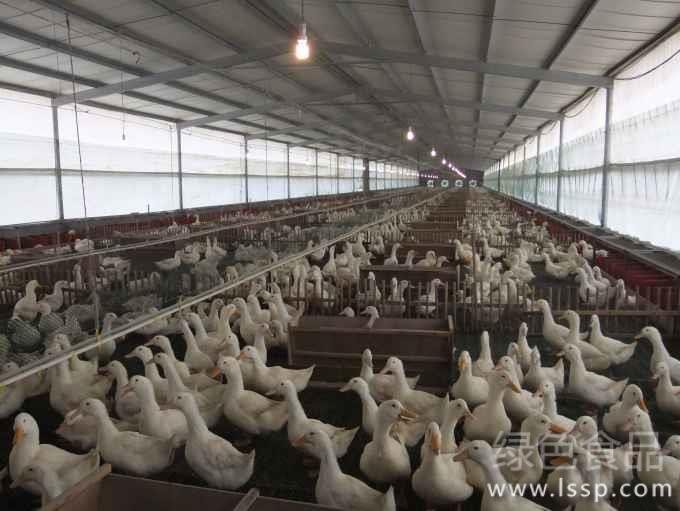
Raising Ducks in Greenhouses
I. Construction of the plastic shed.
1. Construction of the plastic shed. Choose a place with good drainage, convenient transportation, close to a water source, high terrain, and dry ground, and build the shed in an east-west direction. The shed is 4O m long, 6-7 m wide, and 2-2.4 m high, with an arched shape. Use welded pipe with a diameter of 25 mm and a wall thickness of 1.35 mm, bent into a semicircular shape as supports, with every two pipes as one group, fastened with a sleeve pipe with a diameter of 30 mm and a wall thickness of 1.5 mm. When building the duck shed, after installing the supports according to the specification requirements, fix the bracket on each support firmly with wooden sticks or steel pipes, then use bamboo poles and steel wire to secure the supports into 3-5 rows. Set up 1 post every 2-4 m. After the frame is completed, lay straw curtains with a height of more than 1.2 m on the frame. In winter, lower the straw curtains on the north side appropriately; in summer, lower the straw curtains on the south side appropriately. On top of the straw curtains, cover plastic film of equal width, and then cover the plastic film with 70%-80% shade netting. Fasten it firmly along the shed with cables so it is easy to roll up, receive sunlight, and ventilate. Both ends of the greenhouse must have doors.
2. Making and installing the frames. The frames used are made of bamboo and bamboo strips. Each is 2 m long and 0.5 m wide. The bamboo strips are of two types: laid flat and laid edgewise, and can be fastened with small round steel bars. When making them, cut off the sharp corners and smooth the joints to prevent injury to the ducks' feet. During rearing, lay plastic matting netting on the frames to increase elasticity. The frames are raised 30-40 cm above the ground, and when installed they must be laid flat and firm.
II. Raising ducks on frames.
Inside the greenhouse, frames for raising meat ducks are laid. In winter, on the sunny side, from 9:00 to 16:00, roll up 1/3 of the straw curtains to receive sunlight; the temperature inside the shed can be 18-20°C. If all are rolled up, it can reach 3O°C. This creates a greenhouse effect, which both raises the house temperature and saves fuel and feed. On cloudy and snowy days, cover the greenhouse completely with straw curtains. Normally, opening and closing the shed roof should be decided according to the temperature, humidity, and degree of air pollution inside the shed. In summer, cover the entire shed roof with thick straw curtains, fully open the plastic sheeting within 1.2 m above the ground, and surround it with plastic netting to prevent the meat ducks from getting out; at this time the shed is well ventilated and cool, with fresh air, and the temperature does not exceed 32°C. Laying frames inside the shed achieves off-the-ground rearing, improves the indoor conditions, saves bedding costs, significantly reduces diseases, and increases the survival rate of meat ducks.
III. Precautions:
1. The greenhouse for raising ducks must be built in a place sheltered from the wind, facing the sun, and with a water source, and the greenhouse must be tied firmly.
2. The key to raising ducks in a greenhouse lies in controlling the greenhouse temperature. For raising and lowering the temperature, in addition to referring to the ambient air temperature, adjust it by opening and closing the plastic sheeting higher or lower, and by no means keep it sealed and cause poor air circulation, which can suffocate the meat ducks.