Raising geese in summer is not a losing proposition: a quick-fattening method for meat geese in midsummer
Many people believe that in the hot summer climate, geese do not put on weight and raising them is not worthwhile. However, according to the summer confined-raising experience of large goose farmers in Laohekou City, Hubei, the "Hometown of White Geese," goslings raised from June to August each year need only 80 days to grow to 4-5 kg and be ready for market.
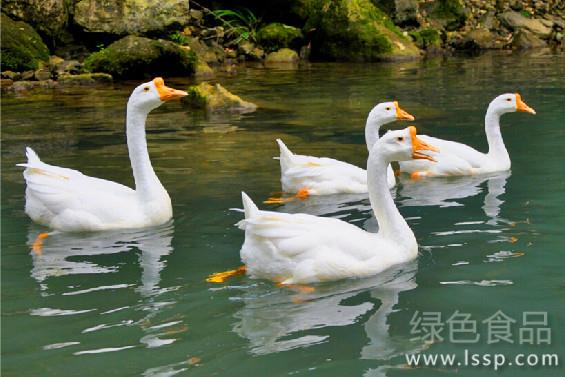
Meat geese
For raising meat geese in confinement in summer, the density must be strictly controlled: only 5-7 geese may be kept per square meter of goose house, and the outdoor activity area should be provided with a shade awning or planted with climbing plants such as grapes and loofah for shade.
For newly hatched goslings, before they begin feeding, add 5 ml of vitamin C, 6 ml of vitamin B, 5 g of glucose and 3 g of brown sugar per 100 ml to 0.05% potassium permanganate water, and feed 3 times a day to cleanse the gut and remove toxins. Then hold finely cut fresh vegetable leaves in the hand to entice and encourage them to eat. When more than 70% of the goslings are competing for food, scatter the finely cut leaves evenly in batches onto a clean straw mat or plastic sheet and let them eat freely, feeding once every 2 hours; at 2-4 days of age, feed rice balls soaked in water, 4-5 times a day, with 1 feeding at night; at 5-10 days of age, feed 6-8 times a day, with 2 feedings at night; at 11-20 days of age, gradually feed a compound feed, 5-6 times a day, with 2 feedings in the evening, and allow appropriate grazing.
The feed formula is (%): corn 50, fish meal 7, peanut bran 10, rice bran 20, unified bran 10, growth promoter 1, antibiotics and multivitamins 0.5, plus shell powder, bone meal and salt 0.5 each; at 21-30 days of age, appropriately increase the feeding of cracked grain and wheat grains, and as they approach 30 days of age gradually switch to dry feed, feeding 3-4 times a day, and appropriately extend grazing time.
After 30 days of age until the main wing feathers grow out, meat geese should be mainly grazed, with appropriate supplementary concentrate. Before being driven back, let them bathe once, rest and receive supplementary feed outside the house, then drive them into the pen. Supplementary feed formula (%): corn 20, fish meal 4, peanut bran 4, rice bran 10, unified bran 60, growth promoter and antibiotics 1, shell powder 1. Mix the mixed feed and green feed in a 2:8 ratio into a moist-dry feed and feed it. The feed trough and waterer must be kept supplied with feed and water all day so the geese can eat and drink freely. When the main wing feathers of the meat geese have grown out and their body weight reaches 1.5-2 kg, a "high-energy, low-protein" diet can be used for 20-30 days of intensive fattening. The diet formula is (%): corn 40, paddy rice 15, wheat bran 20, rice bran 10, rapeseed meal 10, fish meal 3.5, bone meal 1, salt 0.5. Add 19 g of manganese sulfate, 17 g of zinc sulfate, 12 g of ferrous sulfate, 2 g of copper sulfate and 0.1 g of potassium iodide per 100 kg of feed, mix well, add water and stir into a moist-dry consistency, and feed 4-5 times a day, including one feeding at night, with no limit on the amount, and provide plenty of drinking water. When body weight reaches 4.5-5 kg, they can be marketed.
It should be noted that when raising meat geese in summer, disease prevention and control must be done well. Before the geese are brought into the pen, disinfect it with 2% formalin or limewater. Newly hatched goslings should be promptly vaccinated against gosling plague antiserum, with 0.02 ml injected intramuscularly per bird. At 30 days of age, inject 1.5 ml of fowl cholera vaccine intramuscularly per bird. Feeding utensils should be disinfected once every 3-5 days with 5% quicklime. The pen and activity area should be disinfected alternately once every 7-10 days with 1% bleaching powder and 2% grass-ash water, which can effectively control the occurrence of disease.