The value of laying ducks lies in egg production. How can the egg production of laying ducks be maintained?
The key to feeding and management of laying ducks in the early and initial stages of egg production is to bring the egg production of the laying ducks to a peak as quickly as possible. Therefore, the nutritional level of the daily ration for the laying ducks should be gradually increased, and the number of feedings and the lighting time should be increased.
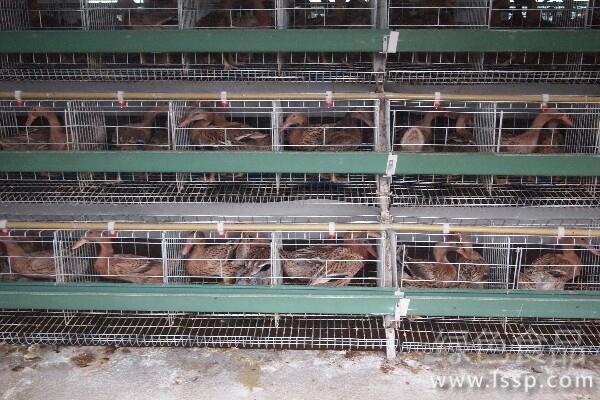
Cage-raised laying ducks
The specific approach is: careful feeding and management. First, do a good job in the four tasks of satiety, sufficiency, cleanliness, and quietness. So-called satiety means letting the laying ducks eat well and eat their fill. Generally, starting from 120 days of age, gradually switch to a complete-price compound feed for the laying period, gradually increase the nutritional concentration of the feed, and increase the number of feedings (4 times during the day, and 1 more feeding at 9—10 at night). Feed should be added appropriately, not too much, so as to avoid the residual feed becoming sour and spoiled, but also not too little, so as not to fail to meet the needs of the laying ducks. Sufficiency means the drinking water supply is adequate and clean. It is best to use nipple drinkers, which can both ensure the water supply and avoid waste caused by the feeding behavior of the laying ducks; plastic jar-type or trough-type drinkers can also be used, but the location should be appropriate. At the same time, the water troughs and feed troughs should be cleaned in time to ensure hygiene. Cleanliness refers to the duck house being hygienic and clean, and the duck tongues and other utensils should be cleaned and disinfected regularly. Quietness means keeping the duck house quiet and avoiding disturbance to the laying ducks. This is because when the laying ducks begin to lay, it is the beginning of a new stage, and they are excited, behave abnormally, are very sensitive to environmental changes, and are prone to flock panic, and once the laying ducks are startled, egg production will be affected. At the same time, pay attention to observing the dynamics of the laying ducks, discover problems at any time, and solve them at any time.
Look at egg shape: if the large end of the duck egg is on the small side, the ducks were not fed well in the morning; if the small end is on the small side, it is a lack of midday feed. Normal duck eggs have smooth, uniform, and thick shells. Sand holes or roughness, or even soft shells, indicate that the feed quality for the laying ducks is poor, especially a deficiency of calcium or vitamin D.
Look at laying time: the normal laying time for laying ducks is from 2 a.m. to 8 a.m. If laying is late, or even occurs during the day, or the time is not concentrated, it indicates that the feed quality for the laying ducks does not meet the requirements, and concentrated feed should be supplemented immediately.
Look at egg weight: the first-laid eggs of most breeds of laying ducks weigh about 40 grams. By 200 days of age, the duck egg weight can reach more than 90% of the standard egg weight for the breed, and by 230—250 days of age, it can reach the standard egg weight. In the early stage of laying, egg weight continues to increase, but the momentum of weight gain must not be too fast. Too fast indicates poor raising and improper management; find the cause and improve it.
Look at the laying rate: the laying rate of laying ducks in the early stage of laying continues to rise, and laying ducks that begin laying in early spring rise even faster, reaching the peak laying period of laying ducks by 200 days of age (no later than 230 days of age) (that is, a laying rate of about 90%). If the laying rate fluctuates greatly and shows a decline, then there is a problem.
Look at body weight: laying performance is also related to changes in the body weight of laying ducks, so it is very important to control body weight according to the growth pattern of laying ducks. After entering the laying period, the body weight of laying ducks is relatively stable, or may increase slightly. A large decrease or increase in the body weight of laying ducks indicates a problem with feeding. Within 201—300 days of age, the body weight of laying ducks should be sampled and measured once a month on an empty stomach. Each time weighing is done, random sampling should be used, and the number of laying ducks weighed should be more than 10% of the flock. Generally, at the start of laying, the body weight of laying ducks is required to be maintained at 1450 grams, with slight increases or decreases afterward, and not exceeding 1500 grams until culling ends.