Free-range chickens are more popular than feedlot chickens, and new techniques bring high returns in raising them
When raising free-range chickens with new scientific methods, the brooding survival rate can reach 95%, and within 50 days the chicks can reach 750 grams in body weight, with a mortality rate of only 2.5%. Raising free-range chickens with new techniques requires little investment but yields good returns.
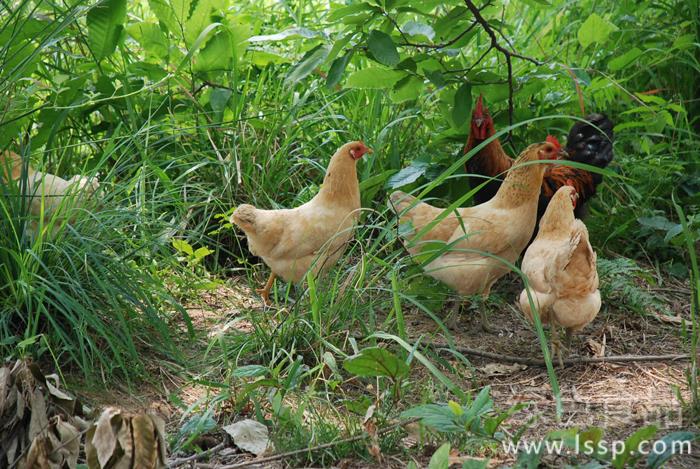
Free-range chickens
I. Select good breeding eggs and brood efficiently.
1. If there is dirt on the shell of a breeding egg, never wash it with water, as this lets bacteria invade. 2. Breeding eggs should be kept away from pesticides, chemical fertilizers and other strongly irritating items. 3. Store free-range chicken breeding eggs in a shady, ventilated place at a temperature below 23°C, with the large end facing up, and turn them once a day to prevent the eggshell from sticking to the yolk. During brooding, grasp 3 key techniques: (1) On the 1st day of brooding, maintain 24-hour light, 30°C-34°C and 70% humidity; starting from the second day, lower the brooding temperature by 1°C each day and reduce light by half an hour, while humidity stays unchanged. (2) The brooding density within 10 days of age is 35 chicks per square meter. The brooding room should be ventilated twice a day. The feed for free-range chicken chicks should be fine, with green vegetables and crushed insects being best. Feed at fixed times and in fixed amounts.
II. Raise them in pens and coops for healthy growth.
Using existing conditions, farmers can convert idle houses into free-range chicken coops, or build sheds, or enclose an area with fencing and netting. It is best to lay a layer of bamboo slats 10 cm off the floor in the chicken coop, with one long row placed on each side of the door. Regularly clean and disinfect the coop, ventilate it and replace the litter. The coop should have sufficient light, and clean drinking water should be supplied in adequate amounts, with routine disease prevention done well. The specific method is: subcutaneous injection of Marek's disease vaccine at 1-4 days of age, subcutaneous injection of Newcastle disease vaccine emulsion or Zhongyun No. 1 vaccine emulsion at 5-13 days of age, injection of infectious bursal disease vaccine at 14-35 days of age, and intramuscular injection of Zhongwei No. II vaccine at 55 days of age.
III. Mix feed for balanced nutrition.
Feed can be prepared according to local conditions. The percentages are: (1) Chicks: corn 45%, broken rice 18%, wheat 12%, soybean cake 20%, fish meal 3%, bone meal 2%, salt in an appropriate amount. (2) Adult chickens (over 45 days of age): corn 20%, broken rice 15%, wheat 10%, bean (bran) cake 30%, chopped green feed 20%, trace elements 3%, salt and baking soda 1%. Among these, fish meal and bone meal can be made at home: collect clam meat, livestock and poultry bones and so on, sun-dry them, bake them thoroughly and grind them into powder.
IV. Sell flexibly to increase returns.
The selling price of free-range chickens is much higher than that of feedlot chickens, so the key to increasing income from free-range chickens lies in selling them. Once free-range roosters reach 750 grams, their growth slows, and at this point they should all be sold. Whether to keep or sell hens should depend on the market price of free-range eggs, but weak and inferior hens should be sold promptly.