Succulent Watering Guide: How Often to Water and Whether to Soak Them Through
In recent years many people keep a pot of succulents such as cacti on their desk to relieve stress, but do you know how to water succulents correctly? Succulents do need water, but when watering you should use a sprayer to mist the surface of the growing medium. If too many water droplets are left on the leaves or the body of the plant, bacteria may multiply, or the leaves may be scorched by sunlight.
On the 6th, the Smart Agriculture Pavilion of the Taichung World Flora Exposition invited Cheng Chung-liang, manager of the Gu Yen Cho-yun Germplasm Conservation Center, to give a talk titled "Survival Warriors in Harsh Environments: Succulent Plants."
Cheng Chung-liang said that the definition of a succulent plant starts from a "morphological" angle. If a plant's vegetative organs, such as its stem or leaves, become specialized into a thickened form that can store water and survival resources, and thereby lives in a habitat with extreme climatic conditions, it can be defined as a succulent. However, although the leaves of a Phalaenopsis orchid are very thick, it is generally not included within the scope of succulents, and sweet potato, potato and the like are likewise not classified as members of the succulent group.
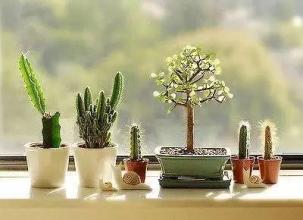
Cheng Chung-liang said that some types of succulents show an obvious phenomenon of "convergent evolution." So-called convergent evolution refers to two distantly related organisms that, because they live in similar environments, evolve in similar ways; for example, Euphorbia species such as Euphorbia obesa and Euphorbia candelabrum have thick fleshy stems similar to those of cacti. Generally, watering once every half month is best.
Cheng Chung-liang also said that at present the cactus family has about 1,750 species, of which about 1,600 species are succulents. Cactus family plants are distributed in southern North America and in Central and South America. Although Pereskia is a cactus family plant, it still retains unspecialized leaves, so it is not classified as a type of succulent either. As for how to distinguish a cactus? He said you can tell by the leaf spines and areoles unique to cactus family plants. Leaf spines are generally called "spines" and are specialized from leaves, while areoles are specialized from branches, and leaf spines always develop within the areoles.
Cheng Chung-liang said that in addition to the cactus family, succulents include, for example, Crassulaceae such as Echeveria and Kalanchoe, Aizoaceae such as ice plant and Lithops, Asphodelaceae such as aloe and Haworthia cooperi, Euphorbiaceae such as Euphorbia trigona, Euphorbia obesa and Euphorbia tirucalli, and Apocynaceae such as Stapelia and milkweed, all of which belong to the scope of succulents.
Cheng Chung-liang explained that for succulents surviving under extreme climatic conditions, their specialized traits include "specialization into fleshy stems and leaves, with a thick cuticle," which can avoid excessive evaporation of water and resist strong sunlight and wind; "waxy, fuzzy or spiny surfaces on stems and leaves," which can provide warmth and prevent dirt from settling; "specialized water-collection mechanisms," such as the areoles and leaf spines of "Golden Cap," which can intercept and absorb fog into their fleshy stems when fog appears at night; and "the habit of flowering in the rainy season," with flowering chosen in the rainy season to avoid excessive consumption of water resources.
Regarding the succulents that ordinary people often buy in the market, Cheng Chung-liang suggested that the growing medium for succulents should use a well-draining granular medium such as akadama soil, fine sand and small crushed grit, mixed with a small amount of potting soil, while for fertilizer a slow-release compound fertilizer can be used, placed on the surface of the medium. When watering, the medium should be misted to moisten it, and water should be added again after the surface of the medium has dried out completely. Do not let a large amount of water remain on the fleshy stems or fleshy leaves, otherwise bacteria may multiply, and water droplets may act as convex lenses concentrating sunlight on the leaf surface and scorch the leaves. Succulents need full sun, but should also be protected from prolonged rain.