Chicken diseases affect weight gain and egg production, folk remedies to help you
Add grit to chicken feed. Adding about 3% grit to chicken feed has the following benefits: it can improve the chicken's gizzard ability to grind feed; it can slow down the passage rate of food through the chicken's digestive tract; it can make digestive juices more easily enter the chyme, promoting better absorption of nutrients by the chicken, and can increase the weight gain rate of broilers and the egg production rate of laying hens. Choose grit that is not easily dissolved, silicon-containing or granite grit, with a grit size of 2 to 5 mm.
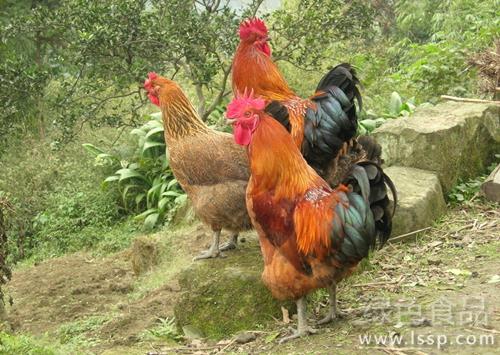
Chicken flock
What to do when chicks bathe? When chicks first enter the brooding room and drink from the drinker, a small number of chicks easily jump into the water to bathe, with all their feathers completely wet, especially in autumn and winter, which is more common. If not carefully managed, the chicks will get sick. Practice shows that this is caused by the water temperature in the drinker being higher than the brooding room temperature. How to stop chicks from bathing? The water temperature in the drinker can be adjusted to basically close to the brooding room temperature, but it must never be higher than or close to the chick's body temperature. In addition, the chicks that have bathed should be placed as close to a heat source as possible to dry their feathers warm, with careful management. In this way, the chick bathing phenomenon can be overcome in about 1 hour.
Chinese herbal medicine for treating summer-dampness cold in laying hens. Under high-temperature stress, laying hens have reduced resistance. If feeding and management are improper, invasion by summer-dampness external pathogens can easily cause colds.
Disinfection with chickens present requires stress prevention. 1. Within 12 hours before and after disinfection, give the flock drinking water containing 0.1% vitamin C or water-soluble multivitamin solution. 2. Choose disinfectants with low irritation, high efficiency and low toxicity, such as 0.02% Baidusha, 0.2% Kangduwei, etc. 3. Before spraying, the temperature inside the house should be 2°C~3°C higher than the specified standard, to prevent water evaporation from chilling the chickens. The disinfectant solution temperature should also be higher than the standard temperature inside the house. 4. When spraying, the droplets should be fine, and the spray volume should be just enough to make the chicken bodies and chicken cage wire mesh moist; do not spray too much. 5. Disinfection should preferably be done at night. For floor-raised chickens, carry it out when the lights are dimmed or turned off and the flock is quiet, to prevent daytime operations from startling the flock and causing flapping, flying and crowding.
Chinese herbal medicine therapy for broiler ascites: 30 grams each of mulberry white bark, Oriental waterplantain rhizome, dried tangerine peel, areca peel, akebia stem and plantain seed, 20 grams each of Polyporus umbellatus and cassia twig, 60 grams each of poria and astragalus, decocted in water for 100 chickens to take orally.
Chinese herbal medicine therapy for egg drop syndrome: 50 grams each of Coptis chinensis, Phellodendron amurense, Scutellaria baicalensis, honeysuckle flower, Isatis leaf, licorice and Isatis root, 30 grams each of airpotato yam and white airpotato yam, decocted in water to obtain 5 kg of medicinal juice, add 1 kg of white sugar, for 50 chickens to take, for 3 to 5 doses consecutively.
Chinese herbal medicine therapy for chicken gout: 50 grams each of Oriental waterplantain rhizome and poria, 30 grams of plantain seed, 80 grams each of Polygonum aviculare, talcum powder and Scutellaria baicalensis, 60 grams each of poria and plantain herb, 50 grams of Polyporus umbellatus, 40 grams each of bitter orange and Lygodium japonicum spore, 30 grams of fennel, 35 grams of licorice, decocted in water, mixed with brown sugar and fed with feed.