Key points for improving meat duck quality in cold winter: keep warm, prevent disease, increase light, prevent feather pecking
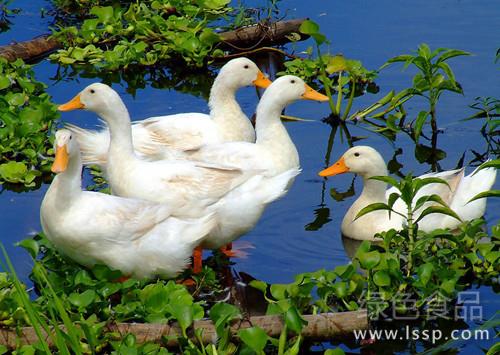
Duck
Do a good job of keeping ducklings warm and preventing disease:
Winter diseases often cause uneven growth in duck flocks, so the main task is to keep ducklings warm. For the first 3 days of the brooding period, the temperature must be kept above 30°C to ensure complete absorption of the yolk by the ducklings, which will reduce later farming problems. Ducklings need to adapt to temperature gradually; they must not be exposed to direct wind, and at night the shed temperature needs to be higher than during the day. If the duck house is sealed too tightly, the ammonia concentration inside will become too high, which instead makes respiratory diseases more likely. Colds are common in ducks in winter. Before ducks reach 20 days of age, each medication should include some cold-prevention drugs, then vaccination should be done well, and environmental hygiene and disinfection should be strengthened, which can reduce the occurrence of disease.
Make adjustments in all aspects to prevent feather pecking in ducks:
Winter weather is dry. In net-raised farming, feather pecking is obvious because wind cannot be blocked and blows directly onto the ducks, causing excessive stress and leading to feather pecking. Litter issues also have an effect. Practice has shown that feather pecking with sawdust litter is noticeably more common than with wood shavings litter. Effective ways to solve feather pecking: after switching entirely to floor rearing, open the duck house for ventilation during the day and put down windbreaks at night; using windbreak equipment well reduces stress and can effectively reduce feather pecking.
Strengthen management to reduce the occurrence of “bare-board ducks”:
For confined duck flocks in winter, guard against too little, too thin, too dirty, or too damp litter. Because the farm is damp and muddy, and the litter in the pens is too thin or absent, ducks sleep on cold ground or on overly wet and dirty manure litter, which not only affects weight gain but also makes the feathers on the breast and belly of ducks prone to falling off, causing the “bare-board duck” phenomenon. This lowers the appearance quality of meat ducks, affects sales and carcasses, and reduces duck-raising profits. Therefore, before entering ducklings, preparation work must be strict; when litter is insufficient, ducklings must not be allowed in under any circumstances. In the middle and later stages of rearing, manure should be cleaned promptly, and litter should be replaced and replenished so as to keep the site dry and hygienic; confined rearing sites should be designed with a certain slope to facilitate drainage; reduce stocking density so the duck flock has a dry, comfortable environment, improves its constitution, and stays healthy, which is the only way to achieve fast weight gain and good carcass meat quality.
Artificially increase light to prevent ducks from having “short feather growth”:
Because ducks have a short growth cycle in winter, if feather growth is too short, it will affect the time to market; if the rearing time is too long, costs will increase. Therefore, full effort must be put into feather growth of meat ducks in winter. Light, intensity, and trace elements are closely related to feather growth. In winter, natural light conditions are poor and the duration is short, causing slow feather growth in ducks. Therefore, duck raising in winter requires artificial supplemental lighting, using 24-hour lighting, and in winter the lights must be sufficient and uniform. Finally, after 20 days of age, feed trace elements that promote duck feather growth.