Raising Ducks in Confinement Can Save Labor: Key Management Techniques Explained
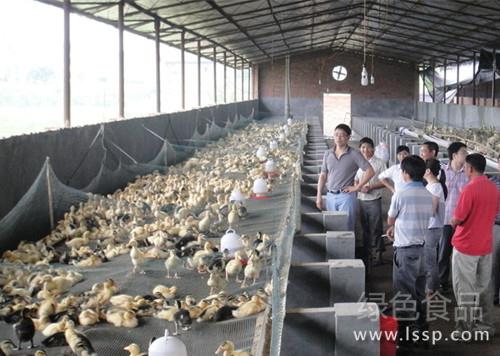
Duck Confinement Raising
1. Grouping and Density:
For confined rearing of young ducks, the scale can be large or small, but each duck group should preferably be around 500 birds. When grouping, try to keep them the same age, uniform in size, the same breed, and the same sex.
Stocking density varies with duck age, season, and temperature. Generally, follow this standard: 4-10 weeks of age, 12-20 birds per sq m; 11-20 weeks of age, 8-12 birds per sq m; in winter, a few more birds may be kept, and in summer, a few fewer. When ducks grow fast, keep the density lower; when ducks grow slowly, keep the density higher.
2: Feed for Confined Ducks:
Confinement raising differs from grazing, as there is basically no wild feed at all, and the ducks rely entirely on artificial feeding. Therefore, the nutrients needed during the growing period of young ducks, especially those needed for bone growth and feather growth, should all be met. The feed should be as varied as possible, maintaining a balance of energy and protein, so that sulfur-containing amino acids, multiple vitamins, and inorganic salts have sufficient sources.
During the rearing period, the dietary protein level for young ducks does not need to be too high, and the calcium content should also be appropriate. For example, for the egg-type Shaoxing duck, the normal age at first laying is 130-150 days, and the standard body weight at first laying is 1400-1500 grams. If the body weight exceeds 1500 grams, the duck is too fat, which affects timely onset of laying; feeding should be mildly restricted, and more green and coarse feed should be given appropriately. For ducks with poor development and low body weight, improve feed quality, feeding an average of about 150 grams per duck per day, plus a small amount of fresh animal-based feed, to promote growth.
For young duck feed, use only mixed mash, not single ingredients such as corn, rice, or wheat; they should be crushed and processed into mixed mash. Before feeding, add an appropriate amount of clean water and mix into a wet mash to feed raw. Feed only 3-4 times per day, with the intervals between feedings kept as equal as possible, to avoid uneven hunger and fullness when the ducks eat.
3. Key Management Points:
(1) Appropriately increase exercise to promote bone and muscle development and prevent excessive fatness. Every day, regularly drive the ducks to walk in circles inside the house, 5-10 minutes each time, 2-4 times per day. If there is suitable grazing ground near the duck house, short-distance grazing activities can be carried out at set times.
(2) Have more contact with the duck flock to increase the ducks' boldness and prevent flock panic. Young ducks are timid, especially egg-type breeds. During the young duck stage, take advantage of opportunities such as feeding, watering, and changing bedding to have more contact with the flock. For example, when feeding, stand nearby and observe feed intake, let the ducks move around you, and when a "delicate duck" quietly crouches beside you, you can stroke it with your hand; over time, the ducks will not fear people. Ducks are timid and prone to flock panic, which can cause serious losses.
(3) Keep lights on all night in the house for dim lighting. During the rearing period of young ducks, do not use strong lighting. The standard daily light duration is 8-10 hours, and it should not be increased before the onset of laying. If natural light is used, autumn ducks are the most suitable. However, to make it convenient for ducks to drink water at night and prevent flock panic caused by mice or birds and beasts moving around, dim lighting should be kept on all night. For example, a 30 sq m duck house can have one 1.5-watt bulb lit; in case of a power outage, a kerosene lamp with a glass chimney should be lit immediately. Duck flocks kept under dim all-night lighting for a long time often suffer severe flock panic when they encounter a dark environment, causing considerable casualties.
(4) Strengthen prevention of infectious diseases. Young ducks mainly have two infectious diseases: one is duck plague, and the other is cholera. Both diseases now have vaccines for prevention. Immunization schedule: inject avian cholera bacterin once at 60-70 days of age. Inject avian cholera bacterin once around 100 days of age, and inject attenuated duck plague vaccine once at 70-80 days of age. For laying ducks kept for only one year, one injection is enough; for laying ducks kept for more than two years, inject once more every other year. Preventive injections for duck plague and cholera must both be completed before the onset of laying. After entering the peak laying period, avoid injections as much as possible to prevent affecting egg production.
(5) Establish a stable daily routine. The living environment of confined ducks is stable, so according to the ducks' living habits, set fixed times for daily activities and formulate operating procedures. Once the routine is formed, try to keep it stable and do not change it often.