Rice Harvest and Fat Ducks: Key Technical Points of the Rice-Duck Symbiosis Model
The rice-duck symbiosis system is a composite ecosystem combining natural ecology and human intervention. Based on paddy fields, centered on rice cultivation, and characterized by free-range raising of domestic ducks, it can maximize the prevention of pollution in rice-growing areas, achieve sustainable rice cultivation and breeding, save cultivation and breeding costs, and produce pollution-free, high-quality rice and duck meat as a new ecological agricultural technology.
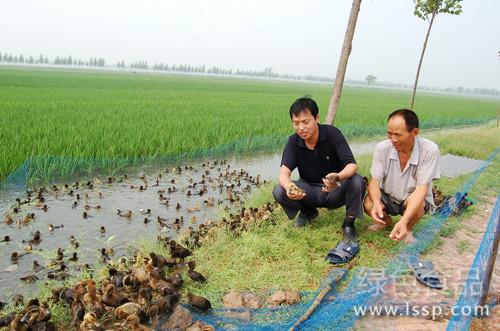
Rice-Duck Symbiosis
1. Field selection and construction. Polluted-free plots with abundant water sources, flat terrain and contiguous square shapes should be selected as rice-duck symbiosis areas. To allow the paddy field to hold water 10cm deep, all field ridges must be raised to 20cm and widened to 80-100cm, to facilitate ducks' resting and water retention.
2. Preparation of rice and duck seedlings. Select high-yield, high-quality rice varieties with large panicles, moderate plant height, upright plant type, strong tillering ability, resistance to rice blast and rice false smut, and a moderate maturity period that can avoid damage from the Asiatic rice borer and the yellow rice borer. Use dry seedling raising in fertile seedbeds to cultivate age-appropriate strong seedlings (seedling age about 30 days, leaf age 4-5 leaves). Select duck varieties that are small to medium in size, agile, with a relatively small feed intake, strong resistance to adverse conditions when roosting in the open, and wide adaptability. Such as Zhenduck No. 1, Zhenduck No. 2, etc. The duck incubation period is about 28 days, and 7-10-day-old ducklings are most suitable for release into paddy fields. Therefore, the hatching date of breeding eggs can be calculated by counting back 35 days from the rice transplanting date and the duck release date.
3. Feeding techniques for working ducks. After transplanting, as soon as the rice has revived, ducklings should be released on sunny days as early as possible, which can effectively eliminate weeds. In case of continuous rainy days, the duck release time can be appropriately postponed; if the ducks have completed water training, they can also be released on rainy days. Generally, 15-20 ducks are released per mu. For initial rice-duck symbiosis, a group of 80-100 ducks on 5 mu is suitable; for those with mature techniques, a group of 150-200 ducks on 10 mu is suitable. When releasing ducklings, it is best to release 3-4 young ducks aged 1-2 weeks in a group to play a leading role. Never release small ducklings into a flock of 1-2-week-old ducks, to avoid the ducklings being bullied. Before release, ducks must be injected with vaccines to prevent duck plague and other diseases. Ducklings released for about 10 days have poor foraging ability, so they should be supplemented morning and evening with easily digestible, nutrient-rich feed, and later gradually shift to mainly free foraging with appropriate supplementary feeding. About 20 days after the ducks are released into the paddy field, azolla previously propagated in another field is put into the rice field, forming a natural ecological system of rice, ducks and azolla. Ducks' natural enemies include hawks, crows, yellow weasels, snakes and other animals. Nylon filament nets can be used along the field ridges as barriers, or rivers, ponds and walls can also serve as barrier walls.
4. Rice cultivation techniques:
1. Transplanting techniques. Rice adopts a sparse planting method with wide rows and wide hill spacing, with a hill-row spacing of 30cm×30cm as suitable, planting 10,000-12,000 hills per mu, with 2-3 seedlings per hill and 50,000-60,000 basic seedlings, which is beneficial both for high rice yield and for ducks to move among the rice plants.
2. Biological control of diseases, insects and weeds. Pests among the rice plants are mainly preyed on by ducks, supplemented by high-efficiency biological pesticide control. The yellow rice borer can be trapped and killed with frequency-vibration insect-killing lamps, and general diseases and pests can be controlled with high-efficiency, low-toxicity and low-residue pesticides.
3. Water management. Both the water requirements of rice and the living habits of ducks must be considered. (1) Water management in the early stage of duck release. Before releasing ducks into the paddy field, the water layer must be adjusted well, with shallow water of 3-5cm as suitable. After transplanting, appropriately deeper irrigation is beneficial for the seedlings to revive. 5-7 days after transplanting, after the seedlings have turned green and revived, the water layer should be appropriately adjusted to facilitate duck release. (2) Water management during the duck release period. The muddy water formed by rice-duck symbiosis contains fertilizer, and drainage will lead to nutrient loss, so no drainage is done; only when the water layer in the paddy field decreases is some water appropriately added, with no more than 10cm as suitable. (3) Rice field drying techniques. The high-yield ditches in the main field should be dug deeper, and a 10cm-deep water layer should always be maintained in the ditches for ducks to bathe. Through the method of drying the field in sections, the ducks' needs for drinking water and foraging in the field are met, that is, a nylon filament net is stretched across one field, with one half of the paddy field maintaining a water layer, and the ducks are driven into it, while the other half is drained and dried; after drying, the field is irrigated, and the ducks are driven into this half of the paddy field, while the other half is drained and dried until the requirements are met. Or the ducks are driven to the rivers and ponds at the edge of the field for a transition of 3-4 days. In order not to affect the ducks' foraging among the rice plants, it is best to apply sufficient fertilizer at one time before transplanting rice, mainly decomposed long-acting organic fertilizer and compound fertilizer, and topdressing is replaced by duck excrement and decomposed azolla returned to the field to fertilize the soil.
4. Fertilization techniques. In principle, no chemical fertilizer is applied in rice-duck symbiosis; when soil fertility is insufficient, some organic fertilizer can be applied. To ensure that no chemical fertilizer, pesticide or herbicide is applied and to achieve strictly organic production, technical systems such as paddy-upland rotation, planting economic green manure crops, or implementing rice-duck-azolla symbiosis can be used for soil fertility and fertilizer.
5. Harvesting of mature ducks and rice. Once the ducks begin pecking at rice panicles, the duck flock must be driven out of the paddy field. After the rice matures, harvest at the appropriate time. Working ducks raised among the rice for about two months weigh 1.3-1.5 kg each. In double-cropping rice areas, female ducks can also be released into the late rice field to continue foraging and growing, with some feed supplemented morning and evening in feeding sheds at the field edge, and eggs laid in the feeding sheds at night.