High summer temperatures cause geese to lay soft-shelled eggs, how to prevent and treat this?
Summer is the late stage of egg laying for breeding geese, and combined with high temperatures, the quality of goose eggs and egg production both decline, and the probability of laying soft-shelled eggs increases, so how do you prevent and treat geese laying soft-shelled eggs?
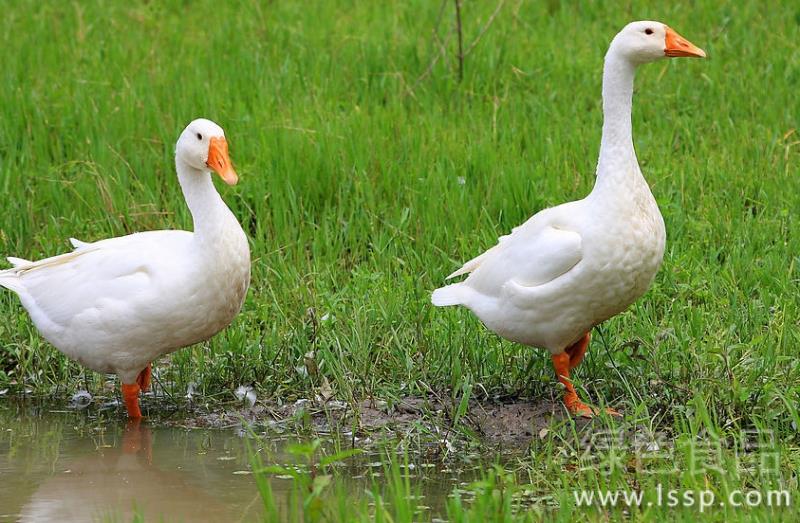
Geese
1. Trematodiasis
Geese lay thin-shelled eggs, soft-shelled eggs or deformed eggs, then become listless, stand motionless, lose appetite, the abdomen becomes distended, and they excrete eggshell fragments or a lime-like liquid flows from the body, and finally the body temperature rises, thirst increases, the cloaca protrudes, and death occurs 2 to 7 days after onset.
Prevention and treatment measures: (1) Strengthen prevention, conduct regular surveys of goose droppings, and upon finding eggs, immediately isolate and treat. (2) Goose droppings should be piled up and fermented so as to kill the eggs within them. (3) Use hexachloroethane (trematode remedy), 0.2 to 0.5 grams per goose, mixed into a small amount of concentrated feed and made into small pills for administration, once a day, for 3 consecutive days. (4) Administer carbon tetrachloride, and after an interval of 5 to 7 days, administer the drug once again (best to mix with an equal amount of liquid paraffin each time).
2. Lack of vitamin D or calcium and phosphorus in the feed.
A lack of vitamin D in the feed of female geese, especially vitamin D3, or insufficient calcium, an improper calcium-to-phosphorus ratio, or long periods of rainy and overcast days when geese cannot get sunlight, will all cause metabolic disorders in geese and they begin to lay thin-shelled eggs and soft-shelled eggs, after which egg production declines, and they may even stop laying entirely. Sick geese have weak legs, often squat on the ground, the beak becomes soft, pecking for food is difficult, growth is poor, and the joints swell.
Prevention and treatment measures: (1) Ordinarily add an appropriate amount of minerals to the geese's feed and provide sufficient green feed. (2) Expose them to more sunlight, with more than 6 hours of light per day. (3) Give the geese intramuscular injections of A and D. (4) Feed them cod liver oil, 1 to 2 times a day; to improve the therapeutic effect, vitamin D3 can be fed, 150,000 international units per goose each time. (5) Feed the geese waste sugar (molasses) made from sugarcane sugar crystals: when geese lay soft-shelled eggs, immediately mix 5% waste sugar into the geese's feed, or add 5 kg of waste sugar to every 50 kg of drinking water, dissolve it, and feed it to the laying geese; after 7 days, the geese lay eggs normally. This is because waste sugar, besides containing sugar, also contains vitamins, calcium, phosphorus and yeast, which can increase the geese's appetite, promptly supplement vitamin D, calcium and phosphorus, and also add sugar substances, meeting the geese's nutritional needs, while at the same time improving the geese's cold resistance and curing the geese's soft-shelled egg laying.