Summer meat geese easily lose weight - how to improve goose farming profitability
How to improve goose farming profitability in summer is a matter of great concern to the vast number of specialized goose farmers. Some specialized goose farmers have summarized the secrets of efficient summer goose farming, which not only brings high profits but also keeps costs low. The farming experience for efficient goose raising is introduced as follows:
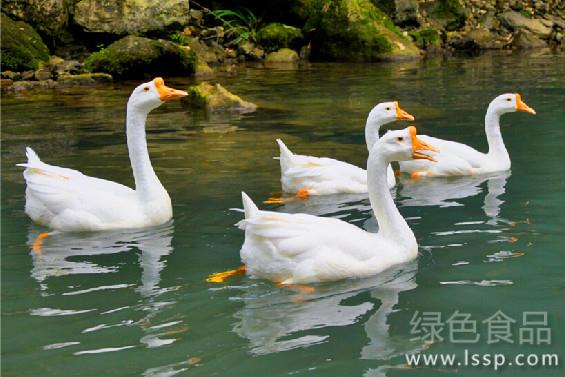
Meat geese
I. Prevent heatstroke and cool down, reduce stocking density.In summer the climate is hot, and the suitable stocking density for meat geese is 6-7 birds per sq m, with the goose house temperature kept below 26°C. For this purpose, cooling measures are needed: keep the goose house well ventilated, and spread a 1cm-thick layer of fine sand on the ground; at noon when the temperature is high, spray water mist over the goose house or the geese; avoid direct sunlight on the geese as much as possible.
II. Combine confinement with grazing, and supplement with concentrated feed appropriately.In summer, temperatures are low in the morning and evening, and the geese eat a lot, so graze them in places rich in water and grass. Grazing is best done before 9 a.m. and after 6 p.m., and the rest of the time they are kept in confinement with appropriate supplementary concentrated feed. This makes full use of forage resources and also meets the geese's growth needs. Two feed formulas that can make geese grow quickly are introduced here:
Formula One (%): corn 21, wheat bran 41, soybean 7, bone meal 1.5, fish meal 8, mixed bran 20, calcium powder 0.5, trace element additive 0.3, growth promoter 0.7.
Formula Two (%): broken rice 20, coarse bran 40, rice bran 25, soybean 5, fish meal 5, bone meal 1, shell powder 3, trace element additive 0.7, multivitamin 0.3.
When mixing feed according to the formula, the soybeans are best fried until cooked, then crushed and evenly mixed into the feed to improve utilization.
III. Fatten at the right time to shorten the growth cycle.Geese can be fattened at about 35 days of age. At this time, the geese's digestion, adaptability and resistance are enhanced, their bones, muscles and feathers grow quickly, and their nutritional needs are high; the volume of their digestive tract increases and they eat a lot. Therefore, fattening at this time can provide sufficient nutrition for the geese's rapid growth and shorten the growth cycle.
IV. Strictly prevent epidemics and reduce mortality.Strict epidemic prevention measures can provide favorable conditions for the growth and development of meat geese and ensure a high survival rate of the flock. First, do a good job of immunization against gosling plague; second, when the goslings reach about 1 month of age, give each goose an intramuscular injection of 1.5 milliliters of fowl cholera vaccine.
V. Keep clean and maintain good hygiene.To maintain hygiene, do the following: first, every evening, use bacterial and viral enemy to sterilize once; second, remove goose droppings promptly every day and concentrate them for fermentation; third, disinfect the rearing utensils once every 2-3 days.