Crayfish molting affects growth: how should the molting period be managed?
Strengthen the management of molting crayfish. Crayfish growth is achieved through molting, and molting is an important sign of crayfish growth, so good management of molting crayfish is very important. To make it easier to strengthen the management of molting crayfish, measures such as feeding and water changes should be used to promote concentrated molting of the crayfish population. When large numbers of crayfish are molting, feeding should be reduced and human disturbance should be minimized to promote smooth molting. After large numbers of crayfish have molted, high-quality feed should be added promptly, and cannibalism among crayfish caused by insufficient feed must be strictly prevented.
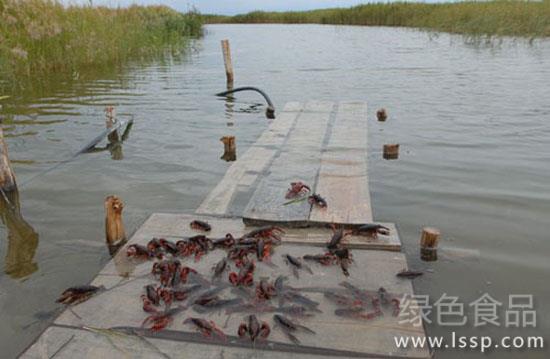
Crayfish farming
Apply additional topdressing. During the rearing period, additional topdressing should be applied at the appropriate time. One week after the shrimp fry are stocked, 100-150 kg of fermented livestock and poultry manure can be applied per mu to cultivate plankton for the shrimp fry to feed on. In the middle and later stages of rearing, additional topdressing should be applied at the appropriate time according to the transparency of the pond water, so that the water color is green or tea-brown and the transparency is 30-40 cm; the water quality should not be too fertile, otherwise it easily causes crayfish to suffer from oxygen deficiency and surface gasping. Generally, topdressing is applied once every half month, mainly with fermented organic manure, at 15-20 kg per mu. In summer, special attention should be paid to oxygen deficiency and surface gasping in crayfish, and observation is necessary.
Feeding molt hormone: during growth, crayfish need to absorb large amounts of mineral trace elements from the water body (especially the absorption of P is greater than the demand for other trace elements such as Ca, Fe, and Cu) to meet normal growth needs, and intensive farming methods often cause the content of mineral trace elements in feed and water to be seriously insufficient. Due to insufficient absorption of trace elements such as P and Ca, the crayfish shell cannot molt and harden, forming a soft shell or incomplete molting, and the growth rate slows down. Molt hormone, through scientific proportioning, contains the mineral trace elements needed for crayfish growth and can rapidly supplement and maintain the crayfish's demand for mineral trace elements.
The body surface of various aquatic crustaceans such as shrimp and crabs is wrapped in a shell of chitin and a calcified layer, and body growth must escape the restraint of the hard shell, so molting is one of their peculiar physiological characteristics. However, their bodies lack the hormones needed to synthesize molting, and under intensive farming conditions, molting hormone and its precursors must be added to the food they ingest. Molt hormone can meet the special needs of shrimp and crabs for molting hormone. Molt hormone can make shrimp and crabs molt immediately, accelerate the molting process, increase the survival rate and synchrony of molting, and achieve the goal of rapid growth. Molt hormone, also known as hard-shell hormone (cholecalciferol), contains multiple trace elements such as VA, VE, Vk3, Ca, Fe, P, and Mg. Usage: (1) Splashing: for 1 m water depth, 3-5 mu/bag (1 kg), once every 10-15 days; when soft shells or incomplete molting occur, once a day for 2-3 consecutive days; (2) Mixed with feed: when crayfish develop shell ulcers, use for 3-5 days, or use continuously for 10-15 days before leaving the pond, 1-2 kg/ton of feed.