Water Quality Deteriorates and Diseases Prevail in Summer: Pond Management and Fish Disease Prevention Methods
Summer temperatures are high, with large temperature differences between day and night, and a marked temperature difference between the upper and lower layers of pond water. Water quality changes quickly. Especially during prolonged high temperatures, fish in the pond suffer intensified stress reactions due to environmental changes, and their resistance declines, causing fish diseases to prevail. When raising fish in summer, pond management and fish disease prevention must be done well.
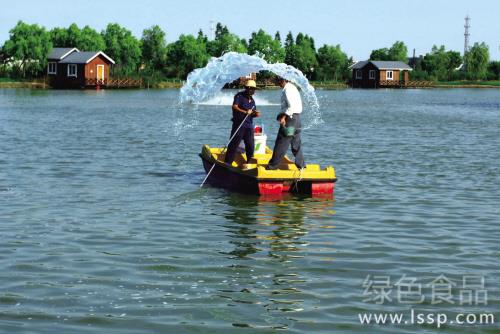
Pond Disinfection
1. Feed scientifically to strengthen fish resistance.
1. Increase the amount of feed and expand the feeding area to avoid large numbers of fish gathering in one place to feed; for ponds deeper than 2 m, reduce feeding time, with 20-30 minutes being appropriate.
2. Persist in feeding according to the “four fixed principles” of fixed quality, fixed quantity, fixed time and fixed location, ensure feed quality, and supplement fish with vitamins and trace elements to improve their resistance.
3. Often hang bags and baskets around the feeding area, using disinfectants such as copper sulfate and bleaching powder to prevent infection by pathogenic bacteria.
2. Regulate water quality and improve the farming environment.
1. Regularly add an appropriate amount of fresh water; generally add or change water once every 7-10 days, with each water change not exceeding 25 cm, keeping the water level at 1.5-2 m. When adding fresh water, avoid stirring up the bottom mud.
2. Frequently turn on the aerator to promote exchange between the upper and lower water layers or water circulation. Turn it on for 2-3 hours every day at noon.
3. Every 10-15 days, splash quicklime over the whole pond at a dose of 30-50 jin per mu to improve water quality; every 10-15 days, use microecological preparations such as photosynthetic bacteria and Bacillus to improve the microbial ecological environment of the farming water. After applying microecological preparations, try to avoid applying drugs.
3. Farming density must be scientific and reasonable.
Fish species should be stocked according to pond conditions, supporting facilities and technical level, and stocking should be as sparse as possible, or the method of catching the large and leaving the small should be adopted before the high-temperature season arrives. Do not use the method of seining the whole pond to catch fish. It is recommended to set up lift nets near the feeding platform to catch fish during the high-temperature season, catching the large and releasing the small. This not only reduces the farming capacity and increases the efficiency of capital flow, but also reduces the impact on fish bodies, water quality and pond ecology.