Feeding and Management Methods for Rapid Weight Gain During the Growing Period of Meat Ducks in Greenhouse Farming
After ducklings reach 3 weeks of age, they enter the growing period. During this time, the feathers of meat ducks have basically covered the whole body, and their cold resistance is enhanced, so except in cold seasons, no additional heating equipment is needed. In this period, the bones and muscles of meat ducks grow vigorously, the digestive function is already well developed, feed intake increases greatly, and body weight rises very quickly. In feeding and management, seize this characteristic to bring meat ducks quickly to market weight.
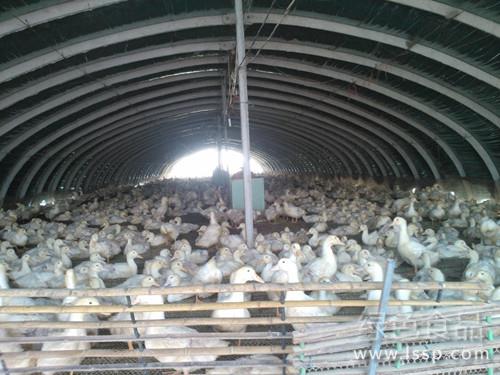
Greenhouse meat ducks
One: Feeding during the transition period:1. Temperature. Duck houses generally are not heated, but when the natural temperature differs from the room temperature at the end of brooding by more than 5 degrees C, it can cause diseases such as colds in meat ducks, so when transferring the flock in winter, the duck house should be properly warmed for the first few days.
2. Transfer on an empty stomach. Stop feeding 8 hours before transfer, and only move them out after the meat ducks have an empty stomach, but when feed is withheld, water must not be withheld.
3. Prevent stress. One day before transfer and 3 days after transfer, add multivitamins or anti-stress electrolytes to the feed to prevent stress in meat ducks during transfer, until the flock feeds normally after transfer.
Two: Changing feed:1. From 3—5 days before transfer into the growing house, gradually change the duckling feed to growing feed; it must not be too sudden, otherwise it easily causes digestive system disorders in meat ducks and affects their growth rate. To let meat ducks slowly adapt to the new feed, on the first day of feed changing mix 30% growing feed into the duckling feed, increase it to 60% on the second day, to 80% on the third day, and from the fourth day onward feed only growing feed.
2. During the growing period, meat ducks grow quickly and eat large amounts, and generally feed with low nutrient concentration can meet their needs, so the protein content of growing-period feed is about 16%.
Three: Adjusting stocking density:1. Meat ducks grow quickly and can reach more than 1300 grams at 21 days of age. To adapt to the rapid growth characteristics of meat ducks, the rearing space during the growing period must be increased, the unit stocking density reduced, and production efficiency improved; the specific method should be determined according to the rearing system. If floor rearing is used throughout the whole rearing period, the guard boards can be removed during the growing period and the stocking density directly adjusted to the level at market, that is, 5 or 6 birds per square meter. If net rearing is used throughout the whole rearing period, during the growing period directly adjust to 7-8 birds per square meter, or adjust the stocking density at any time according to the weekly age of the meat ducks. If net rearing is used during brooding and floor rearing during the growing period, because the rearing space suddenly increases and the floor structure changes, the meat ducks will run about excitedly and often sprain themselves and go lame. Sprained ducks, if not treated promptly, will be trampled crippled or killed by other meat ducks. Therefore, for meat ducks that have just come down to the floor, when adjusting the floor space there must be a process of change, first small and then large, letting them adapt to the environment before expanding the feeding space.
2. If sprained meat ducks are found, isolate them promptly and raise them separately, and after the injury recovers mix them back into the flock. When adjusting density, group the meat ducks by size and strength; weak ducks that are smaller in weight and slow in growth should be raised together in a concentrated way and given strengthened management, so that they quickly catch up with strong ducks of the same age and do not affect the sale date.
Four: Disease prevention and control:1. Do good disinfection work to prevent disease transmission. Pay attention to keeping good drainage and dry ground in the duck shed and exercise yard, clean up every day, change litter frequently, and often wash and scrub feed troughs and drinkers; when an infectious disease occurs, isolate sick ducks promptly, do not discard dead meat ducks randomly, and immediately disinfect contaminated areas. Commonly used disinfectants: quicklime, plant ash, lysol, caustic soda, No. 5 disinfectant solution, potassium permanganate, Baidusha, etc.
2. Pay attention to the condition of the meat ducks and detect illness early. At dawn, at noon, late at night, and between the two feedings are good times to inspect the flock. Healthy meat ducks have a strong constitution, are full of spirit, move actively, have tight and glossy feathers, bright and spirited eyes, clean eyelids, a strong appetite, normal droppings, and steady breathing.