How to grow Phalaenopsis from Taiwan, China? Pictures, cultivation techniques and price introduction
The Taiwan, China Phalaenopsis is a Phalaenopsis that grows in Taiwan, China, so it is called the Taiwan, China Phalaenopsis. The price of this Phalaenopsis is generally 70.00 yuan for a mixed half-jin; 140.00 yuan for a mixed one-jin of seeds. How do you grow it?
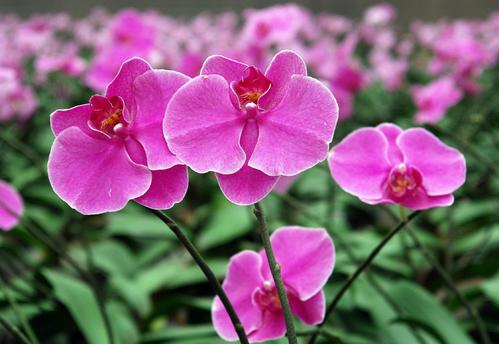
(1) Location: cultivate in a good orchid shed; if grown in an ordinary home, shading and rain-shelter equipment are needed. Strive for good ventilation, which can reduce the occurrence of diseases. Place crushed stone on the ground or store shallow water on top of it, and keep it in a moist state often to raise the air humidity.
(2) Sunlight: Phalaenopsis needs dimmer light than ordinary orchids, and direct strong light is not allowed. The orchid shed can use bamboo strips, wooden slats or shade netting to adjust the light: 70-80% shading in summer, 50-60% shading in spring and autumn, and 40-50% shading in winter.
(3) Temperature: the suitable temperature for Phalaenopsis growth is 20-30 °C. Above 35 °C in summer or below 10 °C in winter will make growth stop. Because its cold tolerance is rather poor, when a cold wave strikes in winter and the temperature is below 10 °C, heating must be added, and cold wind should be kept from blowing directly on the orchid plants, which would cause cold damage and leaf drop. Flower bud differentiation requires below 18 °C, and after differentiation the temperature must be raised to promote flowering.
(4) Humidity: Phalaenopsis likes air that is ventilated and high in humidity; the appropriate humidity is about 70%, and balcony cultivation must match this. Watering is best done in the morning during the day, so that the water can dry completely before night; leaves and leaf stalks should not retain water overnight, otherwise diseases are easily caused, and in winter cold damage and frostbite are also easily caused, even leaf drop. The above are the key points for cultivating Phalaenopsis, and special attention must be paid to them. When using tree fern boards, tree fern posts or wood blocks for planting, water will not accumulate on them, and frequent watering supplements the humidity.
(5) Planting utensils: plastic pots, unglazed clay pots, porcelain pots, tree fern pots, tree fern boards, tree fern posts, wood blocks and large tree trunks can all be used for planting. Seedlings and small plantlets can be planted using plastic baskets.
(6) Planting medium: medium and small plantlets can be grown entirely in sphagnum moss (water grass), or entirely in finer tree fern chips. When they become mature plants, materials such as polystyrene, tree fern chips, sphagnum moss, perlite, vermiculite, peat soil, artificial green-growing soil, charcoal and broken tile pieces are mixed and blended. For example, using 40% fine tree fern chips, 10% artificial green-growing soil, 20% peat soil, and 10% perlite or vermiculite, mixed and then planted, gives a good effect. If the surface of the planting medium grows moss or rots, it needs repotting and fresh medium. If tree fern boards, tree fern posts or wood blocks are used for planting, they will also decay after a long time, and new boards and fresh medium should be replaced; when choosing tree fern boards or tree fern blocks, they should not be too hard, as slightly loose ones are more favorable for growth.
(7) Planting method: the drainage material at the bottom of the pot is about half or more than half of the planting medium, and drainage must be kept unobstructed. Since the flowering period is mostly concentrated in spring, if repotting and changing the medium are needed, it must be done immediately after the flowers fade; otherwise it must pass through the hot summer, and wait until early autumn when it turns slightly cooler to repot.
(8) Fertilizer: apply a small amount of slow-release fertilizer into the planting medium in the pot. If tree fern boards are used for planting, it needs to be wrapped in gauze netting and hung near the upper part of the roots. Ordinarily, use 1500-2000 times diluted water-soluble quick-acting fertilizer and spray once every 10-15 days. Before young plants flower, the nitrogen fertilizer proportion should be somewhat higher. As they approach maturity, increase phosphorus and potassium fertilizer, especially for mature plants that have already flowered; after the flowers fade each year, supply fertilizer with a balanced three elements, and in autumn raise the phosphorus and potassium fertilizer again.
(9) Propagation: propagation methods can be divided into: sterile sowing method, growing point tissue culture method, and division method (some varieties can sprout and root on the flower stalk, and can be cut off and planted). In addition, grown plants will produce many aerial roots; the upper part with 2-3 aerial roots can be cut off and planted in another pot, and the remaining lower stem can, after a period of time, grow new shoots again and become a new plant. If the new plant grows another 2-3 aerial roots, divide and plant it again in spring.