How to prevent and control Rhizopus soft rot of lily bulbs
I. Symptoms of damage: During storage or transportation of lily bulbs, water-soaked spots initially form on the outer skin, which later darken in color and have a slightly pungent odor. The bulbs become soft, and in severe cases, destructive rotting of the bulbs occurs. Sometimes a thick layer of mycelium grows on the bulbs, which is the sporangiophores and sporangia of the pathogen. II. Morphological characteristics of the pathogen...
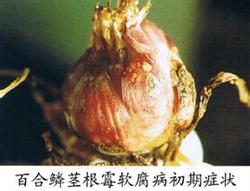
I. Symptoms of damage: During storage or transportation of lily bulbs, water-soaked spots initially form on the outer skin, which later darken in color and have a slightly pungent odor. The bulbs become soft, and in severe cases, destructive rotting of the bulbs occurs. Sometimes a thick layer of mycelium grows on the bulbs, which is the sporangiophores and sporangia of the pathogen.
II. Morphological characteristics of the pathogen: The pathogen is Rhizopus stolonifer (Ehr. ex Fr.) Vuill., known as stoloniferous Rhizopus (black bread mold), belonging to the phylum Zygomycota, fungi. The hyphae are initially colorless, later turning dark brown, forming stolons. The asexual stage produces sporangiophores clustered from the nodes of the stolons, erect, dark brown, each bearing a spherical sporangium at the tip, within which many dark-colored circular spores are produced, unicellular, 11-14 micrometers in size. From the nodes of the stolons, sporangiophores are again formed, causing many bulbs to be contaminated and producing patches of mold. The sexual stage produces black zygospores, spherical, with protrusions on the surface.
III. Disease characteristics: The fungus exists in the air or adheres to infested bulbs, soil attached to bulbs, and dead branches of packaging materials. The pathogen invades the outer skin of the bulbs through wounds, and the hyphae extend to the base of the bulb, then spread from there to other scales. Sporangial spores from diseased parts are transmitted by airflow for secondary infection. The optimal temperature for disease development is 15-25°C, with relative humidity of 76-86%. Under poorly ventilated conditions, the bulbs can completely rot within 2-4 days.
IV. Control methods: (1) When harvesting bulbs, make every effort to reduce wounds. During storage, maintain a cellar temperature of 8-10°C and relative humidity of 70-75%. (2) Bulbs of Oriental lilies can be placed in a 50% benomyl solution at 27-29°C (add 50g of benomyl per 4.6L of water) and soaked for 15-25 minutes, which can control stoloniferous Rhizopus as well as Penicillium, Fusarium, etc. Other varieties should be tested before use.