Control methods and technical key points for Lily symptomless virus
Lilies originate in China. They are distributed across the southeast and southwest, as well as Henan, Hebei, Shaanxi and Gansu, with wild and cultivated forms found in various places, mainly used as cut flowers and for garden planting as potted ornamentals. The bulbs are used for food and medicine, the fresh flowers contain aromatic oil used as a fragrance, and the fruits are eaten. A cold-hardy, autumn-planted scaly bulbous herbaceous flower. There are quite many cultivated varieties; besides white, the flowers also come in yellow, red, pale red, variegated and other colors.
Lilies originate in China. They are distributed across the southeast and southwest, as well as Henan, Hebei, Shaanxi and Gansu, with wild and cultivated forms found in various places, mainly used as cut flowers and for garden planting as potted ornamentals. The bulbs are used for food and medicine, the fresh flowers contain aromatic oil used as a fragrance, and the fruits are eaten. A cold-hardy, autumn-planted scaly bulbous herbaceous flower. There are quite many cultivated varieties; besides white, the flowers also come in yellow, red, pale red, variegated and other colors.
I. In the middle and late stages of growth, the bulb and stem roots are prone to root rot infection, showing bright dark-brown decay spots. Base rot easily occurs at the stem base of the plant, causing the leaves to droop and turn yellow; the leaves may also be infected by leaf spot disease, causing the plant to stop growing. In bulb and scale rot, the underground stem shows brown to dark-brown spots that gradually expand into the interior of the stem, causing the bulb to rot. There is also a damping-off disease, in which yellow-green or white spots appear on the young leaves of diseased plants, and in severe cases the leaves turn brown and curl.
Control: Damping-off is a physiological disease, while the other diseases are all caused by fungi. They can be controlled by drenching the roots with 50% carbendazim at 1 kg per mu, or by using it mixed with a 100-fold dilution of 50% amobam. Note that diseased plants should be pulled up immediately at the early stage of onset, and control measures taken at once.
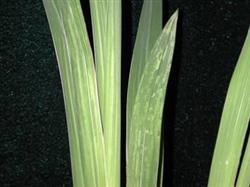
II. Lily symptomless virus, also known as lily virus or "lily curl-stripe virus." (1) Symptoms: generally asymptomatic, or producing mild mottling and crinkled stripes on the leaves. It readily forms complex infections; when combined with CMV it produces necrotic spots, and when co-infected with tulip breaking virus it produces brown necrotic spots or stripes. (2) Distribution: it occurs throughout the regions south and north of the Yangtze River in China, and is especially severe in Xiamen. (3) Pathogen: the virus particles are filamentous, long and slightly curved, with a length of 650 nm and a diameter of 18 nm. It is transmitted by sap and by aphids. Lilium longiflorum (Easter lily) serves as a diagnostic host. Lily bulbs sold on the market generally carry the virus. (4) Control: select virus-free bulbs as the propagation source. Strengthen aphid control efforts. Lily symptomless virus can also harm tulips, so these two ornamental flowers must not be mixed-planted, intercropped or grown in continuous cropping.
Lily seeds have an extremely short lifespan; after half a year of storage they lose their germination capacity, and seedlings grown from seed require many years of cultivation before they can flower. Therefore, cutting propagation is always used: the scales of old bulbs are broken off individually, and the base of each scale should carry a small portion of the stem base plate; they are buried in clean fine sand or mud slurry, with the upper half of the scale left exposed above the soil surface, and kept indoors or in a shade shed. After 3 to 4 months, 1 to 2 small bulbs can grow; these are broken off and planted in a seedbed for continued cultivation, potted up in spring, and after 3 years of cultivation they can flower.
After lily bulbs are dug up, low-temperature treatment and storage are essential to achieve year-round flowering. First keep them at 15°C for 4 to 5 days, then lower the temperature to 9°C for 3 weeks, then lower it again to 0°C to 5°C for 8 weeks, which completes the low-temperature vernalization stage, after which they can enter long-term storage at -2°C. Before storage, however, they must be graded, cleaned, disinfected and packaged. After digging, separate the large and small bulbs. Small bulbs that have already sprouted or grown new roots can be planted immediately; large bulbs that have grown new roots undergo low-temperature storage.