How to prevent and control pests and diseases of Agapanthus (lily of the Nile)?
Also called love flower, the name Agapanthus comes from the Greek words agapé (god of love) and anthos (god of flowers), but in reality, the reason this flower is called the "flower of love" is a distant, forgotten mystery. In 1788, L'Heritier established the genus Agapanthus. It was once classified in the Liliaceae family, and was subsequently classified in...
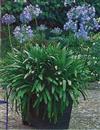
Also called love flower, the name Agapanthus comes from the Greek words agapé (god of love) and anthos (god of flowers), but in reality, the reason this flower is called the "flower of love" is a distant, forgotten mystery.
In 1788, L'Heritier established the genus Agapanthus. It was once classified in the Liliaceae family, then in the Amaryllidaceae family, and later in the Alliaceae family. Afterwards it was returned to the Amaryllidaceae family, and until now it has simply been placed in its own family, Agapanthaceae. In 1679 the name first published in Europe was African narcissus; Linnaeus began to propose the name African lily, and to this day Europe and America still use this name. In South Africa it is called Agapanthus or blue lily.
Growth cycle:
Agapanthus is generally divided into two major categories: evergreen types and deciduous types. Deciduous agapanthus begins growing with the first rain of spring, then grows rapidly, and blooms by midsummer.
Evergreen agapanthus sheds some of its old outer leaves each year and grows new leaves. Evergreen types have a very long flowering period, blooming in late spring or early summer, with midsummer being the main flowering season. In autumn they begin to set seed. In regions where summer is the rainy season, these seeds begin to develop and grow after the first spring rain.
Agapanthus generally grows in regions where summer or the whole year is the rainy season, where the growing soil is rich in humus, and in sunny areas with some shade.
According to the trial results of introduction and cultivation by the Shanghai Institute of Landscape Science, in the Shanghai area the basic growth cycle from sowing seed to flowering is about 18-24 months.
Pest and disease prevention and control methods
Compared with other bulbous plants, agapanthus is a variety rarely threatened by pests and diseases. It is worth noting that its leaves and flowers are sometimes damaged by pests and diseases.
Pests
1. Red spider mite: extremely small in size, red. In a high-temperature, dry environment it reproduces very quickly, and can produce 7-14 generations per year. It likes to spin webs on the plant and suck sap beneath the webs, causing the affected leaves to turn yellow and wither, affecting the flower's growth, and may even lead to the death of the whole plant.
Control method when a large number of pests appear: spray thoroughly with propargite (such as Omite) or dicofol (such as Kelthane); you can also use a 1200x-1500x dilution of dichlorvos emulsifiable concentrate and omethoate, or spray the whole plant with a 1000x dilution of deltamethrin; the pest control effect is significant in all cases
2. Thrips (pasture thrips)
Thrips are very tiny insects, smaller than a small ant; the adult body length is 1.2-1.4 mm, and the body color is black or dark brown. Six legs, one pair of antennae, two pairs of feathery wings, active and good at flying; when you pinch them with your fingers, they vanish in an instant. Thrips feed on host sap with piercing-sucking mouthparts. They are mostly inside the heart leaves, tender buds and flower buds, gathering in groups to cause damage, which can cause deformation or develop into disease.
Thrips are small in size and easy to kill with chemicals. Insecticides such as dimethoate, dichlorvos, pyrethroids, and organophosphorus compounds all have very good killing effects on thrips. However, thrips live inside flower buds and leaf axils, and these places are often dead corners for spraying, so attention should be paid to these dead corners when spraying. When choosing pesticides, it is best to choose those with systemic and fumigant action, for a better effect.
3. Mealybugs
The body surface of mealybugs is covered with white waxy powder, and many species have waxy filaments of varying lengths around the edge of the body, which can serve as a basis for identifying species. They parasitize on leaves and can cause deformation or develop into disease. For control, chlorpyrifos can be sprayed thoroughly; for potted plants, the soil can be soaked.
4. Snails
Although snails rarely directly harm agapanthus, they easily spread diseases among the plants, especially in evergreen variety plants. The removal methods are, first, hand-picking, and second, keeping a few ducks and using natural enemies to kill them.
5. Mosquitoes and flies
The pale yellow larvae of mosquitoes and flies hide in the flower buds of agapanthus, causing the flowers to become deformed and triggering disease, so preventive pesticide spraying with fenthion is very necessary, and the timing must be after bud formation and before flowering.
Diseases
1. Leaf mold
Leaf mold is also called red spot disease. It mainly harms leaves, and also harms branches, petioles, sepals, petals, fruits and seeds. In the early stage of the disease, nearly circular purplish-brown spots appear on the leaves, 1-5 mm in diameter, which later expand into irregular large spots, 7-12 mm in diameter, with a pale yellowish-brown center and purplish-brown edges; the lesions have obvious concentric rings. The lesions expand and connect into patches, and in severe cases the entire leaf scorches and withers. When moist, the surface of the lesions produces a dark green mold-like substance, namely the pathogen's conidiophores and conidia. When the disease occurs at the leaf edge, the leaf becomes somewhat distorted. On green stems they appear as purplish-brown oblong small dots, somewhat raised, with the lesions expanding slowly, only 3-5 mm in size. The symptoms on the petiole are similar to the lesions on the stem, but are elongated strips, which also bear a dark green mold-like substance.
Control methods
① Promptly remove diseased leaves and branches, burn them in a centralized manner or bury them deep more than 15 cm below the soil, to reduce the source of pathogens for the first invasion in early spring of the following year.
② Strengthen management; planting should not be too dense; keep the plants well ventilated and exposed to light.
③ In the early stage of the disease, spray 40% carbendazim wettable powder at 600x dilution, or 50% thiophanate-methyl at 800x dilution, once every 10-15 days, for a total of 3-4 sprays, or spray thoroughly with iprodione or mancozeb.
2. Black spot
Leaves, petioles, young shoots and pedicels can all be affected, but it mainly harms leaves. There are two types of symptoms: one is that in the early stage of the disease, reddish-brown to purplish-brown small spots appear on the leaf surface, gradually expanding into circular or irregular dark black lesions, often with a yellow halo around the lesions, with radiating edges; the lesion diameter is about 3-15 mm. In the later stage, scattered black small granular dots appear on the lesions, namely the pathogen's acervuli. In severe cases, the lower leaves of the plant turn yellow and wither, leaves fall early, and individual branches die. The other type is that brown to dark brown nearly circular or irregular concentric-ring spots appear on the leaves, on which black mold-like substance grows, namely the pathogen's conidia. In severe cases, the leaves fall early, affecting growth.
Control methods:
① After autumn, remove dead branches and fallen leaves, and burn them promptly.
② Strengthen cultivation management, pay attention to shaping and pruning, and ensure ventilation and light.
③ When new leaves unfold, spray 50% carbendazim wettable powder at 500-1000x dilution, or 75% chlorothalonil at 500x dilution, or 80% mancozeb at 500x dilution, once every 7-10 days, for 3-4 consecutive sprays.