Detailed Guide to High-Yield Cultivation Techniques for Edible Lilies
Lilies are a cross-year crop. After planting in the autumn of the first year, they do not break through the soil and emerge until the following spring, spending nearly half a year developing and growing underground in the meantime. To achieve high yields, the following technical steps should be grasped in cultivation: 1. Select suitable improved varieties. Lilies are divided into two major categories, edible and medicinal, with more than 10 varieties in total. Edible...
Lilies are a cross-year crop. After planting in the autumn of the first year, they do not break through the soil and emerge until the following spring, spending nearly half a year developing and growing underground in the meantime. To achieve high yields, the following technical steps should be grasped in cultivation:
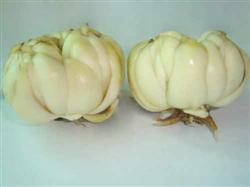
1. Select suitable improved varieties. Lilies are divided into two major categories, edible and medicinal, with more than 10 varieties in total. Among edible lilies, Longya lily (Lilium brownii var. viridulum) is the best in quality; this variety has large, plump scales shaped like dragon teeth, is pure white and tender, has no bitter taste, commands a high price, and sells well. Medicinal lilies generally have small scales, low yields, and a strongly bitter taste, and can only be used as medicine. Therefore, when introducing edible lily planting stock, be sure to select bulbs that are white in color, large in scale, free of speckles, and free of bitterness. Lilies have a low propagation rate and a high seeding rate, requiring about 150 to 200 kg of bulbs per mu.
2. Choose suitable soil. Lilies should not be continuously cropped or rotated with onions and garlic crops; the previous crop is best as a legume or grass-family crop. Before planting, plow the soil deeper than 25 cm, apply 2500 to 3000 kg of decomposed organic fertilizer and 25 kg of superphosphate per mu as base fertilizer, and at the same time plow 0.6 kg of 50% diazinon into the soil for soil disinfection. After finely raking level, make high beds or flat beds, with a bed width of 2 m and a ditch depth of 30 cm.
3. Sow at the right time. Lily seed is the lily's bulb, also called the seed bulb. Lilies are best sown in October. Before sowing, soak the bulbs in 2% formalin solution for 15 minutes, take them out and dry them, then sow. The row spacing is 25 cm, the plant spacing is 15 cm, and the depth is 10 cm. After sowing, cover with rice straw or leaves to retain moisture.
4. Field management. After planting, when seedlings emerge the following March, cultivate 1 to 2 times, and promptly earth up any exposed lilies. Before the Beginning of Spring, when the seedlings have not yet emerged, apply 1 heavy fertilization, with 1000 to 1500 kg of human urine per mu. After the lilies emerge, do not deep-cultivate or weed again, so as to avoid damaging the root system. When the seedlings are 3 to 5 cm tall, cover the ground with about 500 kg of rice straw per mu. When the seedlings are 20 cm tall, apply 1 seedling-promoting fertilizer, with 10 to 12 kg of urea and 7.5 to 10 kg of potassium fertilizer per mu. When the seedlings are about 30 to 35 cm tall, promptly top and pinch off the growing tips, concentrating nutrients for transport to the bulbs. In early July, spray with 10 packets of high-grade compound fertilizer mixed with 50 kg of water to prevent premature aging. Lilies are afraid of waterlogging; in rainy seasons and after heavy rain, promptly clear the ditch system to drain waterlogging and reduce water accumulation. For leaf spot disease and bulb rot, spray with 65% mancozeb 500-fold solution for control, spraying once every 7 days for 3 to 4 consecutive sprays. For aphids, spray with 40% dimethoate emulsifiable concentrate 1000-fold solution for control; for root maggots, use 90% trichlorfon mixed with water to drench the roots.
5. Intercropping. The lily growing period lasts nearly 1 year, so rational intercropping should be used. In winter, radishes, green vegetables, and the like can be intercropped; in May of the following year, intercropping watermelons or sweet potatoes helps loosen the soil, reduce damage from white grubs, and promote lily bulking.
6. Harvest at the right time. After the Beginning of Autumn, when the lily stems turn yellow and die and the flowers fall off, it is the suitable harvest period. At this time the bulbs are fully developed, the yield is high, and they store well. Harvesting should be done on sunny days. After digging out the bulbs, cut off the aboveground parts and immediately transport them indoors to be buried and stored in clean river sand, to prevent discoloration and shriveling, which would affect economic returns.