How to prevent and control chrysanthemum white rust? A detailed guide to practical control techniques
Chrysanthemums are loved for their elegant, bright colors and rich fragrance. Growing flowers can cultivate people's character, enrich cultural life, and improve physical and mental health. At the same time, some varieties of chrysanthemums grown can also be eaten or used as medicine, achieving two benefits at once. However, in the process of cultivating and propagating chrysanthemums, they often suffer from a variety of diseases...
Chrysanthemums are loved for their elegant, bright colors and rich fragrance. Growing flowers can cultivate people's character, enrich cultural life, and improve physical and mental health. At the same time, some varieties of chrysanthemums grown can also be eaten or used as medicine, achieving two benefits at once. However, in the process of cultivating and propagating chrysanthemums, they often suffer from the attack of a variety of diseases and pests, causing abnormal morphology, incomplete or withered branches and leaves, or even plant death, thereby reducing the ornamental and medicinal value of the flowers and causing relatively large economic losses. In order to ensure that chrysanthemums can grow normally and develop robustly during cultivation, bloom beautiful flowers, and safeguard their medicinal value, it is necessary to strengthen the prevention and control of diseases and pests.
In prevention and control, the principle of prevention first and integrated management should be followed. That is, on the one hand, according to the different habits of the chrysanthemums being grown and the local climate and geographical conditions, select suitable varieties for cultivation, promptly grasp the period when white rust occurs, and before the disease causes harm or before it causes obvious harm, adopt different control methods according to the occurrence, harm characteristics, and epidemic patterns of white rust, and take effective protective measures according to the specific local conditions at the time, adapting measures to local conditions; on the other hand, prevent the spread and expansion of the disease as much as possible. Integrated management is not a simple arrangement and piecing together of various control methods, but should coordinate various methods, draw on each other's strengths to offset weaknesses, and cooperate with one another to form a relatively complete and organically combined control system.
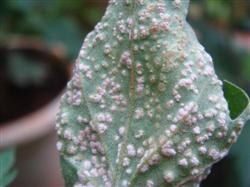
1. Symptoms. First, very small discolored white spots appear on the underside of infected leaves, then they bulge into grayish-white pustule-like protrusions, and the waxy powder gradually turns light brown. On the upper side of the leaf, there are pale yellow spots with slight sunken areas, ranging from pale yellow to yellow-green. When the disease is severe, the entire leaf is covered with diseased spots, causing the leaves to die early.
2. Pathogen. The pathogen of white rust is the teliospore pile of Puccinia horiana, which grows on the underside of leaves, is protruding, grayish-white to light yellowish-brown, 2-5 micrometers in diameter; teliospores are long ellipsoidal (30-52) x (11-17) micrometers, yellowish-brown, two-celled, with rounded or pointed apex, and a colorless or pale yellow pedicel.
3. Occurrence pattern: The pathogen overwinters as teliospores on diseased dead leaves of infected plants. In the second spring, they are released to produce basidiospores, which spread with airflow and infect leaves. The germination and infection temperature of urediniospores is 16-27°C. Below 6°C or above 31°C, infection cannot occur. A water film on the leaf surface is a necessary condition for spore germination. In Xishuangbanna, Yunnan, winter temperatures are exactly 10-25°C, and this disease almost has no phenomenon of overwintering as teliospores, so it occurs and causes harm through suitable urediniospore germination and infection. In open-field cultivation, the disease is severe on cloudy days and in rainy weather. In greenhouses, excessive humidity makes plants susceptible to the disease, and if control is not timely, it spreads and causes harm rapidly.
4. Control methods
1. Cultivation-based disease prevention: remove diseased plant residues, choose fertile and deep soil for planting, keep the aboveground parts of the plants frequently dry, and it is not advisable to spray water from above the plants. Strengthen management in greenhouses, pay attention to ventilation. Ensure light transmission and avoid dense planting, control water and fertilizer, and do not make the soil too moist.
2. Chemical control. (1) When transplanting seedlings, disinfect the soil properly, or when transplanting, combine with watering the root-setting water and drench once with a 500-fold dilution of 70% Heijingqing. (2) In the early stage of disease, spray with a 1000-fold dilution of 15% triadimefon wettable powder, or spray with a 600-fold dilution of 49% Jintian No. 9. In severe cases, apply once more at an interval of 7-10 days, or spray with a 200-fold dilution of 20% triadimefon for control, spraying once every 10 days. Because continuous multiple use of triadimefon or too high a concentration can cause phytotoxicity, shortening the internodes of chrysanthemum plants, causing leaf deformity and thickening, smaller flowers, and burning to death, the above two chemicals can be used alternately.