What are the control methods for sclerotinia rot of chrysanthemum?
1. Damage symptoms: Water-soaked lesions first appear on the middle and lower parts of the stem, later turning grayish white; under moist conditions, the diseased part becomes soft and rots, with a white mold layer on the surface; in the later stage, the cortex of the diseased stem rots into a shredded, split appearance, with mouse-dropping-shaped black sclerotia formed inside, and sometimes sclerotia also form on the stem surface. 2. Morphological characteristics of the pathogen: The pathogen is a fungus of the phylum Ascomycota...
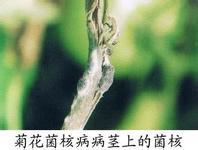
1. Damage symptoms: Water-soaked lesions first appear on the middle and lower parts of the stem, later turning grayish white; under moist conditions, the diseased part becomes soft and rots, with a white mold layer on the surface; in the later stage, the cortex of the diseased stem rots into a shredded, split appearance, with mouse-dropping-shaped black sclerotia formed inside, and sometimes sclerotia also form on the stem surface.
2. Morphological characteristics of the pathogen: The pathogen is a fungus of the phylum Ascomycota (Sclerotinia sclerotiorum (Lib.) de Bary). The sclerotia produced on the diseased parts are oval to irregular in shape, initially white, later turning black on the outside, measuring 2-5 x 1-3 (mm). On PDA, the colony is white, felty, with flat, rough mycelium and rapid growth. The hyphae are colorless, branched, and produce conidiophores; at the tips of the conidiophores or their branches, small phialides are irregularly clustered, densely bearing tiny colorless single-celled conidia, measuring only 1.5-3 x 1-2 (micrometers). After one week, large irregular sclerotia gradually form, initially white and later black on the outer layer.
3. Disease characteristics: The fungus overwinters as sclerotia in the soil, on diseased plant residues, or mixed in compost. Under suitable conditions, the overwintering sclerotia germinate to produce apothecia; after the asci mature, the spores in the asci are discharged when air humidity changes, spread by wind, and infect surrounding plants. In addition, sclerotia sometimes directly produce hyphae; the hyphae on diseased plants have strong infectivity, and the hyphae develop rapidly, causing the diseased parts to rot. When nutrients are consumed to a certain extent, sclerotia are produced, and the sclerotia germinate without dormancy. The disease occurs under cooler and moist conditions, with a suitable temperature of 5-20°C and an optimum of 15°C. Ascospores can germinate at 0-35°C, most favorably at 5-10°C. Hyphae can grow at 0-30°C, with an optimum of 20°C. The temperature for sclerotium formation is consistent with the temperature required for hyphal growth; sclerotia are killed after 5 minutes at 50°C. The pathogen has strict humidity requirements: in moist soil, sclerotia survive only 1 year; in soil with long-term water accumulation, they die within 1 month. In dry soil, they can survive more than 3 years but are not easy to germinate. Sclerotium germination requires high humidity and cool conditions; after germination, the development of the asci requires sufficient moisture for 10 consecutive days. At a relative humidity of 70%, ascospores can survive 21 days; at a relative humidity of 100%, they survive only 5 days. In Guangdong, it occurs from October to December and causes relatively severe damage.
4. Control methods: In the early stage of the disease, spray 40% carbendazim-sulfur suspension concentrate at 600-700 times dilution, or 70% thiophanate-methyl wettable powder at 500-600 times dilution, 50% mixed sulfur suspension concentrate at 600 times dilution, 80% carbendazim wettable powder at 600-700 times dilution, or 35% junheguang suspension concentrate at 600-800 times dilution, once every 7-10 days, for 2-3 consecutive applications.