How to Grow Potted Dwarf Pomegranate? A Complete Guide to Cultivation Key Points
1.1 Cutting period. The local area is in the Yangtze River Basin, and rose cultivation is mostly carried out in spring and autumn. In spring, it starts in late April and ends at the end of May. In autumn, it starts in late August and ends at the end of October. Cuttings taken in autumn cannot be repotted in the same year, as the young roots are not well developed and their cold resistance is poor, so winter freeze protection must be done well. 1.2 Potting soil...
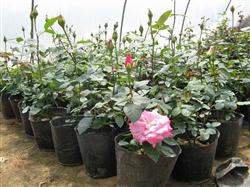 Dwarf pomegranate is a precious potted variety in the pomegranate family. Its plant height is only 50-70 cm, yet it has luxuriant branches and leaves and many large fruits. Moreover, as long as the winter temperature can be kept above 5°C, it will bloom every day and bear fruit every month almost all year round, with flowers and fruits covering the tree, making it very beautiful. Its flowers are red as fire and gorgeously charming, and its fruit has a rich flavor, being both sweet and sour, combining ornamental and edible value, and is deeply welcomed by people.
1. Sowing time. Seeds can be used for propagation in spring, summer, and autumn. Seedling cultivation in early spring and late autumn should be carried out in a greenhouse. Whether raising seedlings in the open field or in a greenhouse, the seedbed temperature must be kept no higher than 25°C during the day and no lower than 18°C at night.
2. Sowing method. The seed coat of dwarf pomegranate is hard, so before sowing the seeds must be soaked in clean warm water below 40°C for one day. After the seeds are sown, cover them lightly with fine soil. Before emergence, the seedbed must be kept moist and must not alternate between dry and wet. In summer, when the temperature is high, the seedbed is prone to drying out and crusting. After sowing, in addition to keeping the seedbed moist, a shade shed should also be built to avoid scorching sun exposure and heavy rain washing. After sowing, seedlings generally emerge gradually in about half a month.
3. Transplanting management. The emerged seedlings of dwarf pomegranate have a pair of green round cotyledons, and the seedling stem is pink. When the seedlings grow to 15 cm, they can be transplanted with soil into flower pots. Generally, a flower pot with a 20 cm diameter is used, with one plant per pot. For the potting soil, use well-drained fertile vegetable garden soil mixed with a small amount of decomposed cake fertilizer. When the seedlings are 15 cm tall, pinch off the tips to promote branching, making the tree shape short, full, and leafy, and improving its ornamental value. For those sown in early spring, they generally bloom in June-July of the same year and bear fruit in autumn. For dwarf pomegranates over three years old, with a plant height of 30-40 cm, each plant can simultaneously open nearly a hundred fiery red flowers and bear dozens of fruits, with a single fruit weight of 70-80 g, and large fruits can reach 200 g, with flowers and fruits on the same tree and lasting a long time without falling. The optimal growth temperature for dwarf pomegranate is 25°C, and it can tolerate low temperatures of about 5°C. After autumn, it can still bloom under light frost, and only sheds leaves and enters dormancy under heavy frost. Dwarf pomegranate likes warmth and plenty of sunlight. In the south, it can overwinter naturally outdoors, while in the north the flower pot should be moved into a greenhouse for the winter. If cold protection and heat preservation measures can be taken, red flowers and fresh fruits can still be enjoyed all over the tree in winter.