How to treat rose black spot? Solve it easily with these few tricks
Black spot is one of the most common and devastating diseases in many regions. It mainly infects leaves, but also infects young shoots, petioles, flowers, pedicels, flower buds and flowers. The disease spots on young shoots are initially oblong, dark purplish red, and slightly sunken. The spots on the pedicels are smaller. When the temperature rises to around 25°C and the air humidity approaches...
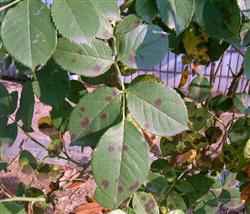
Black spot is one of the most common and devastating diseases in many regions. It mainly infects leaves, but also infects young shoots, petioles, flowers, pedicels, flower buds and flowers. The disease spots on young shoots are initially oblong, dark purplish red, and slightly sunken. The spots on the pedicels are smaller. When the temperature rises to around 25°C and the air humidity approaches saturation in sweltering weather, the disease is most severe; in rainy seasons the disease spreads fastest and infection is also severe, with August and September being the peak period. In addition, planting plants too densely or having poorly ventilated sites are also major causes of this disease.
Black spot control is generally based on prevention, combined with treatment. First, choose varieties with strong resistance; second, improve the cultivation environment. The cultivation site should have air circulation and sufficient light, ensuring at least 6 hours of light per day. The growing soil should be permeable; poor, compacted, and saline-alkaline soils cannot grow roses well; third, clear fallen leaves, dead branches, weeds, and waste from the garden and burn them in a centralized way to reduce sources of infection. At the same time, once diseased leaves are found, cut them off immediately. Do not casually touch the leaves of diseased plants with your hands, to prevent human spread.
There are many chemicals for controlling black spot. In early spring, use 1% asomate to disinfect the soil. Before the disease occurs, use a 75% chlorothalonil 1000-fold solution for spraying, once every 2 weeks, until the spread is brought under control. An 800-fold 70% thiophanate-methyl solution can also be used for sterilization. When the disease occurs, spray an 800-fold 50% carbendazim solution; this chemical resists rain washing.
Practice has proven that using the traditional Bordeaux mixture to control rose black spot is still an effective method. This is because in the humid weather when roses develop the disease, this chemical has strong adhesion and can form a film on the leaf surface, thereby effectively killing the pathogen. The efficacy of Bordeaux mixture can last 2 weeks. Because the incubation period of the black spot pathogen is long, the spraying time is best arranged before the disease occurs, and the effect will be better. For Bordeaux mixture, use a 100-fold lime equal-amount formula; it must be prepared and used immediately, not left overnight. Spraying time should preferably be chosen in the evening; spraying at noon under high temperature easily causes phytotoxicity.