How to Identify and Control Black Spot on Roses? A Detailed Guide to Practical Methods
This disease occurs commonly and causes serious damage, resulting in heavy leaf drop in roses and enormous losses. The pathogen is a fungus of the genus Actinonema in the subphylum Deuteromycotina. 1. Symptom identification: At the initial stage of the disease, brown radial lesions appear on the leaf surface, which gradually expand into circular or nearly circular lesions with a diameter of 4-12 mm; in severe cases...
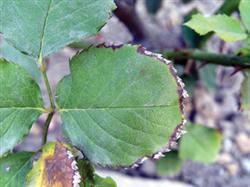
This disease occurs commonly and causes serious damage, resulting in heavy leaf drop in roses and enormous losses. The pathogen is a fungus of the genus Actinonema in the subphylum Deuteromycotina.
1. Symptom identification
At the initial stage of the disease, brown radial lesions appear on the leaf surface, which gradually expand into circular or nearly circular lesions with a diameter of 4-12 mm; in severe cases, the lower leaves drop early, and the disease gradually spreads upward until the upper leaves also fall completely. Rainy and humid conditions are the main requirement for spore production; when water droplets are present on the leaf surface and the temperature is suitable, infection can occur in 6-10 hours, and symptoms appear in 3-6 days. Roses of the yellow flower series have relatively poor disease resistance.
2. Control techniques
1. For field cultivation, select disease-resistant varieties.
2. In winter, prune out diseased branches, and routinely clear fallen leaves from the field or pots and burn them in a centralized manner.
3. Focus on protective spraying. Starting in April, spray 1:1:160 Bordeaux mixture once a week; from June to August, Bordeaux mixture is still needed, or 50% carbendazim wettable powder at 500-800 times dilution; or 75% chlorothalonil wettable powder at 500 times dilution; or 70% mancozeb wettable powder at 500-600 times dilution.