How to control the yellow-tailed moth (Monema flavescens) on roses
Morphological features: The adult is orange-yellow, with filamentous antennae and brownish diagonal lines that converge at a single point on the wingtips. Forming an inverted V shape, the hindwings are grayish-yellow, the legs are brown, and the eggs are flat and oval, pale yellow. The larva is slightly rectangular, somewhat larger at the front end, brightly colored, with a large purple patch on the dorsal side of the body, and a dark brown head. The cocoon is oval. 12m...
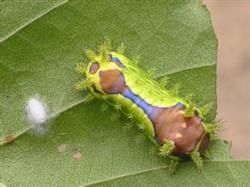
Morphological features: The adult is orange-yellow, with filamentous antennae and brownish diagonal lines that converge at a single point on the wingtips. Forming an inverted V shape, the hindwings are grayish-yellow, the legs are brown, and the eggs are flat and oval, pale yellow. The larva is slightly rectangular, somewhat larger at the front end, brightly colored, with a large purple patch on the dorsal side of the body, and a dark brown head. The cocoon is oval, about 12mm, hard in texture, grayish-white, with alternating black stripes, and is always spun at the branching points of the stem or on twigs. The yellow-tailed moth has one generation per year, overwintering as a mature larva in a cocoon on the plant, and pupating in May to June of the following year. The larva rests quietly on the underside of leaves during the day and feeds at night. It damages the cortex and mesophyll tissue beneath the leaves, and in severe cases can eat all the mesophyll, leaving only the veins and petioles, causing serious damage to roses.
Control methods: (1) In combination with winter pruning, remove the overwintering cocoons on the branches. (2) Use black light traps to kill adults. (3) During the larval occurrence period, spray 90% trichlorfon at 500-1000 times dilution; or spray 20% pyrethroid insecticides at 1000-2000 times dilution; (4) Protect natural enemies, such as yellowjackets, long-legged wasps, praying mantises, and others.