Identification and Control of Gray Mold in Roses
Symptoms: When gray mold occurs on rose leaves at the leaf margins and leaf tips, it first appears as water-soaked light brown spots that are smooth and slightly sunken, then expands and rots. When flower buds are affected, the spots are grayish-black and can prevent the flower from opening; diseased buds turn brown and die. When flowers are affected, some petals turn brown, shrivel and rot. The gray mold fungus also attacks the branch ends after flowers are cut, and the black diseased area can extend several centimeters downward from the infection point. In warm, humid conditions, the gray mold layer can completely cover the infected area.
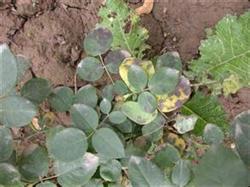
Symptoms: When gray mold occurs on rose leaves at the leaf margins and leaf tips, it first appears as water-soaked light brown spots that are smooth and slightly sunken, then expands and rots. When flower buds are affected, the spots are grayish-black and can prevent the flower from opening; diseased buds turn brown and die. When flowers are affected, some petals turn brown, shrivel and rot. The gray mold fungus also attacks the branch ends after flowers are cut, and the black diseased area can extend several centimeters downward from the infection point. In warm, humid conditions, the gray mold layer can completely cover the infected area.
Pathogen: Botrytis cinerea Pers, a fungus belonging to the class Hyphomycetes, order Moniliales. Transmission route: It overwinters as mycelium or sclerotia latent in diseased parts, and the following year produces conidia, which spread by wind and rain, invading through wounds or directly through the epidermis. In greenhouses where roses are grown, high humidity makes gray mold likely to occur. When faded flowers and pedicels are not removed promptly, the disease often starts on such decaying tissue and then spreads to healthy flowers and flower buds.
Control methods 1. Remove diseased parts promptly to reduce sources of infection; faded rose flowers should also be cut off promptly. 2. Greenhouses should be properly ventilated so that the temperature difference between day and night does not become too great and humidity does not become too high; there should be adequate spacing between rose pots. When watering, pour from the edge of the pot and do not let water remain on leaves or flowers. Cut flowers on sunny days so that wounds heal easily. 3. Chemical control: Spray to protect as soon as symptoms appear; when using 1:1:100 Bordeaux mixture, spray once every 2 weeks. 4. Spray method: You can use 50% procymidone wettable powder at 2000 times dilution, or 50% iprodione wettable powder at 1000-1500 times dilution, or 50% thiophanate-methyl wettable powder at 500 times dilution, or 50% carbendazim at 500 times dilution, or 70% mancozeb at 500 times dilution, spraying once every 7-10 days for 2-3 consecutive times, with each spraying using no less than 50-60 kg of solution per 67 sq m. The preventive effect of the above agents is better than the curative effect, and care should be taken to alternate agents to prevent resistance. When growing roses in greenhouses, the following application methods can also be tried: 1. Smoke method: Use 10% procymidone smoke agent at 200-250 g per 667 sq m, or 45% chlorothalonil smoke agent at 250 g per 667 sq m, fumigating for 3-4 hours. 2. Dust method: In the evening, dust 10% procymidone dust or 5% chlorothalonil dust, or 10% thiabendazole dust, at 1 kg per 667 sq m, once every 9-11 days, used continuously or alternately with other control methods for 2-3 times.