How to prevent and remedy the aging of rose plants?
Symptoms: It mainly harms flowers, leaves and young shoots. At first, water-soaked small spots appear on the petals, or the tips and edges of the petals turn brown, then rapidly expand, wilt and rot, and finally the whole flower turns brown and withers. Under humid conditions, a gray-green mold-like substance can be seen, namely the conidiophores and conidia of the pathogen. Disease characteristics...
 The aging phenomenon of roses often shows as thin and weak branches with few flowers, branches drying up after pruning, thin and pale leaves and petals, yellowing and falling leaves, and weak resistance to diseases and pests. For this, the causes should be identified from aspects such as water and fertilizer, pruning, and maintenance, and targeted measures should be taken for prevention and control.
I. Waterlogging damage: It shows as yellowing and falling leaves, withered branches, and partial root rot. There is a smell of distiller's grains. For severely affected plants or where waterlogging is difficult to drain, they should be heavily pruned and then dug up, the terrain raised, and then replanted. For mildly affected plants, the method of mounding soil at the base of the plant can be used to stimulate the root crown to produce adventitious roots, thereby alleviating the problem.
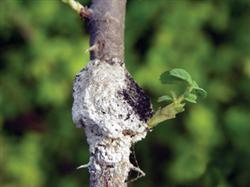
II. Diseases and pests: Leaf spot diseases and powdery mildew caused by fungi cause a large number of leaves to fall, affecting the formation of the flower display, and in severe cases the plants die because the leaves cannot carry out photosynthesis. The pathogens begin to infect from late May to early June, with the peak incidence during the high-temperature rainy season from July to August. Starting from late May, spray 0.3 to 0.5 degree Baume lime sulfur mixture once a week for 2 to 3 consecutive times. If there are signs of a severe outbreak in July to August, spray 40% asomate wettable powder at 500 times dilution once a week for 3 consecutive sprays, which can effectively control it. If there is a lot of rain, the number of sprays should be increased accordingly. Among insect pests, the most serious damage is caused by the stem-boring longhorn beetle. Pruning away the shoots damaged by longhorn beetle larvae from mid-June to July is one of the key measures for controlling longhorn beetles. If this step is missed, the larvae will bore into a main trunk and make control more difficult. Around the Autumn Equinox and Qingming, inspect the tree body, inject 80% dichlorvos emulsion at 5 to 10 times dilution into the insect holes, then seal the openings with mud, and the longhorn beetle larvae can be killed. For other leaf-eating pests, once found, spray 800 times dilution of monocrotophos to kill eggs and larvae, effectively controlling leaf-eating pests.
III. Fertilization: Yellowing leaves, few flowers, small flowers and thin weak branches are signs of fertilizer deficiency. Apply fertilizer according to the lacking elements, and at the same time apply fertilizers with other elements to improve the utilization rate of that element. For severe deficiency of a certain element, damaged roots, or when trace elements need to be applied, foliar fertilization is suitable, with the concentration preferably kept at 0.3%-0.5%. The fertilization time should be chosen in the evening, spraying from the underside of the leaves. To improve the utilization rate of fertilizer, plant vitality essence can be added to help the plants return to normal as soon as possible. Weak plants should be given small amounts many times, with thin fertilizer applied frequently, to prevent fertilizer damage.
Under normal conditions, roses have many flowers and a high fertilizer requirement. Base fertilizer should be applied after winter pruning and before bud break. Sufficient organic fertilizer should be applied, with the fertilization range at the outer edge of the crown diameter and a depth of 20 to 30 cm. During the growing season, topdressing should be applied multiple times: at the leaf expansion stage, after full bloom, and in early August. Quick-acting nitrogen, phosphorus and potassium are suitable for topdressing. At leaf expansion, new roots grow in large numbers, so fertilizer should be applied in small amounts, and concentrated fertilizer should not be applied, so as not to affect new root growth. For topdressing at the end of August, there should be less nitrogen fertilizer and more phosphorus and potassium fertilizer to prevent autumn shoots from growing too vigorously and being damaged by frost. Topdressing depends on plant size and growth conditions, generally 100 to 150 grams per plant each time.
IV. Pruning: Pruning is divided into growing-season pruning and winter pruning. Growing-season pruning: first, promptly prune off flower stalks and dead branches after flowering, and remove rootstock suckers sprouting from the base of grafted plants. Second, 20 days after the previous flush of flowers fades, shorten the current-year shoots that have flowered by retaining 8 to 12 buds, so as to obtain high-quality flowering shoots. Winter pruning is intended to promote the full return flow of nutrients in branches and leaves, and is best carried out 3 to 4 weeks after frost. The general principle of pruning is to remove diseased and pest-damaged branches and thin weak branches, thin out parallel branches, overly dense branches and inward-growing branches, remove upright branches and keep slanting ones, heavily prune weak trees and weak branches, and lightly prune strong trees and strong branches. Of course, the specific pruning method should also be treated differently according to variety and shape.
① Roses grown in clumps should achieve a colorful effect, requiring tall plants and many flowers, not requiring especially large flowers. The pruning height should be 100 to 120 cm, with each branch retaining 15 to 2 pairs of plump strong buds.
② When grown as a variety requiring short plants and large flowers, low pruning is suitable. Each plant should retain 3 to 5 main branches, each main branch 30 to 45 cm long, retaining 6 to 8 buds.
③ When climbing roses are grown creeping on the ground, those that bloom only once a year should have their flowered branches pruned off after flowering, leaving the branches that have not bloomed and stimulating new shoots from the base to bloom the following year. For those that bloom multiple times each year, after flowering prune off the tips of the short branches that have flowered, while retaining 2 buds at their base, to promote new lateral branches to bloom. For once-blooming types, always maintain 5 to 7 branches, reasonably determine the number of lateral branches according to the available space, and retain 3 to 4 buds on the lateral branches for flowering. When grown on pergolas or trellises, in order to achieve a full and dense effect, more main vines should be retained, and the above pruning techniques should be applied to the first-level and second-level lateral branches, which can achieve abundant flowers and luxuriant branches.
④ For shrub rose flower hedges, the requirements of neat appearance, dense branches and leaves, abundant and brightly colored flowers, no gaps, and no bare lower stems should be met. A "one-cut" pruning method should be adopted on the same plane, and the pruning time should be staggered from flowering.