Symptoms, Identification, and Control Methods of Rose Rust
Rose rust occurs in climatically suitable regions around the world. It sometimes causes severe damage to greenhouse-cultivated roses. In addition to roses, the disease can also infect rugosa roses, wild roses, and other flowering plants. Pathogen: Rose rust has many pathogenic species; 10 species have been reported abroad and 3 species are known in China. Among them, Phragmidium montivagum (Pers.) Schlecht. is the main pathogen, belonging to the phylum Basidiomycota, genus Phragmidium.
Rose rust occurs in climatically suitable regions around the world. It sometimes causes severe damage to greenhouse-cultivated roses. In addition to roses, the disease can also infect rugosa roses, wild roses, and other flowering plants.
Pathogen
Rose rust has many pathogenic species; 10 species have been reported abroad and 3 species are known in China. Among them, Phragmidium montivagum (Pers.) Schlecht. is the main pathogen, belonging to the phylum Basidiomycota, genus Phragmidium.
Symptoms
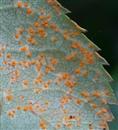
The disease mainly damages leaves, petioles, and buds, and can also damage shoots, calyxes, and fruit. In spring, very small orange-yellow blisters appear on the upper surface of affected leaves; these are the spermogonia of the pathogen. Slightly later, slightly raised orange-yellow spots appear on the underside of the leaves, namely aecia. After maturing, they break through the epidermis and release orange-red aeciospore masses, and the lesion margins often have a faded ring. Soon afterward, orange-yellow urediniospore powder masses also form on the underside of diseased leaves. In the later part of the growing season, brown to black small teliospore powder masses form at the sites where urediniospore masses developed. Affected parts of the plant are often raised, overgrown, or deformed; infected plants defoliate early and decline in growth.
Disease Development Pattern
The pathogen overwinters in diseased buds or infected parts, or as teliospores on dead branches, diseased leaves, and fallen leaves. This pathogen is an autoecious rust fungus, meaning that all 5 stages of its life cycle occur on the same host. The following spring, teliospores germinate to produce basidiospores, and the basidiospores germinate and invade new leaves to cause primary infection. During the growing season, urediniospores spread by wind and rain and invade through stomata, allowing multiple secondary infections to occur.
Epidemic Characteristics
Temperature plays a key role in the epidemic of this disease. The optimum temperature for teliospore germination is about 18°C, and basidiospores are difficult to form at 25°C. The optimum temperature for aeciospore germination is 15-21°C. Although most urediniospores can germinate at 9-25°C, the optimum temperature for germination is 18-21°C. Moisture is also crucial for the germination of aeciospores and urediniospores; generally, spores can germinate only in the presence of free water. Therefore, warm, rainy, and foggy regions throughout the year are favorable for the occurrence and epidemic of this disease, while areas with high summer temperatures or cold winters have milder occurrence.
Control Methods
① Reduce infection sources: in combination with pruning, collect diseased plant residues and destroy them in a centralized manner.
② Do not plant diseased seedlings, and use nitrogen fertilizer rationally.
③ Chemical control: after pruning in early spring, spray 2-5 degrees Baume lime sulfur mixture. During the disease period, spray 50% mancozeb 500-fold solution, or 97% sodium di-nitro-o-cresolate 250-300-fold solution, or 0.2-0.4 degrees Baume lime sulfur mixture, or 50% dinitro-o-cresol wettable powder 200-fold solution, once every 10-15 days, 2-3 times. Or 20% carboxin emulsifiable concentrate 800-fold solution, once every 30 days.