What are the control methods for the rose long-tube aphid?
The rose long-tube aphid belongs to the order Homoptera, family Aphididae. It damages roses, multiflora roses, 'Shijiemei' roses and others with nymphs and adult aphids; the affected young leaves and flower buds stop growing and are difficult to extend, and the honeydew excreted often sticks to the leaves, reducing their ornamental value. 1. Morphological characteristics: The wingless parthenogenetic female is relatively large, body elongated-oval, 4.2 mm long.
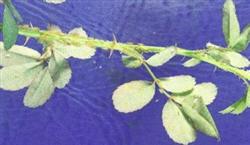
The rose long-tube aphid belongs to the order Homoptera, family Aphididae. It damages roses, multiflora roses, 'Shijiemei' roses and others with nymphs and adult aphids; the affected young leaves and flower buds stop growing and are difficult to extend, and the honeydew excreted often sticks to the leaves, reducing their ornamental value.
1. Morphological characteristics: The wingless parthenogenetic female is relatively large, body elongated-oval, 4.2 mm long. The head is earth-yellow to light green, and the thorax and abdomen are grass-green, sometimes orange-red. The frontal tubercles of the head are raised and distinctly protrude outward. The cornicles are black, long-cylindrical, with a reticulated pattern at the tip and imbricated sculpture on the rest, 1.3 mm long in total. The winged parthenogenetic female is 3.5 mm long, the body is slightly greenish, the mesothorax is earth-yellow, and the antennae are 2.8 mm long. The remaining characteristics are similar to those of the wingless parthenogenetic female.
2. Life history and habits: The rose long-tube aphid produces 10-20 generations per year. In the Jiangsu-Zhejiang region, adult and nymph aphids overwinter in the bud axils of stem stubble. After roses sprout in spring, the overwintering aphids reproduce on the young leaves of new shoots and begin damaging the young shoots from early April, sometimes covering the flower buds and the undersides of leaves in a full layer. From mid-April, winged aphids appear one after another, and both the rate of damaged plants and the population density rise markedly; mid-May is the first reproduction peak. In July-August, high temperatures and continuous rainy weather cause the population density to decline. When the average temperature is around 20°C and the relative humidity is 70-80% (that is, around May and October), reproduction is fastest and the damage is most widespread and severe.
3. Control methods
1. After autumn, from late October to early November, cut down and burn all stems above 10-15 cm.
2. When the population density is relatively high, spray 50% phoxim or 50% fenitrothion each at 1000x dilution, 20% fenvalerate at 2000-2500x dilution, or 50% pirimicarb at 3000x dilution.