Detailed Guide to High-Yield Cultivation Techniques for Leaf-Use Ginkgo
1. Site selection The site conditions for a leaf-use ginkgo plantation require flat terrain, good drainage and irrigation, and fertile loam or sandy loam; a leaf-use ginkgo plantation should not be established on saline-alkali land or thin mountain land. 2. Planting techniques A leaf-use ginkgo plantation can be established by direct sowing, or by planting seedling trees or cutting-propagated plants. Planting can be done in spring or autumn...
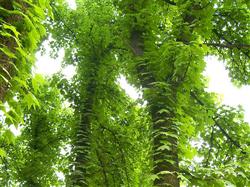
1. Site selection The site conditions for a leaf-use ginkgo plantation require flat terrain, good drainage and irrigation, and fertile loam or sandy loam; a leaf-use ginkgo plantation should not be established on saline-alkali land or thin mountain land.
2. Planting techniques A leaf-use ginkgo plantation can be established by direct sowing, or by planting seedling trees or cutting-propagated plants. Planting can be done in either spring or autumn. For the seedling trees or cutting-propagated plants used, 1- to 2-year-old seedlings should be chosen, requiring strong root crowns, a height of more than 25 cm, a complete root system, luxuriant branches and leaves, and no pests or diseases. Planting density should suit local conditions; areas with fertile soil, varieties with fewer branches and leaves, and a high level of management can be planted somewhat more densely, and vice versa more sparsely. The usual spacing between plants and rows is 0.4 m x 1.0 m. A large-row and small-row planting density of 1.0 m x 0.3 m and 0.5 m x 0.3 m can also be used. In addition, to make full use of the land, short-statured crops can be intercropped for 1 to 2 years after establishing a sparsely planted plantation.
3. Soil, fertilizer and water management To obtain high-yield, high-quality ginkgo leaves, soil management must be strengthened and a sufficient supply of fertilizer and water provided. Soil management mainly means weed control and moisture conservation. During the growing season, hoeing should be carried out once every half month together with weeding, to reduce surface evaporation and maintain soil moisture. Each year, from after leaf harvest in autumn until before the soil freezes, organic fertilizer can be deeply applied together with soil ploughing; in the early growth stage of ginkgo (April to May), the amount of topdressing should be increased, with nitrogen fertilizer as the main component and an appropriate amount of phosphorus and potassium fertilizer; in the middle and late stages (late July), phosphorus and potassium fertilizer should be applied as topdressing. At the same time, foliar fertilizer should be sprayed 3 to 4 times during the growing season (urea, potassium dihydrogen phosphate, etc. can be used), which can significantly increase leaf yield and improve leaf quality. Because a leaf-use ginkgo plantation has many leaves and a high transpiration rate, a sufficient water supply is essential, especially in the high-temperature season of July to August. Generally, irrigation is carried out 6 to 8 times a year, that is, one round of "sprouting water" after the soil thaws in early spring, one round of "freezing water" when the soil freezes, and during the growing season, based on soil moisture, watering once a month in April to June and August to October. Keep the soil moisture content at about 80%, but ginkgo fears waterlogging, so pay attention to timely drainage when waterlogged.
4. Training and pruning A leaf-use ginkgo plantation is mainly for leaf harvest. To make leaf picking and tree management easier, leaf-harvest trees should preferably use a low-trunk, low-canopy cup shape or round-headed shape, with trunk height controlled below 50 cm. Below the trunk-setting cut, choose 3 branches sprouting in different directions as the main branches, and then develop multiple orders of lateral branches on the main branches. A clump shape can also be used for leaf-harvest trees. After 1- to 2-year-old young seedlings are planted, or after seeds germinate and begin to grow, the stem must be cut off at 20 cm above the ground to promote new branches; when the new branches grow to 10 to 15 cm, select and retain 5 main branches in different directions, and cut off all the remaining branches; when each of the five branches grows to 30 cm, pinch the tips again, and lateral branches will sprout again. After 3 to 5 rounds of this training, a clump-shaped crown is formed. To encourage leaf-harvest trees to have more branches and to keep tree height within the management height, heavy pruning should be carried out in winter, replacing and renewing branches in time, and at the same time thinning out some overly dense branches, diseased and pest-infested branches, and thin weak branches; growing-season pruning mainly consists of pinching the tips of new shoots over 30 cm in late May, effectively promoting secondary shoots and increasing the amount of branches and leaves; in autumn, together with leaf harvest, pay attention to thinning out overly dense vigorous growing branches.
5. Pest and disease control Ginkgo has relatively few pests and diseases, but it is mainly susceptible to damage from stem rot, leaf blight, giant silkworm moths, and small leaf-roller moths. On the basis of selecting good varieties, strengthening management, and promptly handling diseased plants, pesticides should be sprayed in time for control. Chemicals that can be used include 1% to 2% ferrous sulfate solution, 50% carbendazim 600 to 700 times dilution, and 70% thiophanate-methyl 800 to 1000 times dilution.
6. Harvesting ginkgo leaves Ginkgo leaves should be harvested in stages, generally starting in early August, picking the basal leaves first, then successively harvesting the middle and upper leaves. Each time, pick 1/3 of the leaves from short shoots, and for the last time harvest all remaining leaves at once when the ginkgo leaves are about to turn yellow. If ginkgo leaves are all harvested at once, it will not only affect leaf quality but also cause the tree to produce a second growth flush, affecting its safe overwintering. To prevent winter buds from sprouting, before the local early frost period arrives, be sure to retain 3 to 5 leaves at the top shoot and do not harvest them all; in addition, before leaf harvest, irrigation should be avoided in the nursery to ensure leaf quality and the safety of fresh leaves during transport. After ginkgo leaves are collected, they should immediately be piled on a drying yard or concrete surface to dry, to prevent heating and moulding, and at the same time remove weeds, twigs, soil and mouldy leaves and other debris. The drying thickness is 3 to 5 cm, turning 2 to 3 times a day, and after 3 to 4 days, once they reach an air-dried state, they can be stored or sold. Finally, special note: ginkgo must never be harvested twice, in both summer and autumn. Double harvesting not only fails to increase leaf yield and quality but on the contrary damages the tree, thereby causing relatively large economic losses.