Detailed Explanation of Cutting Propagation Techniques for Peony-Flower Pomegranate
The peony-flowered pomegranate tree is a new and rare flower-and-fruit tree variety that combines multiple functions such as ornamental value, edible use, greening, and landscape beautification. This tree has pomegranate leaves and blooms peony flowers. It can be widely planted in fields and also cultivated for households, hotels, and tourist destinations, with extremely broad development prospects. Below is a description of its characteristics and cultivation techniques...
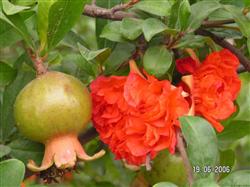 The peony-flowered pomegranate tree blooms more beautifully than peonies and its fruit is more attractive than peaches and plums. Its flowering period lasts as long as 5 months; the fruit is large and red, with sweet seeds. It combines flower viewing, fruit viewing, and edible use in one, and is one of the rare tree species unique to China.
Preparation of cuttings. Cuttings should be taken from one-year-old branches of healthy peony-flowered pomegranate trees that are fully mature, with plump buds and a high degree of lignification. Before root promotion, cut the branches into 20 cm segments (retaining 2-3 buds), with a flat cut 2 cm above the bud at the top end and a slanted cut 1 cm below the bud at the bottom end, then soak in clean water for 12-24 hours.
Root promotion treatment. Use chemical agents such as ABT rooting powder to promote rooting. The method is: first dissolve the agent with a small amount of alcohol, then dilute the stock solution with water to the required concentration and pour it into a treatment container, with a liquid depth of 2-3 cm. Tie the soaked cuttings into small bundles, and stand the bases of the cuttings 3-5 cm deep upright in the water tank for 12 hours, then remove them for use.
Cutting. Generally, ridge planting is used, with a ridge width of 50-60 cm, a height of 15 cm, and a ridge spacing of 40-50 cm. Two rows are planted per ridge, with a row spacing of 25-30 cm and a plant spacing of 10-15 cm. Cutting begins from late March to early April. When cutting, use a wooden stick or similar tool to make holes on the ridge back, then insert the root-promoted cuttings so that the top buds are exposed above the ground, press firmly, and then irrigate water in the furrows. After the water seeps in, take moist soil and cover the buds with a 1 cm layer to prevent the buds from drying out in the wind.
Management after cutting. After cutting, irrigate frequently, but with a small amount of water, and loosen the soil promptly after watering. Seedlings can appropriately retain more branches without thinning, so they can expand their canopy and take shape early. When the seedlings are 20 cm tall, apply nitrogen fertilizer, generally 40 kg of ammonium sulfate per mu, followed by potassium fertilizer. For foliar spraying in the early stage, use 0.3% urea, and in the later stage use 0.3% potassium dihydrogen phosphate or apply plant ash to the soil. For aphids and red spiders occurring at the seedling stage, use dichlorvos (800-1000 times solution) or monocrotophos (1000-1200 times solution) for foliar spraying to control them promptly.