What are the control methods for tobacco brown spot disease?
How to control tobacco brown spot disease? Tobacco brown spot disease is a serious disease that occurs widely in tobacco-growing regions around the world. It is estimated that the area affected by brown spot disease each year accounts for about 30-35% of China's tobacco planting area. Brown spot disease not only makes tobacco leaves incomplete, but during the curing process the lesions continue to expand, causing uneven color and...
How to control tobacco brown spot disease?
Tobacco brown spot disease is a serious disease that occurs widely in tobacco-growing regions around the world. It is estimated that the area affected by brown spot disease each year accounts for about 30-35% of China's tobacco planting area. Brown spot disease not only makes tobacco leaves incomplete, but during the curing process the lesions continue to expand, causing uneven color and uneven leaf thickness, lowering the grade, and because the internal quality is uncoordinated, it also reduces the industrial use value.
I. Symptoms.
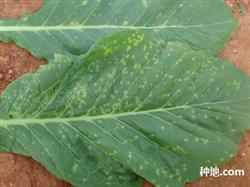
Tobacco brown spot disease mainly begins to occur when the tobacco leaves are near maturity, starting from the lower leaves of the tobacco plant and gradually developing from bottom to top. The main part affected is the leaves; stems, flower stalks and capsules are also affected. The lesions initially appear on the leaves as small yellowish-brown round spots, which later turn brown. Generally, the initial spots are less than 0.1 cm, and then gradually expand, with lesions reaching 1-2 cm in diameter. The lesions are round or irregularly round, brown, with obvious concentric rings; the lesion edges are distinct, with a pale yellow halo on the outer edge.
II. Conditions for disease occurrence.
The main conditions affecting the occurrence and epidemic of tobacco brown spot disease are: the disease resistance of the variety, the growth stage, and environmental conditions, etc.
1. Resistance of the variety. The disease resistance of tobacco varieties has a relatively large influence on the occurrence of the disease. 2. Different growth stages of the tobacco plant. Tobacco brown spot disease is a disease of the tobacco leaf maturity stage; it is resistant during the seedling stage, and as the tobacco leaves mature, disease resistance weakens, with the disease occurring from bottom to top, initially spreading horizontally and later spreading vertically. 3. Influence of climatic factors. Temperature mainly affects how early or late brown spot disease occurs and the length of the incubation period, while humidity mainly affects the degree of disease occurrence. 4. Influence of planting density. Excessive planting density results in poor ventilation and light penetration in the field, which favors the reproduction of the brown spot pathogen, and brown spot disease often occurs severely. 5. Influence of fertilization. The incidence rate and disease index of brown spot disease decrease with increasing potassium fertilizer application. Therefore, with an appropriate ratio of nitrogen, phosphorus and potassium, appropriately increasing phosphorus and potassium fertilizer and controlling the amount of nitrogen fertilizer can reduce the disease.
III. Control.
According to the occurrence pattern of brown spot disease, integrated control measures combining the planting of disease-resistant varieties, chemical control and the implementation of reasonable cultivation measures should be adopted.
1. Plant disease-resistant or disease-tolerant varieties.
2. Chemical control. Use 40% dimethachlon wettable powder at a concentration of 400-500 times (50-60 kg of spray solution per mu, spraying according to the size of the tobacco plants; generally spray evenly and thoroughly, and re-spray if it rains; its efficacy can remain stable above 75%, and it is currently a relatively good pesticide for controlling brown spot disease. 10% polyoxin wettable powder is generally used at 600 to 800 times (60 kg of spray solution per mu); its control effect is similar to that of dimethachlon and can also reach above 70%.
3. Improve cultivation measures. (1) Plant early at the right time. Brown spot disease mainly occurs in the late growth stage of tobacco; spring tobacco can be planted early at the right time and harvested earlier upon maturity, so that the leaf maturity period avoids the peak outbreak period of brown spot disease, which is an effective measure to control the occurrence of brown spot disease.
(2) Reasonable density. Excessive planting density leads to insufficient light, and leaves shading each other favors the reproduction of the pathogen, leading to severe disease occurrence. Therefore, according to variety characteristics and soil fertility conditions, reasonable close planting should be achieved; the density should be such that the leaves of mature plants do not close the rows, generally around 1100-1200 plants.
(3) Reasonable fertilization. Tobacco fields should appropriately increase the application of phosphorus and potassium fertilizer. The ratio of nitrogen, phosphorus and potassium should preferably be 1:1-2:3, or on the basis of nitrogen, phosphorus and potassium at 1:1:1, spraying 1% potassium dihydrogen phosphate three times at the rosette stage, vigorous growth stage and topping stage also gives a relatively good effect. Keep a reasonable number of leaves and avoid the appearance of tobacco plants with large upper leaves and small lower leaves.
(4) Do a good job of field sanitation to reduce sources of infection.
(5) Implement crop rotation. Rotation reduces the amount of bacteria in the soil and can alleviate the harm of brown spot disease.
Click to get more tobacco cultivation techniques
Click to get more flower cultivation techniques