What are the control methods for bacterial wilt in eucalyptus?
Bacterial wilt of eucalyptus and its control. Bacterial wilt of eucalyptus, caused by Ralstonia solanacearum (Smith) Yabuuchi, is a bacterial wilt disease that seriously harms eucalyptus in South China. In the early stage of infection, seedlings generally become wilted, followed by leaf blight, and the seedlings die rapidly; the roots of diseased plants become necrotic, appear water-soaked, and have...
Bacterial wilt of eucalyptus and its control
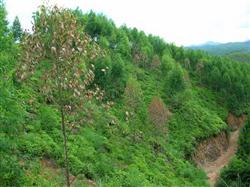
Bacterial wilt of eucalyptus, caused by Ralstonia solanacearum (Smith) Yabuuchi, is a bacterial wilt disease that seriously harms eucalyptus in South China. In the early stage of infection, seedlings generally become wilted, followed by leaf blight, and the seedlings die rapidly; the roots of diseased plants become necrotic, appear water-soaked, and have a foul odor, and a milky yellow pus oozes out when the stem is cut crosswise. After young trees are infected, the leaves wilt, lose their green color, and do not fall off; brown or dark brown streaks appear on the surface of the stems, branches, and trunks; the xylem gradually turns dark brown; the roots rot, the cortex peels off, and milky yellow or pale white bacterial ooze is produced on the surface. After eucalyptus is infected with this disease, the plants will die. The disease mostly occurs from April to November, and the peak incidence period is the hot and rainy season.
Control methods:
(1) Strengthen quarantine and control the spread of bacterial wilt. Strengthening follow-up testing during the seedling-raising period and carrying out strict quarantine on eucalyptus seedlings leaving the nursery can effectively prevent the long-distance transmission of bacterial wilt and the spread of the disease. Eucalyptus seedlings in nurseries that have already been infected with bacterial wilt must absolutely not be transported to planting areas for afforestation, so as to avoid the spread and diffusion of the pathogen.
(2) Biological control. Control of eucalyptus bacterial wilt with Pseudomonas bacteria and mycorrhizae; control of virulent Ralstonia solanacearum with non-virulent Ralstonia solanacearum.
(3) Chemical control. Different application methods can be chosen, such as soil disinfection, root drenching, and spraying. Usually, root drenching gives the best control effect. Commonly used agents for root drenching include: 72% agricultural streptomycin wettable powder, 53.8% Kocide, 86.2% cuprous oxide wettable powder, 10% difenoconazole (Score), 25% Qingkuling wettable powder, copper ammonium complex, Ludebao, Kocide, DT, Miejunling, Chuanhua 018 (thiabendazole, leaf blight azole, dikunin, Yeqingshuang, Yekuning), thiram, Yishuangqing, Yekujing, etc. Drench the roots once every 7-10 days for 2-3 consecutive times, and a very good control effect can be achieved. Commonly used agents for soil disinfection include: formalin solution, 20% lime water, lime powder, bleaching powder, Miejunling, methyl bromide, potassium permanganate, ammonium bicarbonate, etc. These agents can significantly limit the reproduction of Ralstonia solanacearum in the soil and reduce the incidence of disease, and they all have a certain effect on the control and spread of bacterial wilt.