The Art of Osmanthus Landscaping and Its Application in Gardens
Osmanthus is one of the ten traditional famous flowers of our country, and is a specialty ornamental flowering tree and aromatic tree species of our country, excelling in form, color, fragrance and charm. Because of qualities such as "loving the winter glory of the osmanthus tree" and "not abandoning itself because its flowers are small, with pure fragrance drifting far and rich sweetness reaching afar," it has been favored by literati and scholars of past dynasties; and because it is associated with "Chang'e Flying to the Moon"...
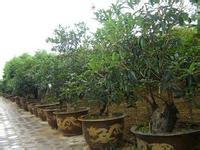
Osmanthus is one of the ten traditional famous flowers of our country, and is a specialty ornamental flowering tree and aromatic tree species of our country, excelling in form, color, fragrance and charm. Because of qualities such as "loving the winter glory of the osmanthus tree" and "not abandoning itself because its flowers are small, with pure fragrance drifting far and rich sweetness reaching afar," it has been favored by literati and scholars of past dynasties; and because it is associated with many folk legends such as "Chang'e Flying to the Moon," it has become one of the most beloved tree species of the Chinese nation and a widely used plant material in the art of garden landscaping.
I. Independent Landscaping with Osmanthus
Under natural conditions, osmanthus has a low branching point, with slender branches drooping to the ground, dense branches and leaves, and a graceful posture. Its tree shape changes richly with increasing age, presenting shapes such as oblong, round and oblate. The color of its leaves differs across the four seasons: new leaves are reddish-brown, then turn tender green, emerald green and dark green. Moreover, its floral fragrance is rich, giving it extremely high ornamental value.
1. Specimen planting. Specimen planting mainly displays the beauty of an individual tree's form and is generally treated as a visual center. The osmanthus tree has a graceful shape and can be planted as a solitary specimen to form a landscape. On the large lawn of Linggu Temple in Nanjing, a king osmanthus is planted as a solitary specimen, shaped like a giant umbrella; set off by the surrounding patches of osmanthus forest, it has a distinct character and produces a "standing out like a crane among chickens" effect. In the Osmanthus Square of the Jiaoshan Scenic Area in Zhenjiang, there is also a solitary osmanthus. The square is square-shaped, and in the center of the square a large circle is made of pebbles. At the center of the circle, taking the characteristic of osmanthus blooming with four petals, a flower bed is built in a cross-shaped petal pattern. At the center of the flower bed, a gracefully shaped osmanthus is planted. Viewed from above, the scene has a square within a circle and a flower within the circle, not only embodying the meaning of "flowers blooming and the moon full, happiness and completeness" but also pointing out the theme of the square.
2. Row planting. Row planting mainly embodies the neat beauty and linear beauty of plants. Osmanthus of similar age generally has a similar tree shape, and when planted in straight or curved lines at equal distances, it easily achieves a neat and consistent artistic effect. In gardens, osmanthus is generally cultivated for greening as street trees, forest belts and waterside plantings, or cultivated as tree walls and hedges. On both sides of the road at Linggu Temple in Nanjing, osmanthus combined with other tree species is cultivated as street trees, making the plant landscape on both sides of the road rich in layered variation and very distinctive. Outside the wall of Dinghui Temple on Jiaoshan, several osmanthus trees are planted in rows, with yellow walls, green tiles and green trees creating rich colors and a beautiful composition.
3. Cluster planting and mass planting. Cluster planting and mass planting mainly embody the collective beauty and harmonious beauty of trees. Planting osmanthus of different ages according to certain rules can present a beautiful osmanthus forest landscape. Places such as Guangfu in Suzhou and Manjuelong in Hangzhou have become famous osmanthus-viewing destinations precisely because flower farmers planted thousands of mu of osmanthus in groups, forming an osmanthus forest landscape and giving the collective beauty of osmanthus its ultimate expression.