Eucalyptus Pest and Disease Control Methods and Key Practical Techniques
The main pests and diseases of eucalyptus include: bacterial wilt, leaf blight (commonly known as defoliation disease), eucalyptus seedling stem rot, eucalyptus leaf roller, termites, and scarab beetles, etc. (1) Bacterial wilt: When the bacterial wilt pathogen infects young trees in the forest, the above-ground symptoms can be divided into two types. The first is the acute type, in which the leaves of the diseased plant rapidly lose water and wilt, hanging on the branches without falling off, showing the typical "green wilt" symptom. For this type of diseased plant, the time from onset to the death of the whole plant is relatively short, generally only 2-3 weeks. The second is the chronic type, in which the diseased plant shows stunted growth, dwarfism, and the lower leaves first turn purplish-red, then gradually deepen and spread upward, and finally the leaves dry up and fall off. Some stems and side branches develop irregular dark brown necrotic spots, and in severe cases the entire plant dies. For this type, the time from onset to the death of the whole plant is relatively long, generally 3-6 months. Eucalyptus bacterial wilt is prone to epidemic outbreaks under high temperature and high humidity. Root collar injury, surface runoff, and root-to-root contact between plants are the main pathways for pathogen invasion and spread. Control measures: select disease-resistant strains; carry out quarantine of seedlings before leaving the nursery, and try to avoid bringing diseased seedlings to the plantation; also try to avoid establishing eucalyptus plantations on forest land that is likely to carry Pseudomonas solanacearum (soil where peanuts, tobacco, potatoes, tomatoes, mulberries, kapok, beefwood, and canna have been planted); do not apply undecomposed organic fertilizer; strengthen tending and management to improve tree disease resistance. After a plant becomes diseased, there is still no proven effective control method; once discovered, the only option is to immediately pull it out roots and all, spread lime on the soil in the planting hole for disinfection, and destroy the diseased plant.
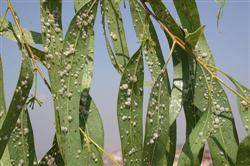
The main pests and diseases of eucalyptus include: bacterial wilt, leaf blight (commonly known as defoliation disease), eucalyptus seedling stem rot, eucalyptus leaf roller, termites, and scarab beetles, etc.
(1) Bacterial wilt: When the bacterial wilt pathogen infects young trees in the forest, the above-ground symptoms can be divided into two types. The first is the acute type, in which the leaves of the diseased plant rapidly lose water and wilt, hanging on the branches without falling off, showing the typical "green wilt" symptom. For this type of diseased plant, the time from onset to the death of the whole plant is relatively short, generally only 2-3 weeks. The second is the chronic type, in which the diseased plant shows stunted growth, dwarfism, and the lower leaves first turn purplish-red, then gradually deepen and spread upward, and finally the leaves dry up and fall off. Some stems and side branches develop irregular dark brown necrotic spots, and in severe cases the entire plant dies. For this type, the time from onset to the death of the whole plant is relatively long, generally 3-6 months. Eucalyptus bacterial wilt is prone to epidemic outbreaks under high temperature and high humidity. Root collar injury, surface runoff, and root-to-root contact between plants are the main pathways for pathogen invasion and spread. Control measures: select disease-resistant strains; carry out quarantine of seedlings before leaving the nursery, and try to avoid bringing diseased seedlings to the plantation; also try to avoid establishing eucalyptus plantations on forest land that is likely to carry Pseudomonas solanacearum (soil where peanuts, tobacco, potatoes, tomatoes, mulberries, kapok, beefwood, and canna have been planted); do not apply undecomposed organic fertilizer; strengthen tending and management to improve tree disease resistance. After a plant becomes diseased, there is still no proven effective control method; once discovered, the only option is to immediately pull it out roots and all, spread lime on the soil in the planting hole for disinfection, and destroy the diseased plant.
(2) Leaf blight (commonly known as defoliation disease): This disease is caused under conditions of high temperature and high humidity. It can cause eucalyptus branches to wither and leaves to fall, and in severe cases can kill the trees. This is especially true for Eucalyptus urophylla and its clones when they encounter continuous high-temperature rainy weather for six or seven days or more. Areas with low-lying terrain, poor drainage, high planting density, and poor air circulation within the plantation are prone to the disease. Control measures: choose land with good drainage for planting; in low-lying areas, build drainage ditches properly; planting density should be appropriate and not too dense.
(3) Eucalyptus seedling stem rot: This is a disease of eucalyptus at the seedling stage. When affected, the stem of the seedling rots and gradually dies. Control measures: at the seedling stage or before seedlings leave the nursery, use chlorothalonil or carbendazim or Bordeaux mixture, etc., diluted with water to the working concentration, and spray the seedlings.
(4) Eucalyptus leaf roller (commonly known as leaf-rolling worm): From April to August each year, it damages the young leaves of eucalyptus saplings, harming the tender shoots and terminal buds, which can cause the tops of small trees to die back and affect growth. Control measures: (1) Manual crushing. When you see curled leaves on the tender leaves of young trees, use your hands to crush the larvae inside the curled leaves to death. (2) Pesticide spraying. Use trichlorfon at 600 times dilution plus a small amount of kerosene, or dimethoate at 1000 times dilution, or pyrethroids (at the working concentration) for spraying and killing.
(5) Termites: They mainly damage the bark of eucalyptus trunks, seriously affecting tree growth. Control measures: (1) Bait trapping. Bury bagasse, sugar, etc. in the soil to lure termites into gathering, then poison them with pesticides. (2) Chemical repellent and killing. Use Metarhizium anisopliae produced by the Guangdong Academy of Forestry to repel and kill them, with very good results. The method is to prepare the Metarhizium anisopliae into a medicinal solution according to the instructions, dip the planting seedlings into the solution, then take them out immediately for planting in the hills, which can effectively control termites. (3) Systemic poisoning. Apply carbofuran to the soil around young trees to poison termites. Carbofuran can be applied alone or together with other base fertilizers.
(6) Scarab beetles: The larvae (commonly known as chicken-hen worms) damage the roots of young trees. Especially in some sugarcane fields, sweet potato fields, and other previously cultivated land used for afforestation, there are more larvae and the damage is more severe. The adults damage the leaves of young trees. Control measures: (1) When planting, apply 4-5 jin of trichlorfon powder (or 2.5 jin of terbufos) per mu evenly into the planting holes, which can repel and kill scarab larvae. (2) Dilute the pesticides trichlorfon and methamidophos to 600-800 times solution and spray on the leaf surface, which can effectively poison and kill the adults.