How to Fertilize Ginkgo Trees? A Full Guide to Practical Fertilization Techniques
1. Choose a suitable planting site. The plot for planting ginkgo must have deep, fertile soil, with a mature soil layer of no less than 30 cm, organic matter content greater than 1%, a year-round groundwater level below 2.5 m, and soil salt content no more than 0.05%. 2. Do not use fake grafted ginkgo seedlings. Ginkgo seedlings are divided into seedling-grown and grafted seedlings, ...
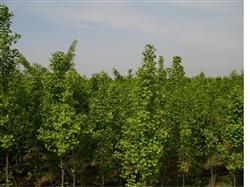 1. In autumn, apply organic fertilizer and compound fertilizer in holes. Hole application means digging fertilization holes 40-60 cm deep and 50 cm in diameter around the tree crown or within the tree basin. Generally, during the young tree stage, dig 1-2 holes per tree; for trees that have just begun to bear fruit, dig 2-4 holes per tree; for large trees in full fruit-bearing stage, dig 4-6 holes per tree. First fill the bottom of each hole with 20 cm of decomposed coarse organic matter (such as crop straw, finely crushed branches, etc.), then mix the fertilizer and topsoil evenly at a ratio of 1:3 and fill it into the hole (apply 100 g of compound fertilizer per hole). After filling, water to settle the soil. Once the water has seeped down, spread the subsoil onto the ground surface and level the tree basin. Rotate the fertilization direction each year, and increase the amount of fertilizer year by year. Using hole application of organic fertilizer and compound fertilizer in autumn, although the fertilization area is small, the fertilizer is concentrated, which can effectively improve the soil in the fertilization holes, making the soil in the holes fertile with good physical and chemical properties, and creating a well-nourished environment for root growth.
2. Timely underground topdressing during the growing season. The fertilization method is to open a strip trench 5-10 cm deep between the rows, apply the fertilizer into the trench, and water immediately after fertilization. (1) Leaf-harvesting orchards. Underground topdressing is done 3 times a year: the first time about 10 days before bud break, apply 20-25 kg of urea per mu; the second time before the peak of new shoot growth (mid-May), apply 25 kg of urea per mu; the third time in early August, apply 20-25 kg of multi-element compound fertilizer per mu. (2) Fruit-bearing orchards. Because ginkgo fruit-bearing orchards vary in tree age, amount of fruit borne, tree vigor, and level of stored nutrients in the tree, topdressing should be adapted to the tree and the site. Young trees (before fruiting) are topdressed 2 times a year: the first time in early to mid-May, apply 10-15 kg of urea per mu; the second time from late August to early September, apply 15 kg of multi-element compound fertilizer per mu. Fruit-bearing trees are topdressed 4 times a year: the first time about 10 days before bud break, apply 25 kg of urea per mu; the second time about 7 days before the peak of new shoot growth (early to mid-May), apply 15-20 kg of urea and 15 kg of potassium dihydrogen phosphate per mu; the third time from late July to early August, apply 20 kg of multi-element compound fertilizer per mu; the fourth time in early to mid-September, apply about 15 kg of multi-element compound fertilizer per mu.
3. Supplementary foliar fertilization. According to the growth and development characteristics of ginkgo, foliar spraying can generally be carried out 6 times a year. The first time, about 20 days before bud break in early spring, spray a 3-5% urea solution once, which can effectively solve the problems of low early-spring soil temperature, late root activity, and poor absorption capacity. The second time, about 15 days after bud break, spray a 0.2% urea solution, which can promote young leaf growth and increase leaf photosynthesis. The third time, in mid-May, spray a 0.5% urea solution, mainly to accelerate new shoot growth and increase the current year's shoot growth. The fourth time, in mid-June, spray a 0.5% urea solution to promote new shoot growth and flower bud formation. The fifth time, in early July, spray a 0.3% potassium dihydrogen phosphate solution, which can extend the new shoot growth period and promote flower bud formation. The sixth time, in late August, spray a 0.4% potassium dihydrogen phosphate solution, mainly to improve leaf photosynthetic function and single-leaf fresh weight and promote fruit growth and development.