Common Types of Orchid Viruses and Analysis of Their Transmission Routes
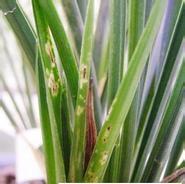
I. Common Orchid Viruses 1. Cymbidium Mosaic Virus (CyMV) (1) Symptoms Orchid plants infected with Cymbidium Mosaic Virus often tend to develop necrotic symptoms, such as black necrotic spots, necrotic streaks, etc. In addition to necrosis on the leaves and stems, infected plants also develop necrosis on the flowers, which is a symptom unique to Cymbidium Mosaic Virus. Orchid varieties susceptible to infection include Cymbidium sinense, Cattleya, Oncidium, Cymbidium hookerianum, Vanda, and Phalaenopsis. Necrotic spots sometimes appear only on the lower surface of leaves and not on the upper surface; this phenomenon occurs in Oncidium, Dendrobium, Vanda, and Phalaenopsis, and is therefore often mistaken by growers as being caused by fungal infection. Some Cymbidium plants infected with Cymbidium Mosaic Virus, such as Cymbidium hookerianum, Cymbidium sinense, Oncidium, and Phalaenopsis, also produce yellow-green mottled mosaic or yellow chlorotic streak symptoms. In addition, some orchid species show no recognizable symptoms after infection.
I. Common Orchid Viruses
1. Cymbidium Mosaic Virus
Cymbidium Mosaic Virus, abbreviated CyMV (1) Symptoms Orchid plants infected with Cymbidium Mosaic Virus often tend to develop necrotic symptoms, such as black necrotic spots, necrotic streaks, etc. In addition to necrosis on the leaves and stems, infected plants also develop necrosis on the flowers, which is a symptom unique to Cymbidium Mosaic Virus. Orchid varieties susceptible to infection include Cymbidium sinense, Cattleya, Oncidium, Cymbidium hookerianum, Vanda, and Phalaenopsis. Necrotic spots sometimes appear only on the lower surface of leaves and not on the upper surface; this phenomenon occurs in Oncidium, Dendrobium, Vanda, and Phalaenopsis, and is therefore often mistaken by growers as being caused by fungal infection. Some Cymbidium plants infected with Cymbidium Mosaic Virus, such as Cymbidium hookerianum, Cymbidium sinense, Oncidium, and Phalaenopsis, also produce yellow-green mottled mosaic or yellow chlorotic streak symptoms. In addition, some orchid species show no recognizable symptoms after infection.
(2) Virus Characteristics and Transmission Mode Cymbidium Mosaic Virus is a member of the genus Potexvirus. Although viruses of this genus are less stable outside the cell than those of the genus Tobamovirus, they are still one of the most stable genera among known viruses. Their particles are slightly flexuous, approximately 450 nanometers in length, with an extracellular thermal tolerance of 60°C to 70°C, and can survive for 25 days at room temperature.
No insect vector capable of transmitting Cymbidium Mosaic Virus has been found to date. Its transmission route is exactly the same as that of Odontoglossum Ringspot Virus; the virus enters and infects through mechanical wounds on the root system.
2. Odontoglossum Ringspot Virus
OdontoglossumRingSpotVirus
Abbreviated ORSV (1) Symptoms According to reports, more than 20 genera of orchids can be infected by Odontoglossum Ringspot Virus. The symptoms produced vary among different orchid genera or species. Orchid species such as Phalaenopsis, Oncidium, Cattleya, Cymbidium sinense, Cymbidium ensifolium, and Cymbidium goeringii are frequently susceptible to infection by Odontoglossum Ringspot Virus, especially Phalaenopsis. The symptom first recorded in the literature for Odontoglossum Ringspot Virus is ringspot; in addition, mosaic, mottling, chlorotic streaks, flower color streaking, and even necrotic symptoms have all been recorded. Among these symptoms, mosaic and mottling are the most common. In addition, some orchid varieties show no symptoms after infection with Odontoglossum Ringspot Virus; this phenomenon is particularly common in the seedling stage of Phalaenopsis and Oncidium, and infected plants usually only gradually show symptoms after their first flowering. Furthermore, in artificially cultivated orchid nurseries, mixed infection of the same orchid plant by both Cymbidium Mosaic Virus and Odontoglossum Ringspot Virus is extremely common, with an additive effect on the plant, and the symptoms are far more severe than with a single virus infection.
(2) Virus Characteristics and Transmission Mode Odontoglossum Ringspot Virus is a member of the genus Tobamovirus. Its particles are short, rigid rods approximately 300 nanometers in length. The common characteristic of viruses in this genus is that they are extremely stable, with strong heat resistance outside the host cell; they can survive for a considerable time even at temperatures as high as 95°C. According to reports by Japanese researchers, Odontoglossum Ringspot Virus can survive outside the cell for more than 10 years at 20°C, making it an infectious virus of extremely high stability. This virus can only enter the plant through mechanical wounds; therefore, during tissue culture or greenhouse cultivation management, all operations that may cause surface wounds, including cutting flower stalks, pruning, and even friction between plant leaves, can become routes for virus entry and infection. To date, it has not been confirmed that Odontoglossum Ringspot Virus can be transmitted by any specific insect vector. However, any insect or small animal that may cause mechanical damage to orchid plants, such as cockroaches, snails, etc., will increase the possibility of Odontoglossum Ringspot Virus infection and should be guarded against.
3. Cucumber Mosaic Virus
Cucumber Mosaic Virus, abbreviated CMV (1) Symptoms The earliest record of Cucumber Mosaic Virus infecting orchids was found in Phalaenopsis. The symptom recorded at that time was the appearance of chlorotic streaks parallel to the leaf veins on the plant's leaves. Cucumber Mosaic Virus can also cause fading or streaking symptoms on the petals of red-flowered Phalaenopsis lines. In addition, Cucumber Mosaic Virus infection has been found in Oncidium specimens. The specimen leaves showed inconspicuous mottling symptoms, with faintly visible yellow streaks parallel to the leaf veins, but the plant size was no different from that of a normal plant.
(2) Virus Characteristics and Transmission Mode Cucumber Mosaic Virus is a member of the genus Cucumovirus. Its particles are spherical, with a diameter of 28 nanometers. This virus has an extremely broad host range, capable of infecting more than 800 species of plants across 85 families and 365 genera. Most important economic crops in many regions of China have records of Cucumber Mosaic Virus infection, and its population is extremely common in field distribution. This virus can be transmitted through wounds caused by mechanical friction. In the field, it is mainly transmitted by aphids in a non-persistent manner; because there are many species of aphids capable of transmitting Cucumber Mosaic Virus, the population distribution of this virus is very widespread.
The best method for controlling orchid viral diseases is to prevent their introduction before disease occurrence, that is, to thoroughly understand all possible transmission routes and sources of the virus, and then comprehensively block them, thereby eliminating opportunities for virus introduction.
1. Routes of virus infection during orchid production.
(1) If virus-infected plants are used as parent plants for pollination, and seed pods are collected for aseptic sowing to propagate seedlings, the infected pod tissue and trichomes contain high concentrations of virus, which will contaminate the seeds and culture medium during the sowing process. Since both Odontoglossum Ringspot Virus and Cymbidium Mosaic Virus are extremely stable viruses, they can survive for long periods outside the cell. After orchid seeds germinate, the virus enters and infects some seedlings through wounds caused by manual transplanting operations. These seedlings then become sources of virus infection, continuing to contaminate other plants during subculture, and even during the process of seedlings maturing and being removed from flasks for planting, they once again become sources of virus contamination, infecting other orchid seedlings.
(2) When plants already infected with virus are used for meristem culture without virus testing because the variety meets market demand, mass propagation of mericlone seedlings results in all propagated seedlings carrying the virus.
(3) Although the operator selects parent plants with superior traits for virus testing, these parent plants happen to be in the infection period, so the virus concentration in the tissue is low or unevenly distributed, and the test results are mistakenly interpreted as indicating that these parent plants are free of virus infection. Using these parent plants for meristem cloning results in seedlings carrying the virus.
(4) Parent plants with superior traits are not infected with virus, but become contaminated with virus during the tissue culture process. If meristem seedlings are contaminated with virus during the mother flask stage, all subsequently propagated seedlings will carry the virus. According to investigations, the procedures and techniques commonly used in operations cannot completely avoid virus contamination, and may lead to cross-contamination between different batches of orchid seedlings.
2. Operational methods that may cause virus transmission.
(1) Incorrect tool sterilization methods: Operational tools used in tissue culture, such as tweezers, scalpels, etc., must undergo sterilization procedures to prevent bacterial and fungal infection; therefore, operators may adopt different sterilization methods according to their own habits. Traditionally, high-temperature sterilization methods are mostly used, such as dry heat sterilization using a high-temperature oven, moist heat sterilization using an autoclave, and flame sterilization used on a laminar flow bench.
Since Odontoglossum Ringspot Virus and Cymbidium Mosaic Virus are extremely stable, if appropriate and effective elimination methods are lacking, these viruses are highly likely to persist long-term on the surface of the laminar flow bench or on tools, and even contaminate the operator's hands and clothing, thereby having the opportunity to indirectly infect tissue culture seedlings.
(2) Contaminated transfer dishes: In addition to using a laminar flow bench for transferring tissue culture seedlings, workers also mostly use culture dishes or supports during operations to isolate tissue culture seedlings from direct contact with the laminar flow bench surface. However, improper use can cause contamination between different batches of seedlings. Strictly speaking, culture dishes must be replaced with each different batch of seedlings. Because if the previous batch of seedlings was infected with virus, it may contaminate the surface of the culture dish, and reusing the contaminated culture dish will cause the next batch of seedlings to also become infected with virus.
(3) Negligence and bad habits of workers: Negligence or bad habits of workers during operations may increase the probability of tissue culture seedlings becoming infected with virus. For example, careless and incomplete flame sterilization of tools, or failure to replace culture dishes when they should be replaced, are key factors making it difficult to avoid virus infection in tissue culture seedlings.
Managers can take measures such as training employees, cultivating their professional dedication, and strengthening quality monitoring to reduce the probability of virus infection in seedlings.
3. Tissue culture seedlings are not infected with virus, but become infected with virus during the process of removal from flasks and planting.
According to investigations, even if meristem seedlings are free of virus infection in the flask, if strict measures to prevent virus infection are not taken during the process of removal from flasks and cultivation, virus infection can still occur.
These commonly made mistakes include: (1) After removing seedlings from the flask, the operator places them in a container to wash off residual culture medium or treat them with protective agents. If the same container is used to treat different batches of seedlings, and some batches of seedlings carry virus, the residual virus will contaminate the container surface, causing virus infection when the next batch of seedlings is treated.
If some individuals within the same batch of seedlings are virus-infected, when all seedlings are placed in the same container for treatment, other individuals will also become infected.
(2) The workbench surface, tools, or workers' hands used for seedling planting operations may all come into contact with virus-carrying seedlings during the transplanting process and become contaminated with virus, thereby becoming vectors for virus transmission.