A Complete Analysis of the Characteristics and Cultivation Key Points of Orchids
1. Introductory Notes. Orchids have a long history of cultivation in China, spanning several thousand years. They are grown in every part of China, especially flourishing in the southwest and in Taiwan, China. They enjoy the honored reputation of "the finest fragrance under heaven" and "the fragrant beauty." Orchid blooms are pure and unadorned, soft and elegant, with a delightful fragrance, making them a uniquely personified flower in the world. In ancient times there was "...
1. Introductory Notes
Orchids have a long history of cultivation in China, spanning several thousand years. They are grown in every part of China, especially flourishing in the southwest and in Taiwan, China. They enjoy the honored reputation of "the finest fragrance under heaven" and "the fragrant beauty." Orchid blooms are pure and unadorned, soft and elegant, with a delightful fragrance, making them a uniquely personified flower in the world.
Ancient records speak of "words of one heart, whose scent is like that of an orchid," comparing the heart-penetrating fresh fragrance of the "orchid" to the kindred spirit of a close friend. Thus later generations often used "orchid words" as a metaphor for words spoken between kindred minds. In the Li Sao there is the line "stringing autumn orchids to wear as a girdle," using the "orchid" as a metaphor for "purity." In the Shuo Yuan there is the famous line "within ten paces there must be fragrant orchids," which expresses the enthusiasm people should have for life, pointing out that as long as you pay careful attention, you will surely discover that there are many beautiful things around us. The ancient writer Zhang Hua wrote in his Qing Shi, "The fair one dwells far away, and the orchid chamber has no radiance." Here the "orchid chamber" became a byword for a woman's boudoir. In olden times, "dreaming of an orchid" was used as a sign of a woman's pregnancy; this allusion comes from the story recorded in the Zuo Zhuan, Duke Xuan, third year, of the concubine of Duke Wen of Zheng in the Spring and Autumn period who dreamed that a heavenly messenger gave her an orchid and she bore a son. In ancient times, when friends were in harmony and became sworn brothers, they exchanged "genealogy cards" bearing their birth dates. These "genealogy cards" were called "orchid registers," hence the phrase "golden orchid sworn brotherhood." The ancients also called fine writing "orchid chapters." In China from ancient times to the present, many women have had the character "Lan" (orchid) in their names, such as Hua Mulan. The name of China's great Peking opera master Mei Lanfang also contains the character "Lan."
Orchids are one of China's oldest famous and precious flowers. The fragrance of the orchid is clear without being heavy; its scent is inwardly contained, pure and mellow, elegant and clean, thought-provoking, and long-lasting. The orchid's colors are light and elegant, its flower form dignified and upright, its leaves green all year round; the jade-green leaves are slender, combining strength and softness, graceful and poised, transcendent and distant. As early as China's Spring and Autumn period, King Goujian of Yue planted large tracts of orchids on the mountains of Zhejiang. During China's Tang dynasty, the fashion for appreciating orchids prevailed. In Emperor Taizong Li Shimin's poem Fang Lan: "In the bright sun the shadows fall unevenly, the wind carries fragrance light and heavy." "Reflecting in the courtyard, holding pale colors; congealing dew glistens with floating light." Li Bai's "The orchid's hidden fragrance travels far on the wind," Liu Yuxi's "An orchid in a secluded forest is fragrant of itself," and Meng Jiao's "Though the border is broken it does not change color; though the orchid dies it does not change fragrance" are all celebrated lines describing orchids handed down through the ages. According to the Han Man Lu, the Tang poet Wang Wei was very knowledgeable about growing orchids. A single orchid plant is a poem, half a delicate blossom a thousand paintings; the orchid's restraint, beauty and elegance cannot be contained by a thousand poems nor painted in ink.
China's earliest book discussing orchid variety characteristics, quality rankings, and methods of cultivation, management and irrigation was the Jin Zhang Lan Pu (Orchid Register of Jinzhang), written by Zhao Shigeng in the sixth year of the Shaoding era of the Southern Song (1233 AD). After this, orchid writings of the Southern Song included Wang Guiping's Wang Shi Lan Pu (Wang Family Orchid Register), Gao Lian's Lan Pu (Orchid Register) of the Ming dynasty, Zhu Kerou's Di Yi Xiang Ji (Record of the Finest Fragrance) of the Qing dynasty, Tu Yunzhuang's Lan Hui Jing (Mirror of Orchids and Cymbidiums) of the Qing dynasty, and more than ten other titles. In New China, with the development of China's horticultural undertakings, large numbers of orchids have been introduced and cultivated throughout the country, and many monographs on orchids have been published, such as Cymbidiums of Sichuan, The Xiamen Orchid Register, A Taxonomic Study of Chinese Cymbidium Species, and Orchids. From the Song dynasty onward, China's orchids successively spread to Japan and the countries of Europe. In recent years, many countries have used test-tube seedling cultivation on an industrial scale to produce orchids, actually forming an "orchid industry."
2. Ecological Habits
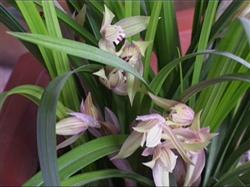
"Lan" is also called "spring orchid," "orchid grass," "mountain orchid," "grass orchid," "duoduo xiang" and so on. Orchidaceae, a perennial evergreen herbaceous plant. Roots clustered, fleshy, cylindrical. Leaves linear, leathery. In early spring many flower stems emerge from between the leaves, each stem bearing one flower at its tip; the flower is pale yellow-green with a clear, delicate fragrance. There are many cultivated types, with a great many variations. It is one of China's potted ornamental plants with a long history of cultivation.
It grows wild in eastern, central, southern and southwestern parts of China, on shaded mountain slopes beneath the trees. It prefers a warm environment with good ventilation and moist air. It is best cultivated in slightly acid soil rich in organic matter and well drained. It has strong cold resistance.
3. Cultivation Key Points
(1) Flower Pots
Orchid roots are relatively well developed, and in accordance with the orchid's requirements for drainage and ventilation, the pots chosen for orchids are rather special compared with ordinary flower pots. It is better to use "orchid pots" with a rough texture, unglazed, with many holes along the bottom edge and with pot feet, for growing "orchids." "Orchid pots" are generally wider at the top and narrower at the bottom, with a relatively deep base, like a trumpet opening upward. The bottom has drainage holes, and around the lower section of the pot there are many small drainage holes. The purpose is to allow the orchid's roots to breathe better. Newly planted orchids are best planted in earthenware "orchid pots." After more than a year of cultivation, once the new roots have developed normally, they may be moved into an attractive purple-clay "orchid pot."
(2) Soil
Whether orchids are grown well or not depends on the soil used. Orchids are semi-epiphytic flowers and must be grown in acid soil that contains humus and has good air permeability. Mountain soil from the mountain areas where orchids grow gives better cultivation results. Orchid soil can also be mixed yourself, using 70% sandy loam and 30% coarse-grained humus soil. After mixing, it must be piled for more than three years before it can be used.
The potting soil chosen should be sieved, separating the coarse particles from the fine ones. The potting soil should be sterilized to prevent pests and diseases. It can be sprayed with an 800-fold dilution of "Topsin" or with "Bordeaux mixture" as a preventive measure. Nowadays the flower and bird markets sell ready-made special orchid growing soil; it works very well, has no strange smell and is clean, and can be bought and used right away.
(3) Potting Up
Wild orchids newly dug from the mountains have not yet produced new roots and have many broken roots; first clear the soil from the roots, wash them clean with water, and cut away dead leaves and dry, scorched leaf tips. For leaves stained with pest or disease spots, the diseased spots should be cut away without hesitation. In addition, rotten and withered old roots must also be cut off. If the orchid has no intact roots, then the rootless old roots and root cores should be retained. It is best to soak the orchid plant for two hours in a solution made by mixing a 600-fold dilution of "Kocide" or "Shadufan" or medical "penicillin" and "streptomycin," dissolving each vial of powder in 2.5 kg of water, then take it out and wash it clean. Drying the orchid roots in the sun can activate the plant's vitality, making the roots soft, easier to straighten out, less likely to break, and easier to pot up. To prevent the orchid leaves from drying out while sun-drying, the leaves can be shaded; generally about 2 hours of light is enough.
When the orchid roots have been exposed to light until they turn slightly white, use a sharp blade to separate the connected seedlings, and remove the excess leafless pseudobulbs, because some leafless pseudobulbs will simply never sprout. The usual practice is: for one or two connected seedlings, select and keep 1 to 2 fresh pseudobulbs. For three or more connected seedlings, no matter how many leafless pseudobulbs are growing together, they should all be broken apart and handled separately. The cut surfaces can be coated with plant ash or sulfur powder for antisepsis. Then, according to the length of the leaves, arrange them separately and place them into the pot. The bottom hole of the orchid pot should be lined with about one quarter large charcoal; first put in coarse soil, then put in a small amount of fine soil. When planting, the orchid's roots should be spread out; when adding soil, the flower pot should be shaken several times; the depth should be close to the base of the leaves, and the soil on the surface of the pot should be slightly mounded and slightly firm, so that the orchid's roots press tightly against the soil, making it easier to sprout and grow. Small pumice stones or lycopodium can be placed on the surface of the pot to retain moisture. Then water thoroughly and generously in several sessions, and place in a cool, ventilated spot. After five or six days, move the orchid pot to a spot with half shade and half sun for cultivation.
It is traditionally held that different varieties of orchids generally cannot be planted mixed together in one pot. This is because long-term mixed planting will cause variation in the orchid varieties. For varieties with different flowering seasons, since their management requirements differ, they especially must not be mixed in one pot. Some orchids have leaves of different heights and different leaf colors; mixed together they look very unattractive and lack harmony. If one deliberately wants to induce mutation in the varieties, then planting different orchid varieties in one pot is actually a simple method. But this takes a very long time to accomplish.
(4) Repotting
For repotting and introducing orchids, the best time is from the cool of autumn to the "little Indian summer" of October. This is because at this time the new plants of the year have basically matured and have not yet gone dormant; the wounds caused by repotting at this time recover more easily and have less effect on the next year's sprouting and flowering. Orchids need repotting once every two years; repotting early and repotting frequently is unfavorable to the growth of the orchid plant. Some orchids grown in small "orchid pots" grow well; when the orchid seedlings reach six or more, they should be repotted once a year. For those orchids with poor growth and severely scorched leaf tips, there may be root rot, or the soil may be unsuitable. At such times they should be repotted promptly. Emergency repotting can be done at any time, but attention must be paid to keeping warm and moist after repotting.
(5) Watering
Orchids are terrestrial plants and like moisture but hate waterlogging. Many beginners, afraid that their plants lack water, end up watering too much and simply rot the orchid's fleshy roots. The watering principle for soil-cultivated orchids is "better dry than wet"; it is enough to keep the orchid soil slightly moist. For soil-less cultivated orchids, the opposite applies: "better wet than dry."
Orchids do not have high water requirements; they should be kept dry rather than wet. In January and February, water once a week; in March and April, water once every 3 to 4 days; in May, water once every 2 days; in June, water once a day; in July and August, water once every 3 days; from September to December, gradually reduce from twice a day to once a week, and be careful not to let them get rained on.
Orchids are best watered with river water, spring water or well water. If tap water is used, it should be left to stand for a period until the chlorine in the water has been released before use. Generally the water quality for watering orchids should preferably have a pH value of 5 to 6; pH test paper can be bought at a pharmacy to test the water quality. If the acidity is insufficient, a little table salt and rice vinegar can be added to the water to adjust it. Watering orchids involves much knowledge; it is best to water along the edge of the pot. In summer, water in the early morning or evening, and avoid watering at noon; the amount of water should not be too great. Generally water once a week; in summer water twice a week; too much watering can cause root pests and diseases in orchids. Especially in continuous rainy weather, the potting soil should be dry rather than wet; a dry pot is beneficial for the orchid to send out new leaves.
(6) Light
From early to mid-March to April, orchids can be exposed to sunlight; from late April onward, after nine in the morning, they should not be exposed to much sun; spring orchids need only two hours of sun a day, and from June to September they must be shaded earlier each day. After October, shading can be delayed.
(7) Temperature
Orchids are relatively cold-tolerant and can be left outdoors to overwinter except on freezing days. Generally, when the outdoor temperature is 2 to 3°C, the orchids should be moved indoors promptly. In summer the temperature is high; in dry seasons the orchids should be misted appropriately to lower the temperature and retain moisture.
(8) Fertilizing
Newly planted orchids should not be fertilized until new roots 2 cm long have grown; generally new roots take about 2 months to grow, and some people maintain that fertilization should wait until after 1 to 2 years of cultivation. Orchid fertilizer can be made yourself, using 4 parts plant ash, 10 parts bean cake and 6 parts bone meal; after mixing well, store in a container and add water in several sessions; after one year of fermentation, dilute before use.
Fertilizing generally begins in May before the new growth emerges from the soil and stops at the Beginning of Autumn. Fertilize once every 15 to 20 days, preferably in the evening. The principle of fertilizing is light fertilizer applied frequently. Fertilize in the evening, then water once with clear water the next morning. This is commonly called "return water." There are 9 kinds of fertilizer used for orchids:
① Growth-awakening fertilizer: This fertilizer can promote early sprouting of the orchid plant. You can use 0.2% "potassium sulfate compound fertilizer," a 500-fold dilution of "Shida," a 1000-fold dilution of "Huabao No. 4," etc.;
② Sprout-promoting fertilizer: Applied half a month after the growth-awakening fertilizer. The fertilizer is the same as the growth-awakening fertilizer, or a 500-fold dilution of "Lanjun Wang" can be used instead;
③ Flower-bud-promoting fertilizer: At this time the orchid's leaf buds have emerged 3 to 5 cm and are in a paused growth stage, with the new buds rooting. The orchid's mother plant now begins to enter the reproductive growth stage, and the plant needs less nitrogen fertilizer and more phosphorus fertilizer nutrition. A 1000-fold dilution of "Huabao No. 3" can be used to water the roots, and a 800 to 1000-fold dilution of "monopotassium phosphate" and "borax" can be sprayed on the foliage;
④ Growth-assisting fertilizer: When the new buds have grown 2 cm of roots, flower bud differentiation is already determined, and the new buds urgently need supplemental nutrition. At this time a "compound fertilizer" solution should be applied once a month, or "Huabao No. 5" sprayed;
⑤ Flower-assisting fertilizer: Applied about 30 days before the flowering stage. A small amount of a 1000-fold dilution of "monopotassium phosphate," "Yiduo liquid fertilizer," "Xishuo," etc. can be applied;
⑥ Post-flowering fertilizer: At this time the orchid is in its flowering period. The plant should promptly be given more nutritional supplementation; a 0.3% "potassium sulfate compound fertilizer" can be watered on, and fertilizers such as "Xishuo," "Jialan Bao," "Suzi," "plant health essence" and "compound trace elements" can be sprayed on the leaves.
⑦ Cold-resistance fertilizer: Before the orchid overwinters, apply more phosphorus and potassium fertilizers; phosphorus can lower the freezing point of plant cells, and potassium can increase plant cellulose and promote a tough plant cortex. On cold winter days, nitrogen fertilizer must absolutely not be applied;
⑧ Dowry fertilizer: This refers to a fertilizer with a balanced three elements applied to the plant before division or repotting, to help improve the plant's survival and rejuvenation; fertilizers such as "Huabao No. 2," "mineral health essence" and "Meinengsu" can be sprayed on the leaves;
⑨ Root-promoting fertilizer: Apply fertilizer that promotes rooting; a 1500-fold dilution of "Cugensheng" or a 1000-fold dilution of "monopotassium phosphate" can be sprayed on the leaves, or a 1000-fold dilution of "Lanjun Wang" or a 3000-fold dilution of "Cugensheng" can be used.
If each kind of fertilizer is applied once or twice, then applying more than 10 times a year is sufficient. Special attention should be paid to the fact that tea water and tea leaves cannot be used as orchid fertilizer, because they are alkaline and after application will alkalize the soil medium and affect orchid growth. Orchid management can be summed up in four phrases: "Do not take them out in spring, do not sun them in summer, do not let them dry in autumn, do not let them get wet in winter." Orchids "like fertilizer but fear turbidity," so fertilizer must be light and dilute, otherwise it damages the leaves and roots.