What are the symptoms of orchid round leaf spot? The prevention and control methods explained in one article
Leaf spot is a common leaf disease of orchids, found in Fujian, Jiangsu, Zhejiang, Shanghai, Nanjing and other places. Symptoms: The disease mainly affects the leaves. In the early stage, small brown spots appear on the leaves and rapidly expand into round patches, relatively wide, with a light brown center, and yellow small protrusions growing on both the front and back sides, occurring on the upper...
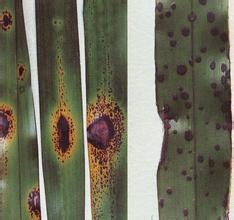
Leaf spot is a common leaf disease of orchids, found in Fujian, Jiangsu, Zhejiang, Shanghai, Nanjing and other places.
Symptoms: The disease mainly affects the leaves. In the early stage, small brown spots appear on the leaves and rapidly expand into round patches, relatively wide, with a light brown center, and yellow small protrusions growing on both the front and back sides, occurring on the upper, middle and basal parts of the leaves, and mostly on the middle and basal parts. Unlike orchid anthracnose, the lesions are large, often stretching across the leaf surface, blocking the transport of water and nutrients above and below, causing the leaf segments above the lesions to die. The damage is more severe than that of anthracnose.
Pathogen and disease pattern: It is a fungus of the genus Cylindrosporium, Cylindrosporium sp. The pathogen overwinters as mycelium or conidia. The conidia can endure a low temperature of 0 degrees Celsius for 20 days without weakening their germination ability. When environmental conditions are suitable, it spreads through wind and rain and through the splashing of water droplets during watering. When the soil is compacted, the distance between pots is too dense, ventilation and light transmission are poor, and when the leaves are damaged, this disease is likely to occur. Among orchids, Cymbidium kanran, Cymbidium goeringii, Cymbidium ensifolium and Cymbidium faberi are susceptible to the disease, with Cymbidium kanran being the most severely affected.
Prevention and control methods:
1. Remove diseased and dead leaves in time to reduce the source of infection. Cut off the lesions on the upper and middle parts in time, and retain the green parts as much as possible.
2. Spraying 1% Bordeaux mixture twice a month can prevent and control this disease. When the disease occurs, spray 75% chlorothalonil 500 times dilution.